
President Dr Julius Maada Bio has reaffirmed his Government’s determination to transform Sierra Leone’s agricultural sector through innovation, mechanization, increased domestic food production and agro-processing, describing food security as a critical pillar of national security, economic independence and sustainable development.
The President made the declaration on Thursday, 22 October 2026, during the commemoration of World Food Day and the official launch of the Feed Salone Third-Year Report at the Ernest Bai Koroma University of Science and Technology in Magburaka, Tonkolili District.
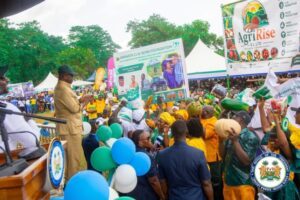
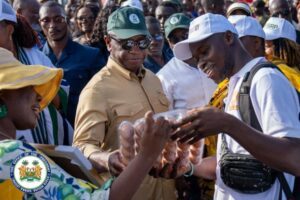
Held under the theme, “Innovate Today and Nourish Tomorrow,” the ceremony brought together Government officials, development partners, traditional authorities, farmers, agricultural entrepreneurs and other stakeholders to assess progress under the Feed Salone initiative and identify priorities for strengthening food production nationwide.
Addressing the gathering, President Bio emphasized that Sierra Leone must accelerate its transition from subsistence agriculture to a modern, commercially viable and technology-driven agricultural economy capable of meeting domestic food demands while creating employment opportunities.
“Food security is a matter of national security and national dignity. We must increase local production, strengthen our farmers and build the capacity to produce more of what we consume,” he declared.
The President called for increased investment in improved seeds, irrigation systems, mechanization, agricultural research, affordable financing and emerging technologies, including drones, to improve productivity and strengthen the country’s agricultural value chains.
He particularly underscored the importance of attracting young people and women into commercial agriculture through improved access to land, financing, technical training, storage facilities, transportation networks and reliable markets.
President Bio further stressed that agricultural development must extend beyond primary production to include processing, manufacturing and value addition, thereby reducing dependence on imported food products and strengthening the national economy.
“Agriculture must become a strong foundation for industrialization. We must add value to our locally produced crops, create jobs, strengthen our economy and reduce dependence on imported food,” he stated.
Highlighting achievements under the Feed Salone initiative, the President disclosed that severe household food insecurity had declined from 28 percent in September 2023 to 13 percent in July 2025.
He further reported that the initiative supported more than 22,000 direct and indirect jobs during its third year, reflecting what he described as encouraging progress towards agricultural transformation and economic empowerment.
According to President Bio, domestic rice production has also improved considerably, with nearly three out of every four cups of rice consumed in Sierra Leone now originating from local farms.
“Today, nearly three of every four cups of rice on our tables come from our own soil,” he stated, while urging continued national commitment to achieving sustainable food self-sufficiency.
The Minister of Agriculture and Food Security, Dr Henry Musa Kpaka, presented key achievements recorded under Feed Salone, including improvements in rice production, declining onion imports, increased domestic poultry production and investments in agricultural infrastructure.
He also highlighted progress in seed multiplication, rice processing and school feeding programmes, disclosing that nearly one million schoolchildren benefited from school meals during the previous academic year, with a growing proportion of food procured from local producers.
Looking ahead to the fourth year of Feed Salone, Dr Henry Musa Kpaka explained that the Government would prioritize making existing agricultural investments fully operational, completing major irrigation and rice-processing facilities at Tormabum and Gbondapi and expanding financing opportunities for farmers, particularly women and young people.
The Food and Agriculture Organization (FAO) Country Representative, Saeed Abubakar Banice, commended the Government’s agricultural efforts and emphasized the need for sustained investment in climate-smart agriculture, modern technologies and inclusive agricultural development.
Similarly, the Chairman of the Presidential Initiative on Climate Change, Renewable Energy and Food Security, Hon. Dr Kandeh K. Yumkella, underscored the importance of coordinated interventions to advance the Feed Salone agenda and strengthen the country’s food systems.
The Minister of Fisheries and Marine Resources, Princess Dugba, highlighted the contribution of fisheries to national food security, while the President of the National Farmers Federation, Yeatta Sama, encouraged more Sierra Leoneans to embrace agriculture as a viable source of income and national development.
Traditional authorities, represented by the National Chairman of the Council of Paramount Chiefs, Paramount Chief Dr Masakà Madibie II of Kafe Chiefdom, pledged continued support for agricultural development and peaceful communities.
Resident Minister North-East Ibrahim Jalloh and Tonkolili District Council Chairman Madam Yabom Seay also welcomed the President and participants to the district.
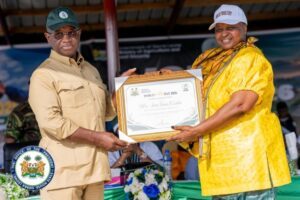
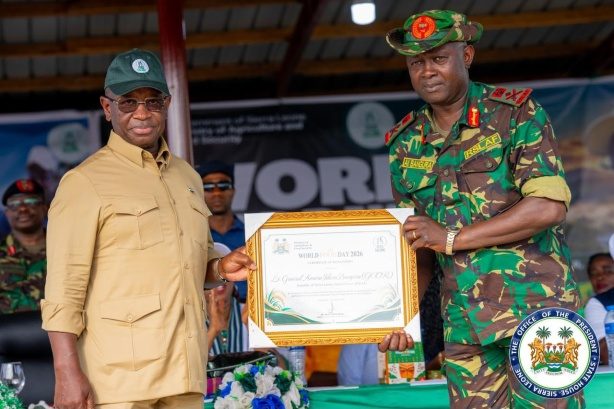
A major highlight of the celebration was the presentation of awards to ten outstanding farmers, agricultural entrepreneurs and champions recognized for their contributions to food production, innovation and agricultural value addition.
The awardees included Lieutenant General Amara Idara Bangura, recognized for his leadership in the Republic of Sierra Leone Armed Forces agricultural programme and Monica Kwame Greene, honoured for her contribution to agricultural programme coordination.
Sitta Isata Kai Kai received recognition for her contribution to domestic production through Mulu Poultry and Chuma Agro Company Limited, while Ms Hannah Elizabeth Tarawally was recognized for Coffee Couriers’ contribution to agricultural development.
Other recipients included Paramount Chief Bai Fonti Thangbathi II for promoting domestic rice production; Ms Safinatu Bockarie for Evergreen Women’s contribution to inland valley swamp farming and women’s agricultural participation; and Ms Saffie Kalokoh for sustainable agricultural innovation and vegetable production.
Peter Dawah was recognized for the National Farmers Association’s contribution to goat farming and livestock production, while John Shallop received recognition for House of Beans’ work in agricultural processing and value addition.
Binta Bio was also honoured for Godwill Investment SL Ltd’s investment in domestic rice production.
Concluding his address, President Bio appealed for collective national ownership of the Feed Salone initiative, stressing that achieving food security requires the active participation of farmers, investors, traditional leaders, development partners and ordinary citizens.
“Wetin wi plant, na im wi go eat. Salone go feed insɛf,” he declared.
The World Food Day celebration and launch of the Third-Year Report underscored the Government’s commitment to transforming agriculture into a key pillar of Sierra Leone’s economic development, driving job creation, industrialization and improved livelihoods. The event also reinforced the country’s long-term vision of reducing dependence on food imports, boosting domestic production and achieving sustainable food security and greater agricultural self-sufficiency.