

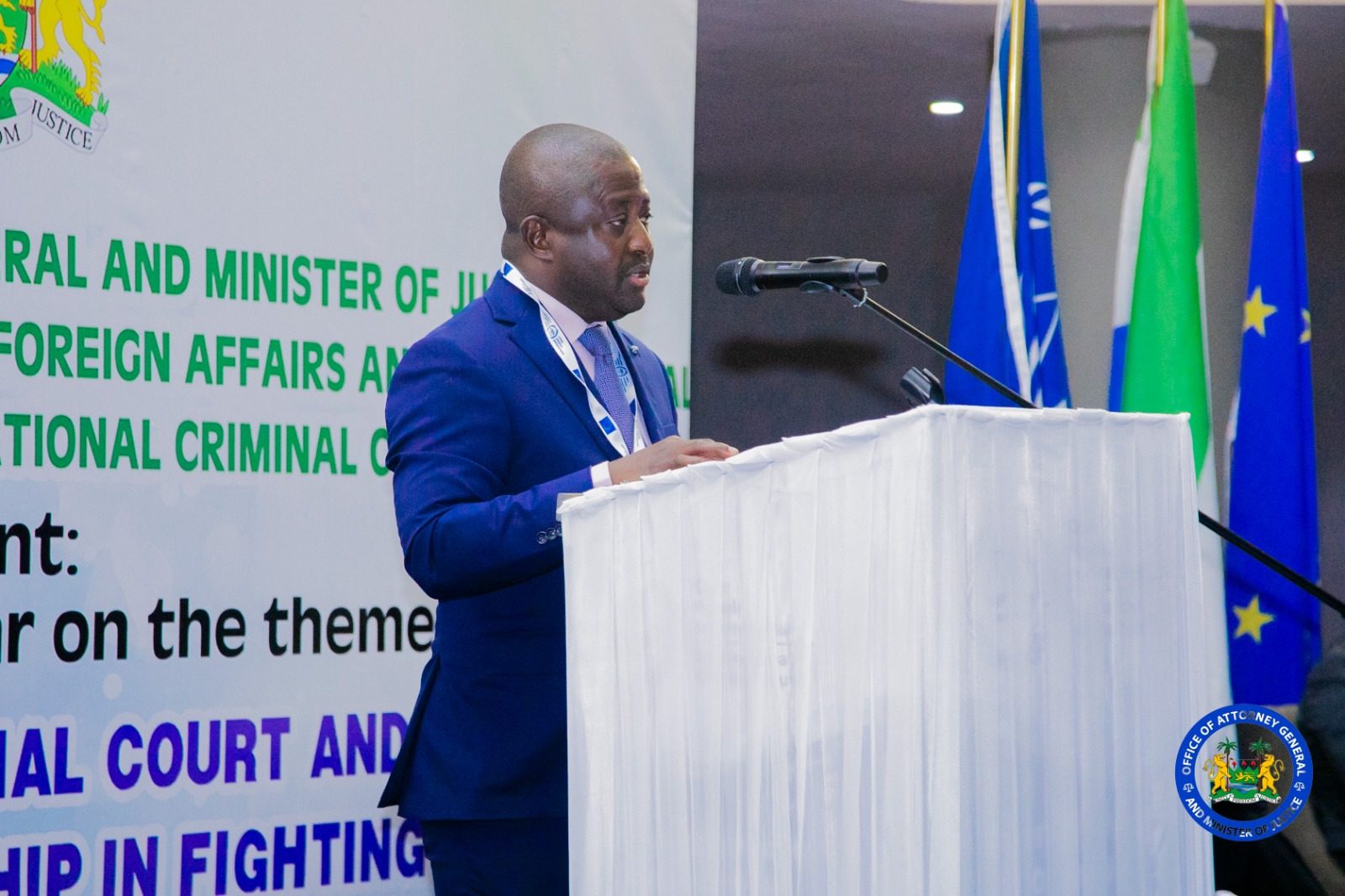
Sierra Leone’s Attorney General and Minister of Justice, Alpha Sesay Esq., has reaffirmed the Government’s commitment to the International Criminal Court (ICC), calling for stronger international cooperation, effective national legal frameworks and greater protection of the Court’s independence in the global fight against impunity.
He made the statement on Thursday, 22 October 2026, during a two-day regional seminar held at the Radisson Blu Mammy Yoko Hotel in Aberdeen, Freetown, bringing together senior judicial officials, legal experts, diplomats and representatives of international justice institutions.
The seminar, organized by the Office of the Attorney General and Minister of Justice in collaboration with the Ministry of Foreign Affairs and International Cooperation and the ICC, was held under the theme: “The International Criminal Court and National Jurisdictions: A Partnership in Fighting Impunity for the Gravest Crimes Under International Law.”
Addressing participants, Attorney General Alpha Sesay expressed concern over mounting political pressure, sanctions and inadequate international cooperation affecting the Court’s operations. He emphasized that protecting international criminal justice requires unwavering respect for treaty obligations and collective responsibility among states.
Referencing Article 127 of the Rome Statute, which governs withdrawal from the treaty, he stressed that states must recognize their continuing legal obligations even when considering withdrawal.
Reflecting on Sierra Leone’s civil war and the establishment of the Special Court for Sierra Leone in 2002, he highlighted the country’s experience in pursuing accountability for serious international crimes.
He recalled Sierra Leone’s ratification of the Rome Statute in September 2000, reaffirming the fundamental principle that “no one is above the law.”
Citing Article 86 of the Rome Statute, the Attorney General urged member states to strengthen domestic institutions responsible for arresting and surrendering suspects, gathering evidence, tracing assets and facilitating judicial cooperation.
He further disclosed that the Ministry of Justice is reviewing Sierra Leone’s existing legal framework to enhance cooperation with the ICC, strengthen accountability mechanisms and ensure effective implementation of international criminal justice obligations.
The Attorney General also emphasized the importance of safeguarding victims’ rights, strengthening reparations mechanisms and protecting the Court’s operational independence.
Speaking at the seminar, ICC Second Vice-President, Judge Reine Alapini-Gansou, warned that sanctions and political interference could undermine the Court’s independence and effectiveness.
She reaffirmed the determination of ICC judges, prosecutors and staff to uphold international law, protect victims and advance accountability, while recognizing Africa’s contributions to the development of international criminal justice.
Representing Acting ICC Prosecutor, Mame Mandiaye Niang, International Cooperation Adviser, Abdoul Aziz Mbaye, explained that the Court depends heavily on cooperation from national authorities because it does not possess its own police force.
He emphasized that national jurisdictions retain primary responsibility for investigating and prosecuting international crimes, while the ICC serves as a complementary judicial mechanism.
The Gambia’s Attorney General and Minister of Justice, Dawda A. Jallow, advocated stronger domestic justice institutions, improved witness protection and closer regional collaboration.
Mauritania’s Minister of Justice, Mohamed Ould Soueidatt, highlighted his country’s judicial reforms and cooperation arrangements with the ICC, despite Mauritania not being a party to the Rome Statute.
Emilio Rosetti, Deputy Head of the European Union Delegation to Sierra Leone, reaffirmed the EU’s continued political, diplomatic and financial support for the Court, while acknowledging the Special Court for Sierra Leone’s contribution to international criminal jurisprudence.
Meanwhile, Ibrahim Sorie Yillah, a member of the Board of Directors of the ICC Trust Fund for Victims, emphasized that accountability must extend beyond criminal convictions to meaningful reparations, rehabilitation and restoration of victims’ dignity.
The regional seminar reinforced calls for stronger cooperation between international and national judicial institutions, underscoring Sierra Leone’s continuing commitment to justice, accountability and the prevention of impunity for the gravest crimes under international law.