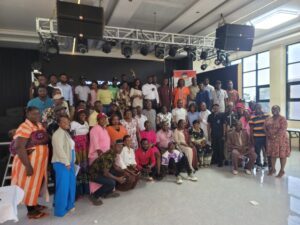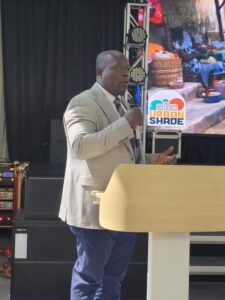

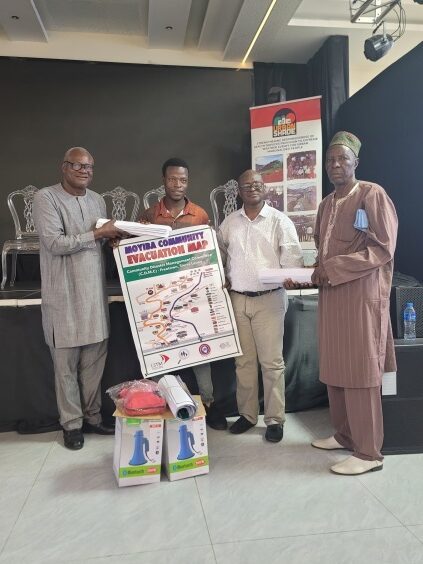
The Urban SHADE Project has handed over disaster preparedness and response materials, including megaphones, first aid kits and Information, Education and Communication (IEC) materials to three vulnerable communities in Freetown to strengthen their capacity to respond to extreme weather events.
The handover took place on Thursday, November 5, 2026, during a dissemination and handover ceremony at Dove’s Nest at Aberdeen in Freetown. The beneficiary communities are Crab Town, Kolleh Town and Gray Bush(CKG) and two stand-alone communities, Susan’s Bay and Moyiba.
The project, which began in 2024, is being implemented by the Sierra Leone Urban Research Centre (SLURC), the Institute of Gender and Children’s Health Research (IGCHR) and the Centre of Dialogue on Human Settlement and Poverty Alleviation (CODOHSAPA).
Speaking at the event, Dr Desta Ali, Senior Research Officer at IGCHR, said the project was designed to strengthen the responsiveness of the health system to extreme weather events, particularly in vulnerable urban informal settlements.
She explained that the project adopted a participatory research approach, involving community members from the beginning rather than imposing predetermined interventions. According to her, interviews, data collection and settlement profiling helped identify gaps in community preparedness and the capacity of health workers to recognize illnesses associated with climate change and extreme weather events.
She said health workers identified the need for capacity building to recognize climate-related illnesses, while community members prioritized disaster preparedness and response.
Dr Desta Ali said the project subsequently engaged relevant institutions, including the National Disaster Management Agency (NDMA), National Fire Force, Freetown City Council (FCC), Ministry of Health and National Public Health Agency (NPHA), to support training and the development of interventions.
Among the outputs, she highlighted an Extreme Weather Events (EWE) Communication Protocol, which outlines how weather-related information should be communicated from relevant institutions to communities.
She also disclosed that the Sierra Leone Meteorological Agency (SLMet) had established a WhatsApp group through which vulnerable communities receive weather alerts to help them prepare for impending weather conditions and protect their property.
Other outputs include a Community Disaster Preparedness and Response Plan, a health worker response checklist, an EWE Event Summary Form and IEC materials developed in collaboration with the Health Education Directorate of the Ministry of Health.
Dr Desta Ali explained that the disaster preparedness plans include vulnerability assessments identifying people who may require assistance during emergencies, particularly evacuation.
She said the project also conducted a validation workshop where community members reviewed the documents to ensure that they reflected the needs and recommendations they had raised.
Also speaking, Dr Joseph Macarthy, Executive Director of SLURC, described climate change as a critical global challenge, stressing the need for Sierra Leone to examine its relationship with public health and healthcare delivery, particularly in informal settlements.
He said the commitment demonstrated by communities had enabled the three implementing organisations to mobilize local action through research, interventions and collaboration with state institutions.
Dr Joseph Macarthy emphasized that the outputs being handed over were developed through a process of co-design and co-production, allowing community members to contribute to decisions affecting their settlements.
Francis Reffell of CODOHSAPA also underscored the importance of community participation, noting that residents understood their communities better and were therefore well-positioned to contribute to the development of relevant interventions.
He said the ultimate objective was to translate research data into practical action, urging beneficiaries not to treat the items received as decorations. “Focus on the messages and translate them into action for the betterment of our community,” he urged.
Meanwhile, Yatta Esther Kallon, Climate Change Officer at FCC, said the Urban SHADE Project complemented the Council’s efforts to address climate change and its effects on communities.
She described extreme heat as a growing global phenomenon and said equipping communities with preparedness and mitigation skills was timely, given the increasing occurrence of disasters associated with extreme weather events. Yatta Esther Kallon highlighted the importance of data in informing policy and decision-making, noting that the evidence generated through the project could help guide interventions.
She further disclosed that FCC had trained 500 healthcare workers on heat and health under its Enhancing Heat Health in Freetown project, to improve their ability to identify heat-related illnesses.
For his part, Gibrilla Kamara, Principal Climate Change Officer at SLMet, described the intervention as timely, considering the effects of flooding and extreme heat on communities.
He called on relevant stakeholders to integrate the project outputs into their respective activities to ensure sustainability, adding that communities must build resilience and adapt to changing climate conditions.
Bai Banya, Chief of Operations at NDMA, said the project’s objectives aligned with the Agency’s mandate of disaster management, capacity building and supporting government policies on disaster preparedness.
He explained that the Agency had established disaster management committees at district, chiefdom and community levels, while providing training to strengthen local capacity to identify hazards and respond to emergencies. He assured the project of the Agency’s continued support.
Mohamed Conteh, Programme Manager at the Health Education Directorate of the Ministry of Health, emphasized the importance of providing individuals and communities with timely, accurate and practical information to protect themselves during extreme weather events.
He said the IEC materials, including posters and banners, would help communicate essential health messages, promote protective behaviours and encourage communities to take responsibility for their health and safety.
He urged institutions, health workers and community structures to ensure the materials were widely distributed, particularly in vulnerable communities, and that the messages translated into positive behavioural change.
Representing the beneficiary communities, John Conteh, a community researcher from Moyiba community, said the project had been inclusive and had equipped community representatives with knowledge they intend to share with residents.
He explained that although communities had traditional ways of responding to floods, heatwaves and fire incidents, the project had introduced them to additional knowledge and practical approaches to preparedness and response. He pledged to take the lessons learnt back to his community to strengthen local awareness and preparedness.
Similarly, Binta Bah, chairlady of Susan’s Bay, expressed appreciation, describing the training as the first opportunity many community members had benefitted from to learn about extreme weather events.
She said community representatives would disseminate the IEC materials in strategic locations and organize community engagements and sensitization activities to ensure residents understood the messages.
The ceremony also featured the signing of the EWE Communication Protocol and Community Disaster Preparedness and Response Plans by community leaders and disaster management committees, alongside the formal handover of the intervention outputs and materials to the beneficiary communities.