

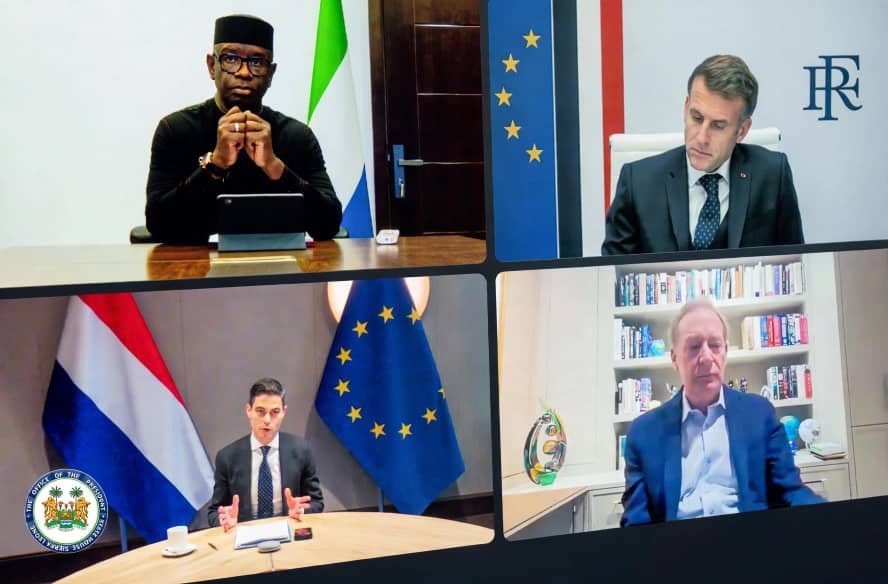
President Dr Julius Maada Bio has called for greater international cooperation in regulating advanced Artificial Intelligence (AI) systems, stressing that African countries and other developing nations must be actively involved in establishing global standards governing the rapidly expanding technology.
The President maintained that the development and deployment of increasingly sophisticated AI models must be guided by internationally recognised safety standards, transparency, accountability and effective human oversight to protect national sovereignty and public interests.
He made the appeal on Monday, 9 November 2026, while participating virtually from State House in Freetown in a high-level international meeting on Strengthening International Cooperation on Frontier Model Security, convened by French President Emmanuel Macron.
The engagement brought together world leaders, senior Government officials and executives from leading technology companies to discuss coordinated approaches to managing the opportunities and security risks associated with frontier AI models.
Addressing participants, President Bio reaffirmed Sierra Leone’s commitment to ensuring that artificial intelligence remains subject to meaningful human direction, supervision and control, regardless of the sophistication or capabilities of emerging systems.
He recalled that Sierra Leone had endorsed the Call for Control of Frontier AI Models during the AI Middle Powers Roundtable held on the sidelines of the United Nations General Assembly in September 2026.
The initiative, co-hosted by Kenya and Finland and spearheaded by Finland and Norway, sought to strengthen international understanding and cooperation on the responsible development and governance of advanced artificial intelligence.
According to President Bio, the latest high-level engagement represented an important opportunity for participating countries to move beyond declarations of intent and establish practical arrangements capable of addressing emerging technological threats.
Highlighting Sierra Leone’s national preparations, the President disclosed that the Government had completed its National AI Readiness Assessment, an important milestone expected to guide the formulation of the country’s first National Artificial Intelligence Strategy.
He explained that the proposed strategy would provide a framework for responsibly integrating artificial intelligence into priority sectors of national development, including agriculture, healthcare, education and public service delivery.
The Government, he added, is also exploring opportunities to strengthen digital infrastructure and expand regional technological cooperation through the Economic Community of West African States (ECOWAS).
Among the initiatives under consideration is the proposed Regional Data Embassy Framework, intended to facilitate access to shared digital infrastructure while protecting national jurisdiction, data sovereignty and institutional control.
President Bio emphasized that countries seeking to harness the economic and social benefits of artificial intelligence must simultaneously establish safeguards to address potential security threats, misuse and accountability challenges.
“As we advance these efforts, we recognize the importance of building safety, security and accountability into our approach from the outset,” he stated.
Turning to international regulatory priorities, the President identified several areas requiring urgent collective attention, including the development of credible standards for evaluating advanced AI models and the establishment of clearly defined responsibilities for technology developers and organisations deploying such systems.
He also advocated effective international mechanisms for reporting serious AI-related incidents, exchanging intelligence on emerging threats and coordinating responses to security challenges that could affect multiple countries.
The President argued that independent assessments, transparent governance structures and effective regulatory oversight would become increasingly important as artificial intelligence systems acquire greater capabilities and influence across critical sectors.
He observed that the consequences of poorly governed advanced AI systems could extend beyond national boundaries, making international collaboration essential to ensuring their responsible development and use.
“No country can adequately address these challenges on its own. Sovereignty does not mean doing everything alone. It means choosing the terms on which we work together,” President Bio declared.
A central theme of his intervention was the need to address the unequal representation of developing countries in international technology governance.
President Bio insisted that African nations should not be relegated to the position of merely implementing regulations and standards developed by technologically advanced countries without meaningful participation in their formulation.
Instead, he called for governance arrangements that recognize the interests, development priorities and sovereign rights of countries across different regions.
He stressed that meaningful participation would require sustained investment in scientific research, specialized technical expertise, institutional development and independent evaluation capabilities.
Such investments, he explained, would enable developing nations to assess the safety and reliability of advanced AI systems operating within their jurisdictions rather than depending entirely on evaluations conducted elsewhere.
The President further underscored the importance of strengthening national and regional institutions so that African countries could participate effectively in international negotiations and regulatory processes concerning artificial intelligence.
He welcomed the proposed Paris Declaration, particularly its provisions promoting common evaluation standards, clearly defined accountability arrangements and improved international cooperation in reporting serious AI-related incidents.
However, he emphasized that the declaration’s effectiveness would depend on whether its commitments are translated into measurable actions supported by credible evaluation systems, timely information-sharing and stronger institutional capabilities.
President Bio maintained that international cooperation must produce practical benefits for participating countries, particularly those still developing the technological infrastructure and regulatory expertise required to manage advanced artificial intelligence.
His intervention also highlighted Sierra Leone’s ambition to position itself as an active participant in international discussions on emerging technologies while pursuing digital transformation as part of its broader national development agenda.
The meeting featured participation by several prominent international leaders and senior officials, including Canadian Prime Minister Mark Carney, Japanese Prime Minister Sanae Takaichi, Norwegian Prime Minister Jonas Gahr Støre, Netherlands Prime Minister Rob Jetten, Finnish President Alexander Stubb, United States Secretary of the Treasury Scott Bessent and Bahrain’s Crown Prince and Prime Minister Salman bin Hamad Al Khalifa.
Senior representatives of major technology companies also participated, including Microsoft President Brad Smith, OpenAI Chief Executive Officer Sam Altman and Mistral AI Chief Executive Officer Arthur Mensch.
Their participation reflected the growing recognition that effective AI governance requires cooperation between Governments, technology developers, regulatory institutions and international organisations.
Concluding his address, President Bio reaffirmed Sierra Leone’s willingness to collaborate with international partners in developing governance systems that promote innovation while safeguarding human security, national sovereignty and public confidence.
He stressed that the extraordinary potential of artificial intelligence should be harnessed to advance human development without weakening the fundamental principle that people and accountable institutions must remain in control of the technology.
His message reinforced Sierra Leone’s position that the future of global AI governance must be built on shared responsibility, inclusive decision-making and international cooperation that gives African nations a meaningful role in shaping the rules of an increasingly technology-driven world.