
Sierra Leone’s Vice President, Dr. Mohamed Juldeh Jalloh, has proposed an ambitious Lagos–Freetown coastal transport corridor, complemented by seamless cross-border digital payment systems and telecommunications networks, to dismantle trade barriers, strengthen regional connectivity and accelerate economic integration across West Africa.
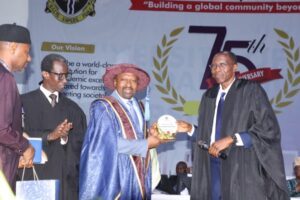
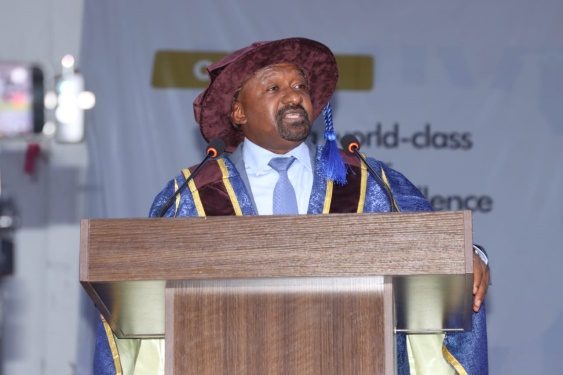
Delivering the 78th Foundation Day and 2026 Convocation Lecture at the University of Ibadan, Nigeria, on Monday, 16 November 2026, Vice President Dr. Mohamed Juldeh Jalloh challenged West African policymakers to move beyond diplomatic commitments and prioritize practical investments in physical and digital infrastructure capable of reducing the cost of doing business across the sub-region.
Speaking on the theme: “The Enduring Promise of Nigeria–Sierra Leone Relations: From Shared Origins to Shared Prosperity,” the Vice President outlined a comprehensive vision for transforming longstanding diplomatic, historical and cultural relations into meaningful economic opportunities for citizens and businesses.
Drawing inspiration from Nigeria’s ongoing Lagos–Calabar Coastal Highway project, Dr. Mohamed Juldeh Jalloh proposed the development of a comparable Lagos–Freetown coastal transport corridor supported by modernized ports, efficient coastal shipping services, simplified customs procedures and commercially viable regional railway networks.
He emphasized that improved transportation infrastructure would facilitate the movement of goods and services, reduce logistical costs, expand market access and create new investment opportunities across West Africa.
“The success of regional economic integration should be measured by how easily businesses deliver goods, obtain approvals, process payments and communicate with customers across national boundaries,” Dr. Mohamed Juldeh Jalloh stated.
The Vice President stressed that regional infrastructure must be designed to minimize the limitations imposed by geographical distance, enabling West African enterprises to operate more efficiently and competitively across national borders.
Highlighting the relatively low level of intra-regional trade, Dr. Mohamed Juldeh Jalloh noted that trade within the Economic Community of West African States (ECOWAS) stands at approximately 11 per cent, compared with 20 per cent within the East African Community and 19 per cent within the Southern African Development Community.
Against that background, the Vice President outlined a four-point commercial integration agenda focusing on borderless digital commerce, maritime and coastal logistics, coordinated regional investment, democratic stability and private-sector leadership.
On digital commerce, Dr. Mohamed Juldeh Jalloh called for deeper collaboration among telecommunications operators, regulatory institutions and financial service providers to reduce roaming charges, strengthen subsea fibre-optic connectivity and establish interoperable cross-border payment systems.
He underscored the importance of creating a regional digital ecosystem that allows businesses, entrepreneurs and consumers to conduct financial transactions and communicate seamlessly across national boundaries.
Addressing maritime and coastal logistics, the Vice President advocated improved port efficiency, the revival of regional coastal shipping services and the streamlining of customs clearance procedures under the ECOWAS Trade Liberalization Scheme (ETLS) and the African Continental Free Trade Area (AfCFTA).
He maintained that effective implementation of those frameworks, supported by adequate infrastructure, would significantly improve the movement of goods, strengthen regional supply chains and enhance the competitiveness of West African economies.
Dr. Mohamed Juldeh Jalloh also emphasized the need for coordinated regional investment, highlighting the importance of connecting academic institutions and business communities with initiatives such as the West Africa Integration and Investment Summit (WAIIS), taking place in Freetown under the leadership of President Dr. Julius Maada Bio.
President Dr. Julius Maada Bio succeeded Nigeria’s President Bola Ahmed Tinubu as Chairman of the ECOWAS Authority of Heads of State and Government in June 2025.
The Vice President highlighted the summit’s potential to mobilize investment in strategic sectors, including regional energy trade, strategic minerals, agribusiness and digital transformation, while strengthening economic cooperation among West African countries.
On democratic stability and private-sector leadership, Dr. Mohamed Juldeh Jalloh underscored the importance of good governance, political stability and strong institutions in safeguarding investments and creating an enabling environment for sustainable economic growth.
He further advocated greater participation by private-sector institutions, universities and young innovators in advancing cross-border partnerships, stressing that regional integration should not remain the exclusive responsibility of Governments.
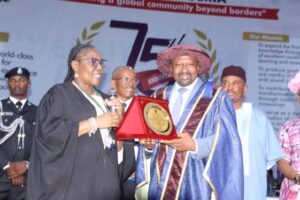
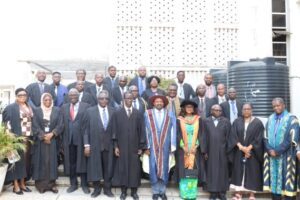
Earlier, the Vice-Chancellor of the University of Ibadan, Professor Peter Olapegba and former Vice-Chancellor, Professor Idowu Olayinka, representing the Chairman of the University’s Governing Council, Chief Bisi Akande, welcomed the Sierra Leonean Vice President.
They described his visit as an important bridge between the historic academic relationship linking Sierra Leone’s Fourah Bay College and the University of Ibadan and contemporary efforts to advance West Africa’s economic transformation.
The lecture reaffirmed the enduring relationship between Nigeria and Sierra Leone while presenting a forward-looking agenda for regional development anchored in infrastructure, technology, investment, education and institutional cooperation.
Vice President Dr. Mohamed Juldeh Jalloh’s proposal for a Lagos–Freetown coastal highway and digital corridor represents an ambitious vision for transforming West Africa into a more connected, competitive and economically integrated region, where national boundaries no longer constitute major obstacles to trade, investment and shared prosperity.