

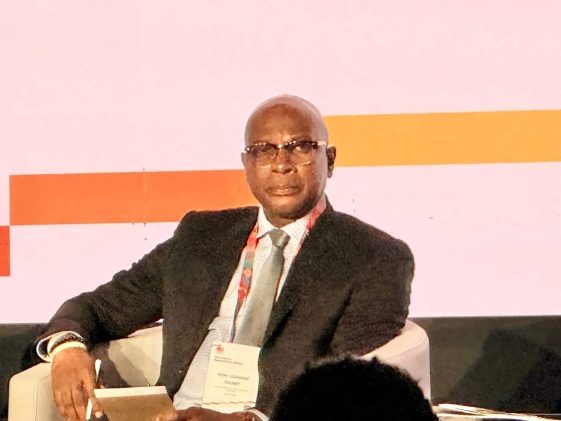
Sierra Leone’s Minister of Basic and Senior Secondary Education, Conrad Sackey, has advocated increased investment in teacher recruitment, remuneration, professional development and welfare, emphasizing that a qualified and motivated teaching workforce remains fundamental to achieving quality education and sustainable learning outcomes.
The Minister made the remarks on Tuesday, November 24, 2026, during a high-level Ministerial Leadership Dialogue themed: “From Evidence to Implementation” , held at the Labadi Beach Hotel in Accra, Ghana, marking the launch of the Mastercard Foundation’s report titled: Secondary Education in Africa: Expanding Pathways to Work, Livelihoods and Lifelong Learning.
Minister Conrad Sackey shared the platform with Ghana’s Minister of Education, Haruna Iddrisu; Liberia’s Minister of Education, Dr. Jarso Jallah and Rwanda’s Minister of Education, Joseph Nsengimana. The session was moderated by Dr. Martha Muhwezi, Executive Director of the Forum for African Women Educationalists (FAWE Africa).
Asked which of the report’s six recommendations he would prioritize for implementation in Sierra Leone, Minister Conrad Sackey identified Recommendation Four, which focuses on teachers and the education workforce.
“I think you cannot achieve quality in education without teachers,” he stated.
The Minister attributed his commitment to strengthening the teaching profession to his previous experience as Chairman of the Teaching Service Commission and his family background, which spans four generations of teachers.
His position reflects the report’s findings, which estimate that Sub-Saharan Africa requires an additional 10.7 million secondary school teachers by 2030 to achieve universal secondary education. The report also highlights the importance of equitable teacher deployment. Sierra Leone is among eight countries featured in its case studies.
While acknowledging the significance of expanding access to education, Minister Conrad Sackey maintained that increasing school enrolment must be complemented by ensuring that pupils receive instruction from qualified and competent teachers.
He explained that Sierra Leone currently has teachers on the Government payroll and volunteer teachers whose remuneration is supported through Government subsidies provided to schools. He expressed his desire to bring more teachers onto the payroll while ensuring their deployment reflects the staffing needs of schools.
Presenting his strategy for strengthening the teaching workforce, the Minister outlined a framework anchored in the “Five Rs”: Recruit, Reward, Retain, Reassess and Retire.
Under recruitment, he emphasized attracting more individuals into the teaching profession, while the reward component focuses on adequate remuneration. He disclosed that the Ministry is currently engaged in negotiations with the Teachers’ Union.
Regarding retention, Minister Conrad Sackey highlighted the importance of protecting teachers’ welfare and wellbeing to encourage them to remain in the profession.
On reassessment, he advocated recognizing teachers who pursue continuous professional development by ensuring their placement on the salary scale reflects their advancement.
The retirement component, he explained, focuses on making adequate provisions for teachers approaching the end of their professional service.
The Minister’s Five Rs agenda closely aligns with the Mastercard Foundation report’s recommendations on expanding the teaching workforce, ensuring fair remuneration, strengthening career progression pathways and promoting teacher wellbeing.
His intervention underscored the importance of placing teachers at the centre of educational reforms, reaffirming that sustained investment in the teaching profession is essential to improving learning outcomes and advancing Sierra Leone’s human capital development aspirations.