By Amin kef (Ranger)
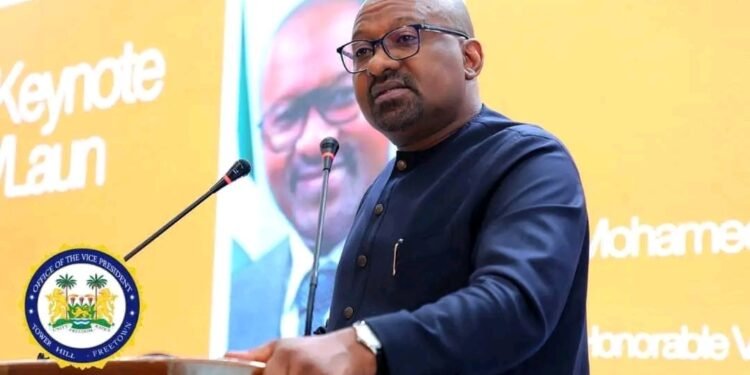
Sierra Leone’s Vice President, Dr. Mohamed Juldeh Jalloh, has urged West African nations to boost domestic revenue mobilization as a critical pathway to sustainable development. He delivered the call on Tuesday September 16, 2025 during the opening of the 7th High-Level Policy Dialogue and the 21st General Assembly of the West African Tax Administration Forum (WATAF), held at the Foreign Service Academy in Freetown.

Welcoming tax administrators, policymakers and international partners, Dr. Mohamed Juldeh Jalloh said Sierra Leone was “deeply honoured” to host the landmark event, which comes at a time of mounting fiscal pressures across the region. He noted that multiple global shocks, from the COVID-19 pandemic and the Russia-Ukraine war to declining international aid and growing insecurity in the Sahel, had severely weakened national budgets.
“We have faced multiple crises in recent years, all putting enormous stress on West African economies,” he stated. “There is no better time than today for low-income countries to prioritize domestic revenue mobilization. Strong revenues equal strong capacity; without them, states cannot deliver development.”
The Vice President pointed out that achieving the United Nations Sustainable Development Goals (SDGs) by 2030 will require nearly $4 trillion annually, far beyond what external financing can provide. He emphasized that countries like Sierra Leone must look inward, reforming tax systems, broadening the tax base and investing in accountability and transparency.
“Our Government is committed to pursue an efficient, transparent and equitable tax system to boost national revenue,” Dr. Mohamed Juldeh Jalloh stressed. He added that Sierra Leone’s reforms, particularly the digitization of tax administration, are aimed at increasing compliance and ensuring fairness across the system.
Highlighting regional disparities, he noted: “In Senegal, the revenue-to-GDP ratio stood at about 21 percent in 2020, while Sierra Leone’s remains under 10 percent. This shows the opportunity to learn from and adopt best practices across the region.”
Finance Minister, Sheku Fantamadi Bangura, echoed those sentiments, describing taxation as a vital driver of national development. “Taxes are not to punish you. Taxes also make sure that the Government collects what belongs to Government,” he said. He underscored the importance of simple and clear legislation to foster compliance and improve taxpayer understanding.
The forum also emphasized the role of tax governance and enforcement. Dr. Mohamed Juldeh Jalloh called for stronger mechanisms to curb leakages, reduce evasion and strengthen legal frameworks, including the role of tax courts. He further linked effective tax systems to broader economic reforms, noting that improving the ease of doing business and attracting foreign direct investment are critical to expanding revenue capacity.
The overarching message of the dialogue was clear: with declining international aid and heightened global uncertainty, West African countries must rely more on domestic resources to finance growth. Participants reaffirmed the need for regional cooperation, innovation and the modernization of tax systems to strengthen fiscal resilience.
By hosting the gathering, Sierra Leone has placed itself at the forefront of the regional push for fiscal reform, signaling a strong commitment to building robust and transparent systems capable of driving development in the years ahead.