By Amin Kef (Ranger)
The Attorney General and Minister of Justice, Alpha Sesay Esq., has called on Sierra Leoneans to embrace national unity, constructive dialogue and informed participation as the country advances its long-standing constitutional review process.

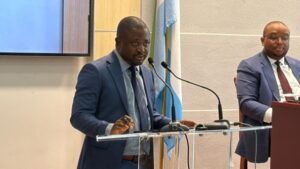
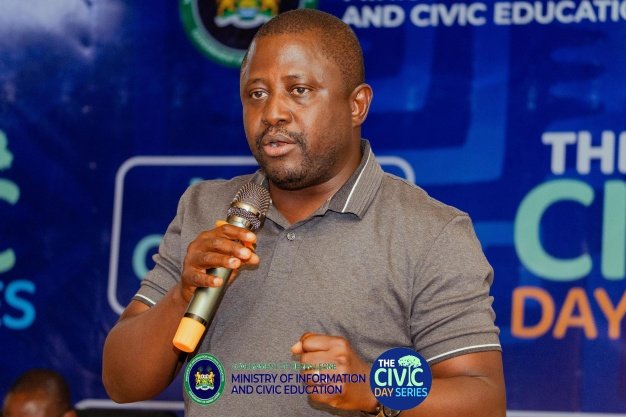
He made the call on Tuesday, 24 February 2026, while addressing participants at the Kono Civic Day Series Conference held at the Kono District Council Hall in Koidu City. The civic engagement was hosted by the Minister of Information and Civic Education, Chernor A. Bah, and focused on Sierra Leone’s constitutional reform journey and the key provisions of the proposed Electoral Reforms Constitution Amendment Bill currently before Parliament.
Addressing concerns surrounding the reform process, the Attorney General clarified that constitutional review is not a new political initiative but a national commitment rooted in the country’s peacebuilding history. He urged citizens to disregard misinformation, particularly on social media, stressing that the process predates the current administration.
Providing a detailed historical perspective, Minister Sesay recalled that the 1978 Constitution introduced a one-party state, which was later replaced by the 1991 multiparty Constitution shortly before the outbreak of the civil war. Following the conflict, the 1999 Lomé Peace Agreement—especially Article 10—recommended a comprehensive review of the 1991 Constitution as part of broader governance reforms aimed at addressing the root causes of the war.
He further explained that the Truth and Reconciliation Commission (TRC) identified significant constitutional and governance weaknesses and called for an inclusive and consultative reform process. Acting on those recommendations, the late President Dr. Ahmad Tejan Kabbah issued a White Paper committing his government to constitutional reform and established a committee chaired by Dr. Peter Tucker. The committee’s report was later submitted to former President Dr. Ernest Bai Koroma.
In 2013, President Koroma constituted the Justice Edmond Cowan Constitutional Review Committee, comprising more than 80 members drawn from political parties, civil society organisations, youth groups and market women. According to the Attorney General, the committee conducted over 10,000 public engagements nationwide between 2013 and 2017, received more than 150 position papers, held 80 expert consultations and 180 stakeholder meetings. Over 70,000 consultation forms were distributed across the country, while nearly 41,000 visitors accessed the committee’s website.
The committee submitted its report in June 2017. Some recommendations were accepted while others were rejected. In 2021, President Julius Maada Bio issued another White Paper building on the Cowan Committee’s work and incorporating provisions of the Gender Equality and Women’s Empowerment (GEWE) Act into the proposed constitutional framework.
The Attorney General also referenced the 2023 National Peace and Unity Agreement, which led to the establishment of a Tripartite Committee to review electoral-related concerns. He disclosed that the committee agreed on 80 recommendations. Non-entrenched provisions have already been tabled in Parliament ahead of the 2028 general elections, while entrenched provisions will form part of the broader constitutional review process requiring approval through a national referendum.
On electoral reforms, he highlighted proposed changes to the Proportional Representation (PR) system. The Bill seeks to repeal Section 38A, which provides temporary authority for PR, and amend Section 74(1)(b) to allow a category of Members of Parliament to be elected through proportional representation, with specific modalities to be determined by Parliament. He assured citizens that government is considering mechanisms to preserve a meaningful link between voters and their representatives while encouraging open and respectful national dialogue.
Beyond the Civic Day engagement, the Attorney General met with magistrates, prosecutors, defence lawyers, police officers and court staff in Kono District to discuss challenges affecting justice delivery, including case backlogs, limited resources and coordination gaps within the justice chain. The discussions underscored the Ministry’s commitment to strengthening access to justice and ensuring that reforms translate into tangible improvements at the local level.
During his visit, he toured the Safadu Correctional Service Centre, where he commended management and staff for their dedication to inmate rehabilitation and initiatives aimed at reducing reoffending. He engaged directly with male and female inmates to better understand their experiences and assess detention conditions, describing the facility as clean and forward-looking in its reform efforts.
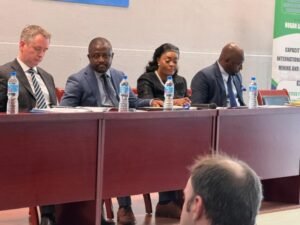
In a related development on Wednesday, 25 February 2026, the Office of the Attorney General and Minister of Justice, in collaboration with the Arbitration Steering Committee and Hogan Lovells London, hosted a capacity-building training on international arbitration at the Foreign Service Academy, Tower Hill, Freetown.
Held under the theme “Justice for Growth: Strengthening Dispute Resolution Framework for Sustainable Investment,” the training brought together State Counsel, government officials and private sector representatives to enhance expertise in managing complex arbitration matters in the mining and power sectors.
Deputy Minister of Justice, Madam Elizabeth Saptieu Saccoh, stated that Sierra Leone has entered a new era of international arbitration supported by modern legislation aligned with global standards. She emphasized that consistent application of the Arbitration Act 2022 is critical to building investor confidence and supporting economic growth.
Delivering the keynote address, Attorney General Sesay highlighted Sierra Leone’s accession to the New York Convention in 2020 and the enactment of the Arbitration Act 2022 as major milestones in modernizing the country’s dispute resolution framework. He noted that Section 82 of the Act provides for the establishment of the Sierra Leone International Arbitration Centre to promote and administer arbitration and alternative dispute resolution.
He described the operationalization of the Centre as a strategic priority aimed at strengthening legal capacity, enhancing investor confidence and positioning Sierra Leone as a credible destination for sustainable investment and dispute resolution