By Foday Moriba Conteh
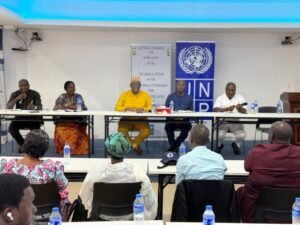
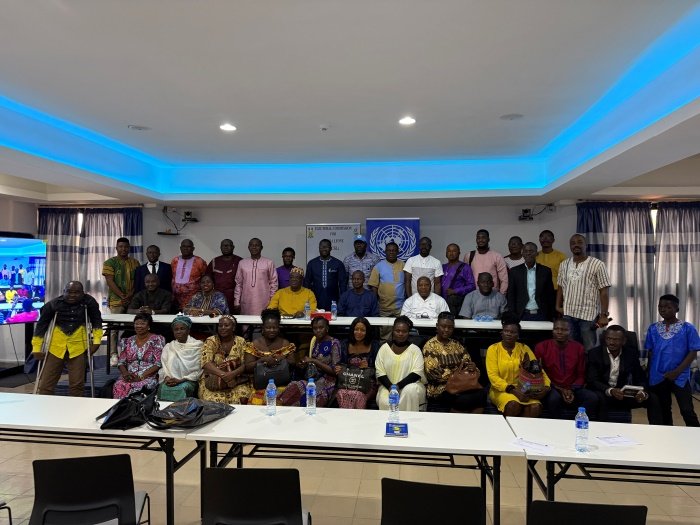
The Electoral Commission for Sierra Leone (ECSL) has provided an update on the progress made in implementing the Tripartite Committee’s recommendations, reaffirming its commitment to strengthening electoral processes ahead of future elections. Speaking at a stakeholders’ engagement meeting on Friday, 5th September 2025, at the Commission’s headquarters on Tower Hill, Freetown, ECSL’s Executive Secretary, William A. Davies, outlined key milestones and ongoing initiatives supported by partners including the Government of Sierra Leone, EU and UNDP.

The meeting brought together Civil Society Organizations (CSOs), media representatives, interreligious bodies and political stakeholders. William A. Davies emphasized that while significant progress has been made challenges remain in fully implementing all recommendations. He noted that many recommendations require legal reforms and amendments to existing legislation.
According to William A. Davies, several recommendations are already at different stages of implementation with the support of partners which includes:
- Policies and Frameworks: A draft Consultation Policy and a new Information/Document Management Policy have been developed. Work is also ongoing to finalize a policy on the Commission’s regulatory-making powers before the end of 2025.
- Voter Information and Education: Plans are underway to develop a new Voter Information Strategy (slated for 2026), integrate voter education into the Electoral Cycle Calendar and collaborate with the Ministry of Education to include governance and electoral topics in school and university curricula.
- Voter Registration: The ECSL is working with UNDP to recruit experts to conduct a feasibility study on the voter registration system between August and October 2025. The Commission has also started reviewing the location of voter registration centers, with full stakeholder engagement planned for 2026.
- Legal and Electoral Reforms: Engagements with the Ministry of Justice are ongoing regarding reforms related to electoral systems, candidate eligibility, fixed election dates and use of census statistics. Recommendations tied directly to election years such as nomination software, accreditation of agents and training are scheduled for 2026–2028.
- Election Observation and Inclusivity: The Commission intends to adopt international standards for citizen and international observers as the basis for a new Sierra Leone code. It also plans to make access assessments of polling stations before finalizing voter registers, with special arrangements for voters with disabilities where needed.
- Electoral System Dialogue: William A. Davies confirmed that a national dialogue has already been held on whether Sierra Leone should adopt proportional representation or retain the First Past the Post system for Parliamentary and local council elections.
He emphasized that while some recommendations are already completed or in progress, others are longer-term and will be rolled out in phases between 2026 and 2028.
In his welcome address, Acting Chief Electoral Commissioner, ECSL, Edmond Sylvester Alpha, emphasized the importance of dialogue and collaboration in strengthening Sierra Leone’s electoral system. He expressed appreciation to all stakeholders for their presence noting that their participation demonstrated broad national interest in the Commission’s reforms.
“We are not in an electoral vacuum, nor are we stagnant. We have processes and activities on course that will lead to the successful conduct of the 2028 elections,” Edmond Sylvester Alpha stated. He highlighted the Commission’s engagement with political parties, Government institutions and development partners as part of ongoing reforms to ensure peaceful, transparent and credible elections.
Reflecting on past electoral cycles, Edmond Sylvester Alpha explained that Sierra Leone’s electoral system has continuously evolved since the 2007 general elections, through reforms informed by observer mission reports and legal updates. These included the transition from the old Electoral Act to the Public Elections Act, which consolidated previous laws into a more robust legal framework.
“An election is a process with laws and procedures. As long as we abide by those laws, peace and stability will be maintained,” he stressed. Edmond Sylvester Alpha assured stakeholders that the Commission is already laying the groundwork for 2028, with activities such as voter registration, constitutional review processes and legal consultations with the Ministry of Justice already underway.
He described CSOs as the “third sector of society” and the media as the “fourth estate,” underlining their crucial roles in bridging the gap between the Commission and the electorate. He called for continued collaboration to enhance voter education, raise awareness and strengthen public trust in the electoral process.
The Acting Chief Electoral Commissioner also praised the role played by observer groups both national and international in providing oversight and recommendations that have contributed to electoral improvements over the years. “We cannot push this drive alone. Civil society, religious bodies, the media and observer groups must join hands with us to take the process back to the people,” he emphasized.
Edmond Sylvester Alpha acknowledged the centrality of the Tripartite Recommendations describing them as a “household name” in Sierra Leone’s political and electoral discourse. He reassured participants that the Commission remains committed to implementing the recommendations in full, with ongoing updates and consultations forming part of this commitment.
The Acting Chief Electoral Commissioner noted that the engagement was not an isolated event but part of a series of continuous dialogues with political actors, civil society and international partners to ensure reforms are inclusive and widely understood.
While emphasizing progress, Edmond Sylvester Alpha was clear that challenges remain. He underscored the need for sustained cooperation among stakeholders to guarantee stability, transparency and credibility in future elections.
“We assure citizens that the Commission is ready to conduct the 2028 elections in a peaceful, stable, transparent and credible manner,” he said.
The engagement ended with statements from other ECSL Commissioners, further reiterating the Commission’s determination to build on the lessons of past elections, implement the Tripartite Recommendations and deliver reforms that strengthen Sierra Leone’s democratic institutions followed by question-and-answer segment, providing participants with the opportunity to pose questions. ECSL Commissioners addressed these inquiries, offering clarifications and insights into the Commission’s ongoing efforts and future plans.