By Amin Kef (Ranger)
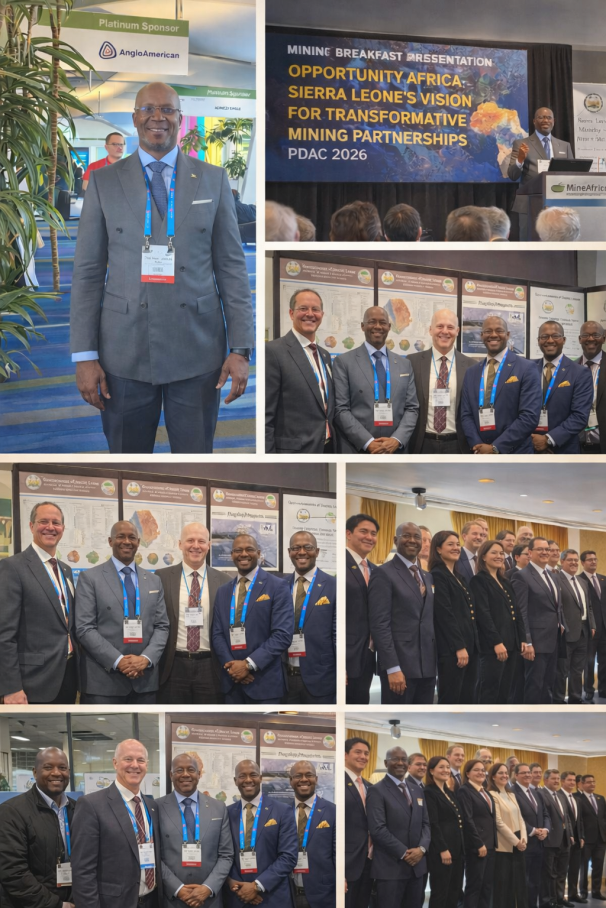
Sierra Leone has strengthened its position as an emerging destination for responsible and strategic mining investment following the country’s participation in the 2026 Prospectors and Developers Association of Canada (PDAC) Convention held in Toronto from 1–4 March 2026. The high-profile global gathering of mining investors, policymakers and industry leaders provided a platform for Sierra Leone to present its evolving vision for a more equitable and transformative minerals economy.

Leading the country’s delegation was the Minister of Mines and Mineral Resources, Julius Daniel Mattai, who delivered a compelling keynote presentation during MineAfrica’s 27th Annual African Mining Breakfast and the 24th Annual Investing in African Mining Seminar. His address, delivered under the theme: “Opportunity Africa: Sierra Leone’s Vision for Transformative Mining Partnership,” outlined the country’s ambition to reposition its mineral wealth as a catalyst for industrial development, shared prosperity and long-term economic transformation.
Accompanying the Minister at the international forum was a senior technical delegation from the National Minerals Agency (NMA). The team included Director-General, Ing. Hadji Dabo, Director of Mines, Peter Bangura, Director of Geological Surveys, Joseph Lebbie, Director of Precious Minerals Trading, Mohamed M. Bah and Manager of Large-Scale Mining Yusuf Summa. Their presence signaled Sierra Leone’s commitment to presenting a coordinated and technically credible case to the global mining community.
Addressing an audience comprising investors, mining executives, policymakers and development partners, Julius Daniel Mattai emphasized the strategic importance of Africa and Sierra Leone in particular in the global supply chain of critical minerals required for the energy transition.
“The choice before us is stark,” the Minister declared. “Will Africa remain the world’s raw material warehouse or will we become the twenty-first century’s manufacturing powerhouse? The answer depends on what we do together, starting now.”
He reminded participants that Africa possesses approximately 30 percent of the world’s known mineral reserves, including about 80 percent of global platinum resources and 70 percent of global cobalt deposits. The continent also hosts significant reserves of lithium, rare earth elements, copper, graphite and nickel; minerals considered essential for renewable energy technologies and advanced manufacturing.
Within that continental context, Sierra Leone, according to the Minister, represents a uniquely resource-rich and strategically positioned country. He highlighted that the nation’s 72,000 square kilometres contain vast deposits of iron ore, rutile, bauxite, gold, diamonds, lithium, rare earth elements, coltan and heavy mineral sands.
Beyond geological potential, Julius Daniel Mattai also underscored Sierra Leone’s geographic advantage and governance reforms. With direct Atlantic Ocean access through the Port of Freetown, a stable political environment and an English-language business ecosystem, the country offers what he described as a favorable environment for international investors seeking long-term partnerships.
However, the Minister did not shy away from highlighting structural challenges facing African mining industries. He noted that global critical mineral supply chains remain dangerously concentrated, creating strategic vulnerabilities for consumer nations.
“This is where Africa becomes indispensable,” he explained, adding that African producers provide opportunities for supply diversification, partnerships grounded in democratic governance and alignment with global transparency standards.
Julius Daniel Mattai further addressed persistent infrastructure and financing constraints that continue to affect the competitiveness of mining investments in many African countries. Limited electricity access, inadequate road and rail networks and high financing costs were cited as significant barriers.
He pointed out that African entrepreneurs often face borrowing costs between 18 and 25 percent, compared to approximately 3 percent in developed economies, describing the disparity as a structural disadvantage that requires genuine international partnership to overcome.
The Minister also used the opportunity to highlight Sierra Leone’s recent governance and regulatory reforms designed to strengthen investor confidence. Among the achievements cited were the country’s four consecutive peaceful democratic elections, compliance with the Extractive Industries Transparency Initiative (EITI), the enactment of the Mines and Minerals Development Act of 2023 and the strengthening of regulatory oversight through the National Minerals Agency and the Environmental Protection Agency.
Despite those reforms, he noted that global investor perceptions often lag behind reality, creating what he described as a costly double standard that deprives African economies of billions of dollars in potential investment each year.
Central to Sierra Leone’s new mining vision is the shift away from exporting raw minerals toward value addition and industrial processing within the country. The Minister outlined several initiatives aimed at achieving that objective.
Those include the establishment of heavy mineral separation plants, the development of a national gold refinery, diamond polishing and jewellery manufacturing facilities and the creation of a Critical Minerals Special Economic Zone designed to attract industrial investors with dedicated infrastructure and policy incentives.
“These are not aspirational fantasies,” the Minister told participants. “They are concrete projects seeking investment partners.”
According to him, domestic mineral processing will create skilled employment opportunities, encourage technology transfer, expand government revenues and strengthen supply chain resilience for global industries.
In a powerful closing message, the Minister also raised the ethical dimension of the global energy transition. He observed that while minerals from African countries increasingly power electric vehicles and advanced technologies, millions of Africans, including many Sierra Leoneans, still lack access to reliable electricity.
“The global energy transition cannot be built on Africa’s perpetual underdevelopment,” he stated.
Julius Daniel Mattai stressed that Sierra Leone is not seeking charity but equitable partnerships based on mutual respect, shared prosperity and sustainable development.
“We do not seek charity. We seek justice. We do not request assistance; we demand partnership,” he affirmed.
During the Toronto convention, the Sierra Leone delegation held a series of engagements with investors, mining companies and development partners aimed at translating the country’s policy vision into concrete investment opportunities.
Officials said the discussions focused on expanding exploration activities, supporting mineral processing ventures and strengthening Sierra Leone’s role in emerging global supply chains for critical minerals.
Concluding his address, Julius Daniel Mattai reiterated Sierra Leone’s readiness to work with partners who share the country’s vision for responsible mining and inclusive economic transformation.
“Opportunity Africa is not a slogan,” he concluded. “It is a commitment; to genuine partnership, shared prosperity, environmental stewardship and justice.”
With its growing reform agenda, strategic mineral resources and renewed diplomatic engagement, Sierra Leone is positioning itself to play a more influential role in shaping the future of Africa’s mining industry and the global transition to sustainable energy systems.