By Amin Kef (Ranger)
A comprehensive national study conducted by the Media Reform Coordinating Group (MRCG) has revealed persistent and systemic welfare challenges confronting journalists across Sierra Leone, raising serious concerns about the sustainability of the media sector, press freedom and the safety of media practitioners.

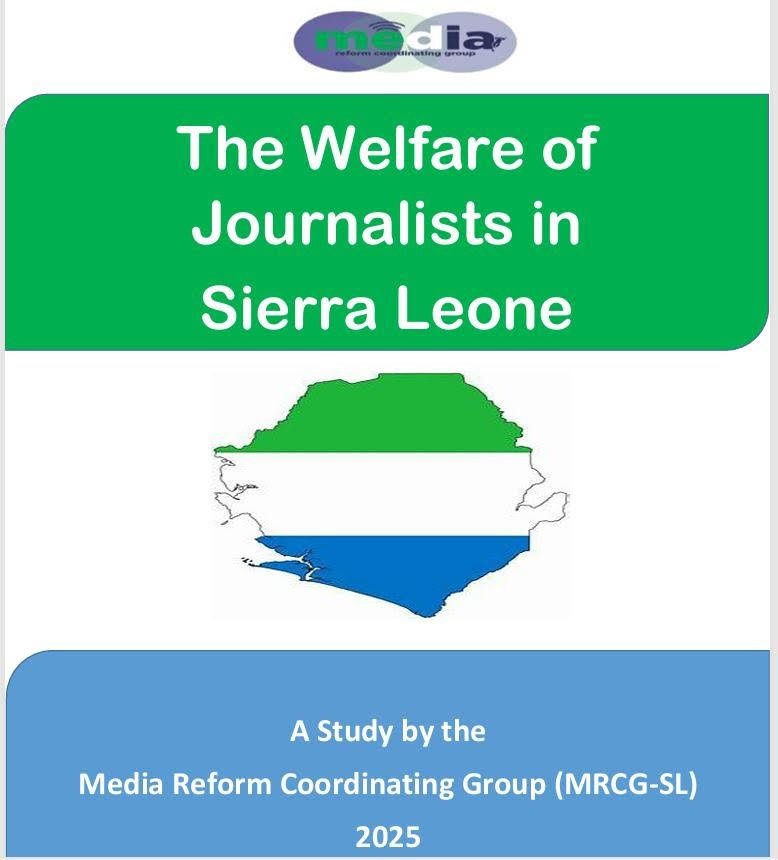
The study, titled: “The Welfare of Journalists in Sierra Leone (2025)”, surveyed journalists working in radio, television, newspapers and online media and paints a troubling picture of low pay, job insecurity, weak social protection and inadequate safety mechanisms within many media institutions nationwide.
According to the report, journalism in Sierra Leone remains a high-risk profession not only because of physical dangers associated with news gathering, but also due to widespread economic vulnerability. The study found that 25.9 percent of journalists have never received a monthly salary, while many of those who are paid face chronic delays. Even more alarming, 42 percent of journalists earn below the national minimum wage, undermining their dignity and professional independence.
One of the most striking findings of the study is the widespread failure of media institutions to comply with existing labour and social security laws. Nearly half of the journalists surveyed, 47.3 percent, are not registered with the National Social Security and Insurance Trust (NASSIT), while others are unsure of their status. This exposes journalists to severe hardship during illness, retirement or emergencies.
The report further reveals that many journalists lack written employment contracts, a situation that fuels job insecurity and arbitrary dismissals. In several media houses, there are no clear policies governing staff welfare, health emergencies or workplace safety, leaving journalists largely unprotected.
“These conditions do not only undermine the wellbeing of journalists but also threaten the quality and integrity of journalism in Sierra Leone,” the report notes.
While journalism inherently carries risks, the study found that safety mechanisms in many media houses remain weak or rudimentary. Although staff identification cards are common, essential safety tools such as first aid kits, fire extinguishers and protective equipment are largely absent in many institutions.
Only 27.7 percent of respondents confirmed the existence of a formal welfare policy in their media organizations, while the rest either reported none or were unaware of any such policy. This lack of institutional preparedness becomes more critical in times of crisis, such as public unrest, elections or health emergencies.
Despite those shortcomings, a majority of journalists indicated they “cannot complain” or feel only moderately safe at work; an attitude the report suggests may reflect resignation rather than genuine satisfaction.
The study places special emphasis on the welfare of female journalists, highlighting structural inequalities and gender-specific vulnerabilities. Although women make up nearly 40 percent of respondents, many face unequal pay, limited career progression and weak maternity protection.
More than 41 percent of media houses offer neither maternity nor paternity leave, while only a quarter provide both. The absence of family-friendly policies disproportionately affects women and contributes to their underrepresentation in leadership roles.
The report also raises concerns about sexual harassment and gender-based violence in the media workplace. While most respondents reported no harassment, cases involving colleagues and supervisors were documented, underscoring the need for clear sexual harassment policies and confidential reporting mechanisms.
Commenting on the findings, the President of the Sierra Leone Association of Journalists (SLAJ) described the employment situation for journalists as “troubling,” citing poor remuneration, lack of contracts and inadequate safety gear particularly for reporters working in remote or high-risk environments.
The Sierra Leone Reporters Union (SLRU) also acknowledged that poor welfare conditions expose reporters to exploitation and compromise ethical journalism. The Union is pursuing a bargaining certificate to formally engage media owners on wages and conditions of service.
Meanwhile, Women in the Media Sierra Leone (WIMSAL) highlighted persistent gender discrimination, noting that female journalists are often denied equal pay and leadership opportunities. WIMSAL has intensified advocacy, legal support and digital safety training to protect women in the profession.
The Independent Media Commission (IMC) acknowledged compliance challenges within the industry but said it has strengthened monitoring and enforcement. Media houses are now required to submit proof of salary payments, staff lists and NASSIT registration during licence renewals.
IMC Executive Secretary, Khalil Kallon, warned against the use of forged salary documents and assured journalists that they would not be penalized for reporting wage fraud. The Commission has also deployed district media monitors to improve on-the-ground oversight and ensure compliance with labour standards.
The MRCG study warns that poor welfare conditions directly threaten press freedom. Journalists struggling to survive are more vulnerable to inducements, self-censorship and unethical practices, weakening the media’s watchdog role in democratic governance.
The report argues that improving journalists’ welfare is not a luxury but a necessity for national development, accountability and social stability.
To address those challenges, the study calls for urgent, coordinated action. It recommends that all media institutions comply fully with the national minimum wage and social security obligations. The IMC is urged to enforce welfare provisions rigorously during licensing processes, while SLAJ, SLRU and WIMSAL are encouraged to intensify advocacy and collective bargaining.
The report also proposes collaboration and resource-sharing among media houses, investment in sustainable business models and enhanced professional training especially for women journalists.
As Sierra Leone continues to strengthen its democratic institutions, the report concludes that safeguarding the welfare of journalists must be a national priority. Without decent pay, safety and social protection, journalism risks becoming unsustainable, with far-reaching consequences for governance, transparency and public trust.
The MRCG study serves as a wake-up call to media owners, regulators, policymakers and development partners to move beyond rhetoric and take concrete steps to protect those who inform the nation.
Read the full report: https://mrcgonline.org/wp-content/uploads/2026/01/A-STUDY-ON-JOURNALISTS-WELFARE-IN-SIERRA-LEONE-2025.pdf