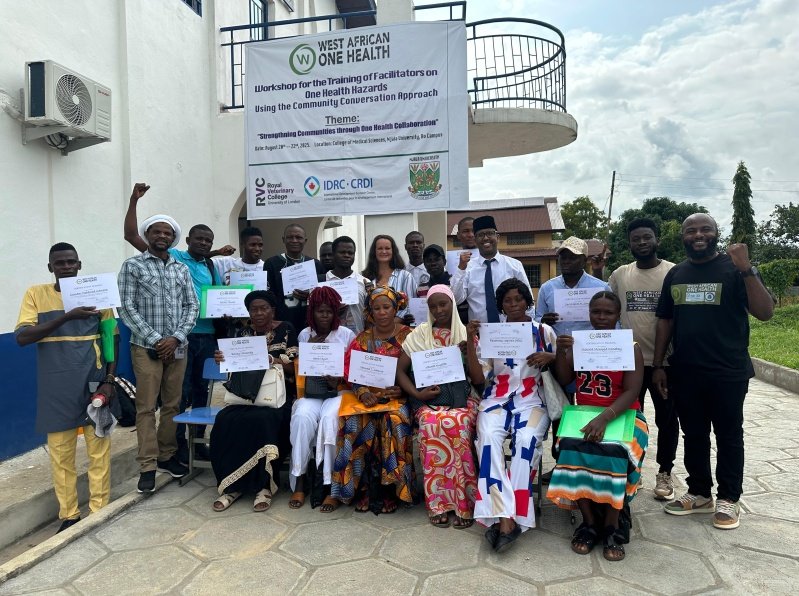
Njala University’s West African One Health (WAOH) Project has successfully wrapped up a three-day Training of Trainers (ToT) workshop aimed at equipping community facilitators to lead Community Conversations (CCs) on One Health hazards and climate-sensitive health risks.
The workshop, held from 20–22 August 2025 at the College of Medical Sciences, Kowama Campus, Bo, was organized in partnership with the Royal Veterinary College (RVC), United Kingdom and supported by the International Development Research Centre (IDRC), Canada. It was conducted under the theme, “Strengthening Communities through One Health Collaboration.”

A total of 16 participants, representing Community Action Networks (CANs) from 16 border communities across eight districts, Pujehun, Kenema, Kailahun, Kono, Kambia, Koinadugu, Port Loko and Falaba, attended the training. These facilitators are now set to roll out CC sessions between September and November 2025, fostering community resilience against zoonotic diseases and climate-related health threats.
The sessions were led by Dr. Abdinasir Yusuf Osman, veterinary epidemiologist from RVC and co-facilitated by Monya Konneh, WAOH socio-ecologist and Assistant Project Coordinator at Njala University.
Delivering the keynote address, Professor Rashid Ansumana, Dean of the College of Medical Sciences, emphasized the significance of empowering facilitators as grassroots champions of One Health. Community Conversations. By training CAN members to lead those dialogues, it is ensured that vital One Health messages reach households and influence everyday practices, he said.
In her closing remarks, Amber Martin, WAOH Project Coordinator, praised participants for their commitment and active engagement throughout the training. She noted that the workshop had equipped them to lead discussions on health hazards, climate change, food systems, water and sanitation and other issues critical to community wellbeing. Describing group activities as “phenomenal,” she encouraged participants to take the lessons learned back to their communities.
Amber likened the One Health Approach to a bicycle wheel, with climate, health, education, nutrition and financial security acting as spokes each essential for a stable and functioning society. She reminded participants that as community leaders, they serve as “first responders” in addressing local challenges, particularly in areas with limited Government resources. She also urged them to sustain momentum beyond the life of the project by educating, mobilizing and inspiring their communities toward better health, environmental protection and social development.
During the closing ceremony, Gasimu Mallah, Director of the People’s Development Organization (PDO), encouraged participants to translate their skills into practical action. “The knowledge you have gained must flow into your communities. By owning and driving these conversations you can prevent diseases and strengthen trust between communities and health systems,” he stated.
Participants were introduced to five key domains of Community Conversations:
- Hazards from daily human–animal interactions – rodent infestations, livestock management, bushmeat handling.
- Hazards from animal bites – rabies and post-exposure care.
- Food and water safety – cholera, brucellosis, salmonellosis, hygiene.
- Management of sick and dead animals – anthrax, antimicrobial resistance, Ebola risks.
- One Health and climate adaptation – vector control, flooding, reforestation, resilience strategies.
Using participatory methods such as storytelling, role plays, problem scenarios, community mapping and group discussions, participants practiced guiding CCs in ways that encourage reflection and practical action. Each session concluded with the development of community action plans aimed at translating discussions into tangible behavior change.
Facilitators also highlighted challenges in their communities, including limited mobility support, PPR vaccine availability, personal protective equipment and visibility tools such as T-shirts. These inputs were documented to inform future project planning.
The workshop concluded with field debriefings, lessons-learned sessions, post-training assessments and the certification of participants. Monya Konneh emphasized that the newly trained facilitators will not only strengthen CANs but also reinforce linkages between local communities and national One Health structures, contributing to Sierra Leone’s epidemic preparedness and climate resilience.