
By Foday Moriba Conteh
Mining activity continues to shape both the economy and social structure of Kenema District, Eastern Province of Sierra Leone particularly in diamond-rich Tongo, the alluvial fields of Lower Bambara, Wando, Bojabu and Kandu Leppiemah Chiefdoms, the gold prospects of the Kambui Hills, and the controversial operations around Lowuma in Koya Chiefdom. But while minerals generate income for many households, emerging data reveal a troubling pattern: a significant proportion of children are involved in labour, including hazardous mining work.
According to a 2019–2020 household survey conducted by the African Programming & Research Initiative to End Slavery (APRIES), approximately 35 percent of children aged 5–17 years in Kenema District were engaged in child labour. This means that more than one in every three children in that age bracket was involved in some form of economic activity considered inappropriate or harmful. The Eastern Province average stood at 44.6 percent, while neighbouring Kono and Kailahun recorded higher rates of 52 percent and 41 percent respectively.
Within Kenema’s child labour population, about 7 percent were involved specifically in mining and quarrying activities. Though mining does not represent the largest share of child labour sectors, it remains one of the most dangerous. The same survey found that 20 percent of affected children were engaged in portering and 9 percent in fishing. In addition, 26.6 percent of children in Kenema District were estimated to have experienced trafficking meaning roughly one in four children had been moved or compelled into exploitative situations, often overlapping with labour in mining communities.
At an artisanal diamond site near Tongo, 17-year-old Abdulai Sesay said he earns between one hundred and two hundred on a lucky day carrying gravel for adult miners. “If there is no find, I go home with nothing,” he explained. He spends long hours shoveling and washing sediments from riverbanks, a method known as alluvial mining, where loose soil and gravel are excavated and sieved manually in search of diamonds. Without boots, gloves or helmets, children face exposure to collapsing pits, sharp tools and contaminated water.
The mother of a child miner in Lower Bambara Chiefdom, Hawa Sheriff, acknowledged that poverty drives many families’ decisions. “When there is no food, you cannot tell the child to sit at home,” she said. Like many households in mining areas, her family survives below the national poverty threshold and depends on irregular mining income. Although the Government promotes free quality education, indirect costs such as uniforms, learning materials and transportation remain barriers, pushing children into labour rather than classrooms.
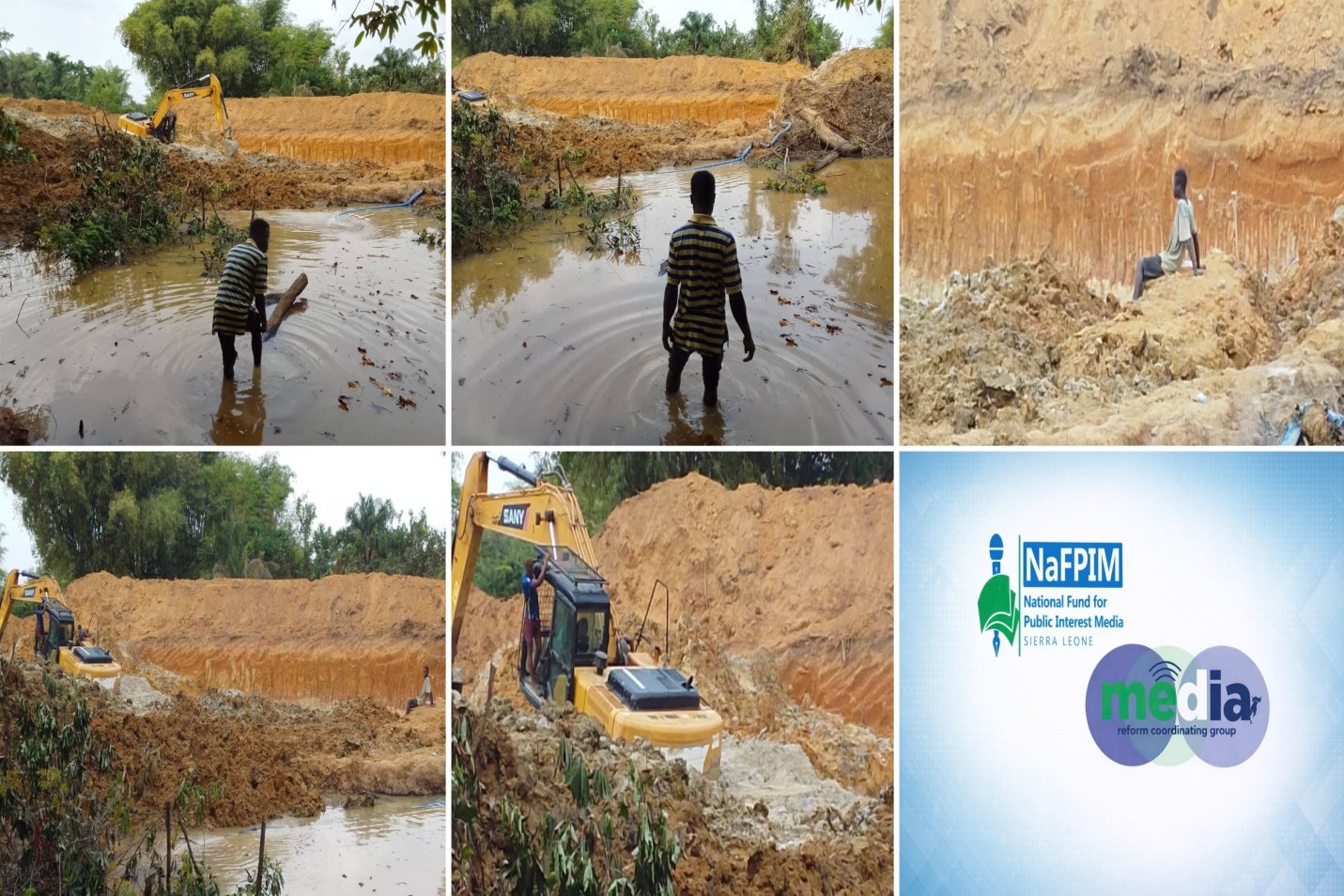
Mining methods vary across the district. Artisanal and small-scale mining (ASM) dominates in rural chiefdoms, where individuals dig shallow pits using basic tools. Formal operations, such as the gold project under development in the Kambui Hills by JM Mining under an Environmental Impact Assessment (EIA) licence, are legally required to adhere to regulatory and environmental standards. However, illegal mining operations, including mechanized dredging near watercourses, continue to be reported, particularly around Lowuma in Koya Chiefdom, contributing to environmental degradation and increasing the vulnerability of children.
A district official from the National Minerals Agency (NMA), Ing Mohamed Gaima confirmed that hazardous child labour is prohibited under the Child Rights Act 2007 and labour regulations although it is regarded as cultural. “Our responsibility is to inspect licensed sites and enforce compliance,” he stated, noting that license holders who allow child labour risk sanctions or revocation. According to him they embark on sensitization drives to raise awareness. However, he admitted that monitoring dispersed artisanal sites remains a challenge.
Traditional leaders also recognize the gravity of the statistics. A Town Chief in Bomboma Village, Nongowa Chiefdom, Mohamed Sidie ,said that while children helping families has historically been normalized; hazardous mining work crosses a legal and moral line. “When one in three children is already in labour, we must intervene decisively,” he said, calling for strengthened chiefdom by-laws and community child protection committees.
Officials from the Ministry of Gender and Children’s Affairs expressed particular concern about the trafficking figures. “If 26.6 percent of children have experienced trafficking, that is not just a labour issue; it is a protection crisis,” a district representative emphasized. She stressed the need for psychosocial support, reintegration programs and accelerated learning opportunities for former child miners.
Teachers in mining communities report increased absenteeism during peak mining seasons, with some pupils permanently dropping out. The educational consequences, combined with health risks such as respiratory problems, musculoskeletal injuries and waterborne diseases, reinforce cycles of poverty and underdevelopment.
Experts agree that reducing child mining in Kenema requires coordinated enforcement, poverty alleviation and education support. Routine site inspections, conditional cash transfers to vulnerable households, school feeding expansion, vocational training for parents and formalization of artisanal mining with strict “No Child Labour” clauses are among the recommended measures.
If these interventions are implemented effectively, the district could see measurable declines in child labour prevalence, improved school retention rates and reduced trafficking figures. For Kenema’s children, statistics should not merely reflect hardship, they should become benchmarks for progress toward safer communities and protected childhoods.
The publication is supported by the National Fund for Public Interest Media (NaFPIM), through the Media Reform Coordinating Group (MRCG), with funding from the International Fund for Public Interest Media (IFPIM) and the United Kingdom.