By Amin Kef (Ranger)
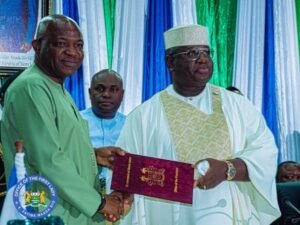
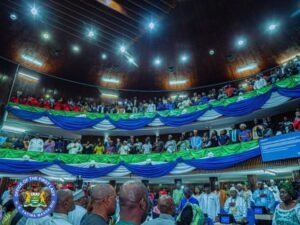
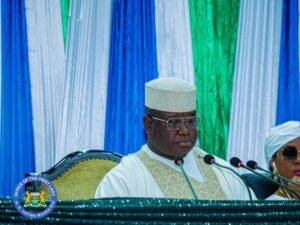
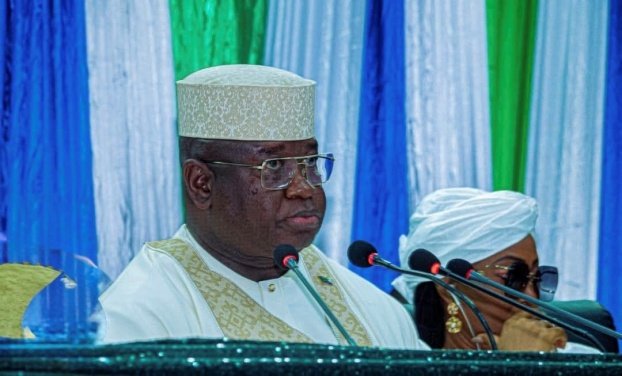
His Excellency President Dr. Julius Maada Bio delivered a powerful and optimistic address during the State Opening of the Third Session of the Sixth Parliament of the Second Republic of Sierra Leone. Speaking in the Chamber of Parliament on Thursday, August 7, 2025, at Tower Hill, President Bio outlined sweeping achievements under his administration and reaffirmed his vision to transform Sierra Leone into a resilient, inclusive and prosperous nation.
In his opening remarks, President Bio praised Members of Parliament for placing national interest above partisan politics. He emphasized the vital role of the legislature in shaping a future of progress and unity. “This House is the beating heart of our democracy,” President Bio declared. “It is here that we make decisions which shape every home, every farm, every school and every market across our nation.”
Centering his address around the Government’s flagship development strategy, President Bio highlighted the Big Five Game Changers, which include Feed Salone, Human Capital Development, Youth Employment Scheme, Technology and Infrastructure Development and Public Sector Reform.
President Bio reported significant gains in agricultural productivity. He revealed that in 2024, rice production increased by 8%, leading to a 13% reduction in imports and saving over US$15 million in foreign exchange. Rice prices dropped by 20%, easing the financial burden on families across Sierra Leone.
He noted that three new rice mills have opened and the World Food Programme now sources 30% of its rice from local farmers. Additionally, egg and onion imports have decreased and Sierra Leone began exporting vegetable oil for the first time under his administration.
President Bio further highlighted that over US$800 million in pledges were secured to support agriculture, with US$205 million already committed. Key advances include the country’s first digital soil mapping, a $10 million credit facility for equipment, crop insurance for rice and maize farmers and the biometric registration of over 300,000 farmers.
Turning to education, President Bio celebrated the construction of more than 1,500 classrooms and training of over 20,000 teachers. He pointed out that all public examination fees for NPSE, BECE and WASSCE are now paid by the Government. Girls’ school completion rates have improved dramatically and Starlink-enabled internet now connects 23 university campuses nationwide.
President Bio also underscored new technical institutes equipping youth with practical skills in agriculture, mechanics, digital literacy and entrepreneurship. He proudly announced that a digitized student loan scheme has already supported over 1,000 postgraduate students.
In the health sector, President Bio highlighted a 70% reduction in maternal and newborn deaths. He noted the commissioning of new and upgraded hospitals, deployment of over 14,000 health workers and installation of off-grid solar systems powering rural health facilities. He praised the expansion of the national vaccination drive and the Government’s swift response to Sierra Leone’s first confirmed Mpox case earlier in the year.
Addressing gender equality, President Bio celebrated the enforcement of the Gender Equality and Women’s Empowerment Act, the passage of the Child Rights Act and intensified efforts to combat sexual and gender-based violence.
Reaffirming his administration’s commitment to youth empowerment, President Bio pledged to create 500,000 jobs by 2028. He detailed how thousands of young people have received training in agriculture, construction, hospitality and digital skills. More than 250 young women have participated in digital entrepreneurship programs supported by the Government.
Highlighting ongoing youth support, President Bio described the World Bank–funded PSSNYE Project, which will provide seed capital to 8,000 youths to start or grow their businesses. He also pointed to Government efforts to scale up youth-led farming and fisheries initiatives.
President Bio issued a stern warning about the rising challenge of drug abuse, especially the synthetic drug Kush. He called on all Sierra Leoneans to unite against this threat and urged young people to remain focused, healthy and hopeful.
On technology and infrastructure, President Bio outlined transformative investments in digital Government services, energy, roads and public transport. He noted the digitization of payroll, audits and access to public services, along with the launch of a new Government Yellow Pages for easy access to Ministries and Agencies.
President Bio announced that over US$100 million in technology investment is underway. He revealed that Sierra Leone has joined the Mission 300 Energy Compact, aiming for 78% electricity access and 52% renewable energy use by 2030. Key energy projects include the 108.5 MW NANT gas-to-energy plant, 40 MW solar plants at Lungi and Newton, upgrades to hydroelectric facilities and electrification of rural schools and health centers.
He also highlighted infrastructure progress, with 418 km of roads completed and 17 new bridges constructed. He proudly reported the launch of 50 Waka Fine buses serving 25,000 passengers daily and the piloting of an electric bus policy in partnership with international stakeholders.
In public sector reform, President Bio announced a revised Civil Service Code and performance appraisal system. He detailed new Public Service Policy and Constitutional reforms aimed at embedding integrity in Government operations.
President Bio cited successes of the Anti-Corruption Commission, which recovered nearly NLe 35 million in 2024 and achieved 90% compliance through a digital asset declaration system. He noted Sierra Leone’s ranking as 7th in Africa for anti-corruption efforts according to the Mo Ibrahim Governance Index.
Digital payment reforms are improving financial management, with 88% of public spending audited. Retiree payments have been automated, ending years of delays and hardship for pensioners.
Despite global economic challenges, President Bio reported that Sierra Leone’s economy remains on a positive trajectory. He stated that GDP grew by 4% in 2024, inflation dropped from 54.5% to 9.38% and the Leone depreciated by just 5.7%. Domestic revenue reached NLe 14.6 billion and public debt was reduced to 39.5% of GDP.
President Bio also celebrated the International Monetary Fund’s approval of a US$243 million Extended Credit Facility, which he described as validation of the government’s economic reforms.
In closing his address, President Bio delivered a strong message of unity, urging all Sierra Leoneans to put country before party and work together for national development. “This Government will stand with you, invest in you and fight for you,” he declared. “But you too must rise and fight for yourselves. Because the story of Sierra Leone’s next chapter will not be written by politicians alone.”
President Bio’s 2025 Parliamentary address set a bold and hopeful tone for the year ahead emphasizing that the transformation of Sierra Leone is already underway; driven by vision, action and collective resolve.