

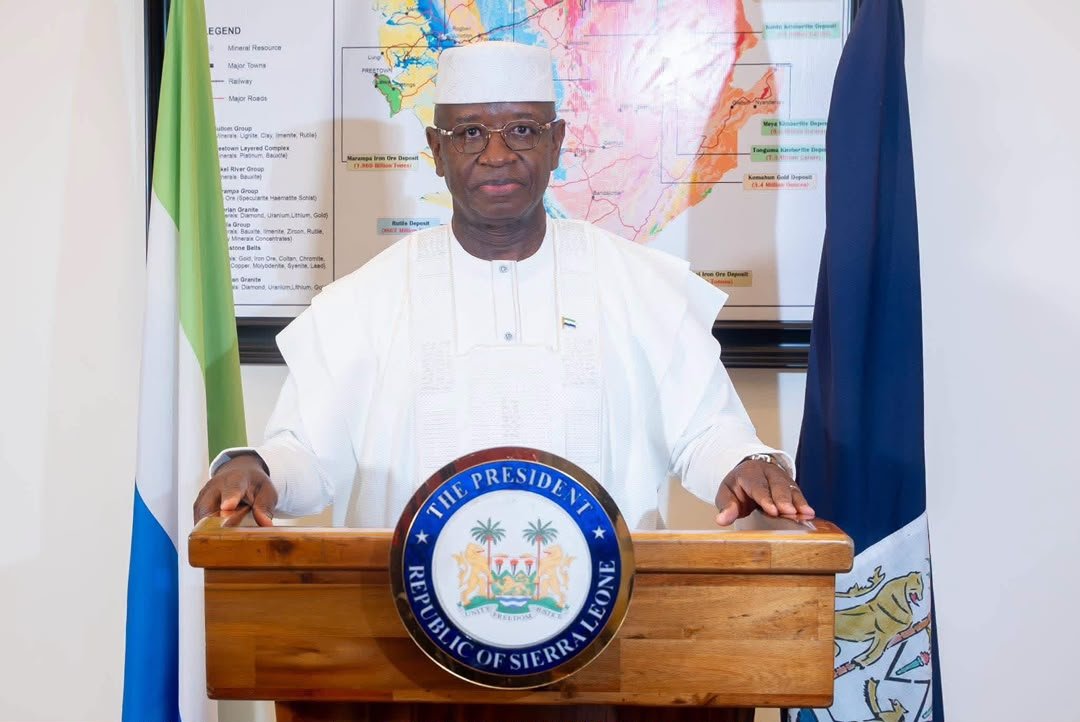
President Dr Julius Maada Bio has made a strong appeal to Members of Parliament to vote in favour of the Constitution of Sierra Leone (Amendment) Bill, 2025, describing the proposed reforms as the culmination of decades of national consultations aimed at strengthening democracy, political inclusion and electoral governance.
In a national address delivered on Sunday, 9 August 2026, ahead of the parliamentary vote on the Bill, President Bio urged lawmakers to put aside partisan considerations and make a decision that, he said, would shape Sierra Leone’s democratic future for generations.
“Do not vote for me. Do not vote for this Government. Do not vote for any political party. Vote for Sierra Leone,” President Bio declared, as he called on Parliament to support reforms intended to increase political participation, strengthen electoral institutions and constitutionally guarantee greater representation for women.
The President traced the origins of the constitutional reform process to Sierra Leone’s transition from civil war to peace and democratic governance, arguing that the proposed amendments should not be viewed as the initiative of one government or political party.
Reflecting on his period as Head of State in 1996, President Bio recalled initiating negotiations with the Revolutionary United Front, overseeing democratic elections and returning the country to civilian rule. He said those developments contributed to the peace process that eventually resulted in the 1999 Lomé Peace Agreement and the end of the country’s brutal civil war.
According to the President, the Lomé Peace Agreement itself called for a review of the 1991 Constitution, recognising the need for a constitutional framework capable of addressing the aspirations of a country emerging from conflict and seeking greater inclusion, justice, stability and accountability.
He noted that the Truth and Reconciliation Commission subsequently reached a similar conclusion, while successive governments, civil society organisations, commissions and citizens continued to advocate constitutional reform for more than two decades.
President Bio highlighted the roles played by previous administrations, beginning with the late President Ahmed Tejan Kabbah, who established the Dr Peter Tucker Constitutional Review Committee.
He said the process continued under former President Ernest Bai Koroma, who determined that a broader and more inclusive national exercise was necessary and subsequently established the Justice Edmond Cowan Constitutional Review Committee.
The President described the Cowan Committee, comprising 80 members, as having undertaken the most extensive constitutional consultation in Sierra Leone’s history. According to him, between 2013 and 2017, the Committee conducted more than 10,000 public consultations nationwide, engaged 133 stakeholder groups, received 150 position papers, broadcast more than 20,000 hours of airtime and distributed over 70,000 consultation forms across the country.
“This was a truly national process — not a partisan exercise,” President Bio maintained, noting that the Committee submitted its report to former President Ernest Bai Koroma in 2017.
He explained that when his administration assumed office in 2018, it chose to build on the work already undertaken rather than abandon the process or begin another constitutional review from scratch.
President Bio said consultations have continued over the years, with stakeholders contributing to the refinement of proposals now contained in the Amendment Bill before Parliament.
Among the key provisions highlighted by the President is the introduction of proportional representation, which he said would broaden political participation and create greater opportunities for women, young people, professionals and minority groups to gain representation in decision-making institutions.
He also pointed to a proposed minimum 30 percent quota for women in political nominations, describing the measure as an attempt to transform women’s political inclusion from an aspiration into an enforceable constitutional commitment.
According to President Bio, the proposed reforms would further strengthen the independence and accountability of electoral institutions and contribute to ensuring that Sierra Leone’s electoral rules are fair, transparent, credible and trusted.
The President commended citizens and stakeholders who have followed the parliamentary proceedings and participated in the continuing national debate. He also praised Members of Parliament who have remained engaged in lengthy deliberations on the proposed amendments.
Turning directly to lawmakers, President Bio stressed that their decision would extend far beyond the immediate political environment.
“The decision before you will not end with the vote. It will be remembered by generations yet unborn,” he said.
He argued that the parliamentary decision would influence whether women inherit a Constitution that recognises their equal right to leadership, whether young people receive a meaningful voice in determining their future and whether citizens retain confidence in Parliament’s ability to rise above political divisions.
Addressing questions over the timing of the reforms, President Bio said changes to the electoral framework should be completed ahead of the next general elections rather than being undertaken when voting is imminent.
He maintained that proceeding with another election under provisions recognised by political actors, civil society groups and election observer missions as requiring reform could create uncertainty.
According to the President, making constitutional and electoral changes before elections is consistent with democratic principles recognised by the African Union, ECOWAS and the United Nations and would help protect the electoral process from uncertainty, manipulation and confusion.
President Bio also responded to arguments that the existing Constitution does not require amendment and that concerns instead relate to its interpretation by the Supreme Court.
He said if constitutional interpretation is the central concern, Parliament has a responsibility to provide clarity, stressing that lawmakers must not only defend the constitutional text but also safeguard its meaning and strengthen its application.
“A Constitution is not designed for one political party. It is not the property of one government, one institution, or one group,” he stated.
President Bio said the Constitution must reflect the aspirations, rights, hopes and dreams of all Sierra Leoneans while promoting inclusion, protecting democracy and supporting national progress.
He consequently urged lawmakers to consider the voices of citizens who participated in years of consultations, particularly women seeking greater political representation, young people demanding a stronger role in shaping the country’s future and communities that contributed to the constitutional review process.
In one of the strongest sections of his address, President Bio repeatedly appealed for lawmakers to support the Bill.
“Vote ‘Yes’ for inclusion. Vote ‘Yes’ for women. Vote ‘Yes’ for the youth. Vote ‘Yes’ for credible elections. Vote ‘Yes’ for a stronger democracy. Vote ‘Yes’ for the future of our beloved nation,” he urged.
Drawing a connection between the current constitutional debate and Sierra Leone’s democratic transition three decades ago, President Bio recalled that in 1996 he took steps towards restoring multiparty democracy and returning governance to civilian authority.
He said Parliament now has an opportunity to take what he described as another historic step by giving Sierra Leone a stronger and more inclusive constitutional framework.
President Bio concluded by making what he described as a “clear and solemn appeal” for Parliament to pass the Constitution of Sierra Leone (Amendment) Bill, 2025.
“Let Honourable Members vote ‘Yes’—not for a party, not for an individual, but for the people and the future of democracy in Sierra Leone,” he said.
The President expressed hope that history would remember the parliamentary decision as one in which lawmakers chose “country over division, progress over stagnation” and laid the foundation for a stronger democracy for future generations.