By Amin Kef (Ranger)
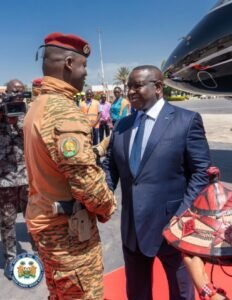
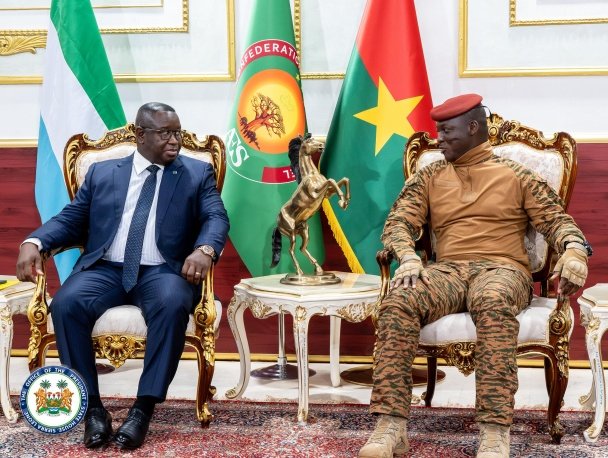
His Excellency Julius Maada Bio, President of Sierra Leone and Chairman of the ECOWAS Authority of Heads of State and Government, was warmly received in Ouagadougou by Burkina Faso’s Head of State, Captain Ibrahim Traoré, during a one-day working visit on Tuesday, 16 September 2025. The visit attracted regional attention, as President Julius Maada Bio became the first ECOWAS Chair to pay an official visit to a member country of the Alliance of Sahel States (AES) since its formation, a move widely seen as a deliberate effort to promote dialogue, cooperation and mutual understanding at a critical juncture in West Africa’s political and security landscape.

During the visit, President Julius Maada Bio and Captain Ibrahim Traoré held a bilateral meeting in which they reviewed relations between ECOWAS and AES countries. Their discussions focused on opportunities for collaboration to address shared security threats, strengthen political ties and expand avenues for economic partnership. Diplomatic observers noted that the talks also reaffirmed Sierra Leone’s bilateral friendship with Burkina Faso and encouraged more open engagement between the two regional blocs.
President Julius Maada Bio’s leadership as ECOWAS Chair has often been associated with efforts to build consensus on difficult regional issues and his presence in Burkina Faso reinforced that approach. His visit followed closely on the heels of an earlier mission in August 2025, when, as President of the United Nations Security Council, he travelled to Burkina Faso to assess its security environment. That visit provided him with first-hand insight into the country’s ongoing challenges, including terrorism, insurgency and humanitarian pressures affecting the wider Sahel. By returning in his ECOWAS capacity, President Julius Maada Bio demonstrated continuity in his commitment to regional stability and showed readiness to translate high-level consultations into practical cooperation.
Regional analysts described the Ouagadougou meeting as a diplomatic milestone that could open a new chapter in relations between ECOWAS and the AES. With Burkina Faso, Mali and Niger asserting new regional alignments, the initiative taken by President Julius Maada Bio was viewed as a constructive step to keep dialogue alive while exploring avenues for collaboration that could strengthen peace and security across West Africa. His leadership style is praised as inclusive and pragmatic, with many noting that the symbolism of the visit was as significant as the concrete outcomes it produced.
At the conclusion of the working visit, a joint communiqué was issued, outlining areas of agreement and a shared commitment to address security and development challenges. Both countries reaffirmed their determination to deepen bilateral ties and to maintain open lines of communication within the broader regional framework.
For Sierra Leone, the visit reinforced its growing reputation as an active and respected diplomatic voice in Africa. For Burkina Faso, it represented recognition from ECOWAS and an opportunity to engage constructively with the regional bloc despite recent political shifts. As West Africa continues to grapple with some of its most complex challenges in recent history, the outreach of President Julius Maada Bio in Ouagadougou carried a clear message: that unity, dialogue and cooperation remain indispensable tools for building a peaceful and stable sub-region.