
By Amin Kef (Ranger)
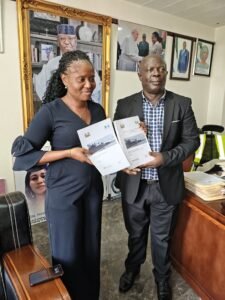
The Sierra Leone Urban Research Centre (SLURC) on 10 December 2025 officially handed over the completed Lungi Spatial Development Framework (SDF) and the Strategic Environmental and Social Assessment (SESA) to the Ministry of Lands Housing and Country Planning during a ceremony held at the Youyi Building conference room in Freetown. The event marked the culmination of a 15-month national planning assignment jointly undertaken by SLURC and ARS Progetti S.P.A., with funding from the African Development Bank (AfDB).

Senior officials including Deputy Minister Phyllis Kormoh, Permanent Secretary Abdulai Fofanah and Director of Planning, Policy and Project Development Dr. Alphajoh Cham attended the ceremony alongside technical staff from the Ministry and representatives from SLURC, led by its Executive Director, Dr. Joseph Macarthy.
In his keynote submission, Dr. Joseph Macarthy expressed sincere gratitude for the confidence placed in SLURC to co-deliver the assignment, describing the finalization of the documents as both timely and significant, especially following Cabinet’s recent approval of Lungi as one of Sierra Leone’s newly recognized cities. He outlined that the project commenced on 1 July 2024 and was concluded on 30 September 2025, representing 15 months of intensive technical work, comprehensive consultations and rigorous planning activities.
According to Dr. Joseph Macarthy, the assignment comprised three core components: the formulation of an inclusive and sustainable Spatial Development Framework for Lungi, the preparation of a Strategic Environmental and Social Assessment to guide responsible land use and a capacity-building package involving GIS training for three executives, supported by advanced software and hardware. Although the training aspect could not be fully completed due to unforeseen circumstances, it has been rescheduled for January 2026, with consistent communication maintained between SLURC, AfDB and the Ministry throughout the process.
He described the planning process as methodical, beginning with extensive data collection on land use patterns, population demographics, environmental assets, infrastructure conditions and economic activities in Lungi and its surrounding areas. This data, he said, provided the foundation needed for evidence-based planning decisions. The team then conducted wide-ranging stakeholder engagements involving community members, local authorities, traditional leaders, private-sector actors and civil society organizations to ensure inclusivity and local ownership of the development vision.
Based on insights gathered, multiple land-use scenarios were developed and evaluated in alignment with national development priorities. Draft versions of the SDF and SESA were subsequently presented in public workshops held in both Lungi and Freetown, during which participants provided constructive feedback used to refine the final documents. These iterative consultations, Dr. Joseph Macarthy noted, strengthened the credibility and practicality of the frameworks.
The completed SDF and SESA outline clear action plans for sustainable urban development, including priority projects that support economic growth, environmental protection, social service delivery and resilient infrastructure. They also include monitoring and evaluation mechanisms to support adaptive management and ensure long-term implementation.
Deputy Minister Phyllis Kormoh, who received the documents on behalf of the Minister, expressed appreciation to AfDB and the implementing team for their unwavering support. She welcomed the donation of computers and technical equipment that accompany the project, saying the resources will significantly aid the Ministry and its Directorate in strengthening planning capacities. She recalled that the Ministry had recently completed nationwide consultations on the Country Planning Act and described the new inputs as timely. The Deputy Minister also assured that a formal letter of appreciation would be dispatched to the Bank and other partners.
Permanent Secretary Abdulai Fofanah lauded the initiative, noting that it aligns with the Government’s ongoing decentralization reforms, which place increased responsibility for local planning on district councils. He said the Ministry plans to cascade training to council officials after completing regulatory engagements and consultations with council representatives. He emphasized that traditional leaders, who participated in early planning sessions, now better understand their responsibilities in community land governance. Although he acknowledged persistent challenges such as insufficient equipment, he assured that the Ministry would work diligently to ensure the SDF serves its intended purpose rather than remain unutilized.
Dr. Alphajoh Cham, Director of Planning, Policy and Project Development, explained that AfDB funded the entire project following a request submitted by the Minister to both the World Bank and AfDB. He thanked the Bank for its support and highlighted the catalytic role played by its representatives throughout the project. Dr. Cham stressed that while the SDF and SESA provide a strong foundation, they represent only the preliminary stage of a much larger vision. The next phase, he revealed, will involve the development of a comprehensive city plan for Lungi.
Meanwhile, the Ministry displayed key elements of the newly completed SDF, describing it as a national planning blueprint designed to guide Lungi’s sustainable transformation. The document outlines a participatory, environmentally sensitive development model that prioritizes biodiversity restoration, climate resilience, compact urban growth, ecological protection, and social inclusion.
The framework further highlights opportunities for economic expansion, especially in aviation-linked logistics, maritime trade, SME development, construction and green jobs. It reinforces the importance of well-planned housing, improved land tenure systems, accessible public services, coherent street networks and expanded educational and health systems to support population growth.
Officials at the Ministry concluded that the Spatial Development Framework positions Lungi as a potential model for sustainable urban growth in Sierra Leone. They affirmed Government’s commitment to ensuring that the document guides practical implementation and supports a future in which Lungi becomes a well-organized, economically vibrant and environmentally resilient city.