By Amin Kef (Ranger)
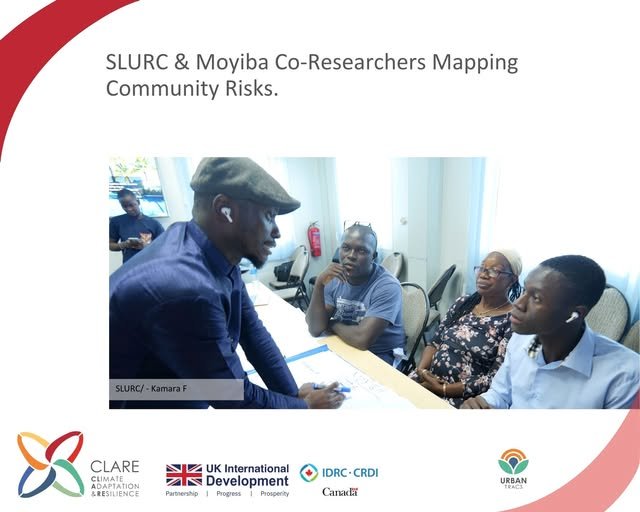
As climate change intensifies across West Africa, Sierra Leone’s capital, Freetown, remains one of the most vulnerable cities, with mudslides, flooding and coastal erosion posing increasing threats. A recent vulnerability mapping exercise led by the Sierra Leone Urban Research Centre (SLURC) in Moyiba has underscored the dangers, with residents citing deforestation and stone mining as major drivers of deadly mudslides.

“In my earliest days in the community you hardly heard of mudslides. Deforestation is our biggest threat,” a Moyiba co-researcher explained. Another noted, “There is no coping mechanism in our community. Some residents have moved because their lands are gone.”
These voices reflect a wider problem: informal settlements, often hit hardest by climate disasters, are too frequently left out of planning and policy conversations.
SLURC is responding through the Urban TRACS (Transformative Research for Adaptation to Climate Change in Informal Settlements) project, which puts community participation at the heart of climate action. The initiative employs Participatory Action Research (PAR), ensuring lived experiences directly inform solutions; co-creation, where residents help shape context-specific adaptation strategies and inclusive governance, which empowers vulnerable communities to influence decision-making.
Urban TRACS is supported under the CLARE Programme, a flagship initiative largely funded by UK Aid and co-financed by Canada’s International Development Research Centre (IDRC). CLARE promotes Southern-led climate adaptation research, bridging the gap between science and local action.
Reflecting on Sierra Leone’s climate vulnerability eight years after the devastating August 14, 2017 mudslide, SLURC Executive Director, Dr. Joseph Macarthy, called for a multi-sectoral approach to urban planning. He stressed that collective action is needed to reduce risks in Freetown’s informal settlements, where rapid urbanization continues to worsen flooding, landslides and heatwaves.
“Stakeholders must understand climate change as a shared challenge requiring collaborative solutions,” Dr. Joseph Macarthy urged.
Communities such as Moyiba, Cockle Bay and Colbot remain on the frontlines of climate risks with climate change already affecting their health, livelihoods and safety.
SLURC is using Geographic Information System (GIS) technology to strengthen resilience in informal settlements like Pamoronko and Thompson Bay. By mapping community boundaries, hazards such as flood-prone areas and unsafe boulders and existing adaptation measures, SLURC is generating vital data for disaster prevention.
Community members are trained as GIS data collectors, ensuring the maps reflect lived experiences and equipping residents with new skills. “By blending technology with local knowledge, GIS becomes a bridge between research and community action,” a SLURC research officer explained.
In coastal areas, unregulated sand mining is accelerating erosion and destroying ecosystems. Communities in Lakka, Hamilton, John Obey and Bureh are losing their coastlines, threatening fishing, tourism and local livelihoods.
SLURC and partners recommend stricter enforcement of environmental laws, promotion of alternative income sources such as fishing and small-scale tourism, greater investment in local businesses and stronger community leadership in decision-making.
From Moyiba’s hills to Sierra Leone’s vanishing coastlines, SLURC’s work demonstrates that resilience must be built from the ground up. By amplifying local voices, documenting adaptation strategies, and linking science with community realities, the organization is helping build a safer, healthier and more resilient Freetown.
Climate change is not a distant threat; it is already shaping daily life in Sierra Leone’s informal settlements. The solutions, experts say, must begin with the people most affected.