
By Foday Moriba Conteh
The Ministry of Health has announced the nationwide rollout of the National Multi-Age Cohort (MAC) HPV Vaccination Campaign, scheduled to begin today, Monday, 17th November 2025. This initiative marks a significant milestone in Sierra Leone’s ongoing efforts to eliminate cervical cancer, the second most common cancer among women of reproductive age in the country. The campaign, implemented through the Expanded Programme on Immunization (EPI), expands eligibility to girls aged 11 to 18 broadening coverage beyond the single-age cohort previously targeted.

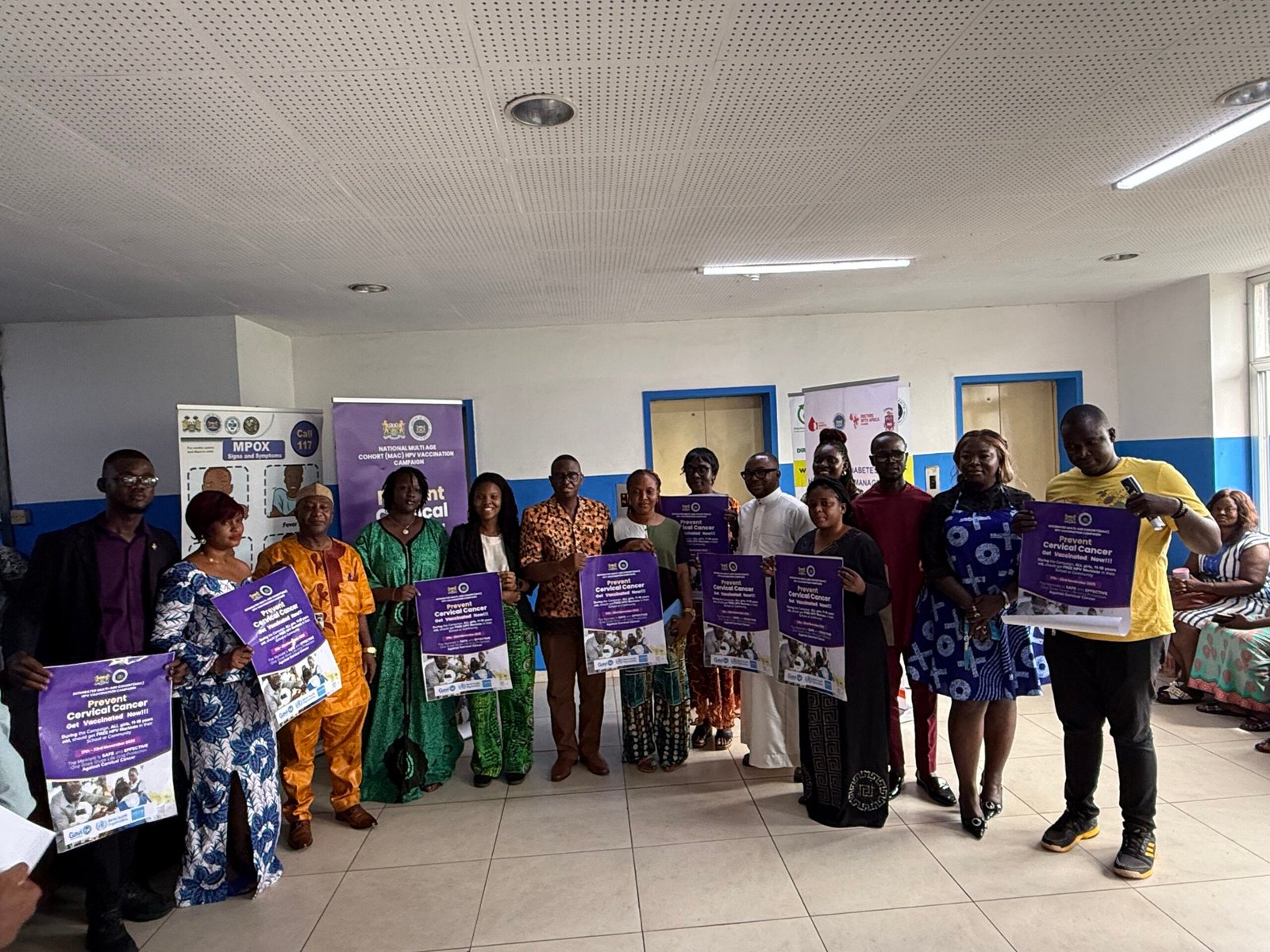
Ahead of the official launch, the Ministry held a press briefing on Friday, 14th November 2025, at its Conference Hall in the Youyi Building, Freetown. The session aimed to equip media practitioners with accurate information to support nation-wide sensitization and public education efforts.
Deputy Medical Officer, Dr. Alie Wurie, emphasized that the engagement was intentionally scheduled before the campaign launch in order to strengthen public awareness. He acknowledged the media’s longstanding partnership in supporting public health delivery, noting that previous vaccination campaigns owed much of their success to timely and accurate reporting by journalists.
Dr. Alie Wurie explained that Sierra Leone has administered HPV vaccines for several years, with more than 168,000 girls vaccinated since the country began HPV immunization efforts in 2013. He described the HPV vaccine as one of the most effective tools in preventing cervical cancer and said that expanding the vaccination cohort represents a renewed commitment to protecting young girls.
He added that full technical details, including operational plans, vaccine delivery strategies and target population specifics would be explained by the EPI team. Dr. Alie Wurie encouraged the media to engage critically, ask questions and ensure clarity before disseminating information to the public. He praised journalists for their patience and reaffirmed the Ministry’s appreciation for their role in healthcare communication.
Representing the Ministry of Basic and Secondary School Education (MBSSE), Dr. Kuyateh delivered a statement on behalf of the Minister and Deputy Minister. He highlighted that the HPV MAC campaign chiefly targets school-going children, who constitute the largest portion of the 11–18 age bracket. Because most eligible girls are enrolled in primary, junior secondary and senior secondary schools, the MBSSE stands as the “largest stakeholder and beneficiary” of the campaign.
Dr. Kuyateh stressed that a successful vaccination campaign will lead to improvements in school enrollment, retention and academic performance. Healthy children, he said, are more likely to stay in school, achieve better results and contribute positively to society. He outlined the Ministry’s nationwide education structure, which includes Chief Education Officers, Directors, Deputy Directors, District Directors, over 380 School Quality Assurance Officers and thousands of school heads and teachers. This communication network is actively disseminating information to ensure nationwide awareness.
He assured the Ministry of Health that even the most remote communities have received information about the vaccination campaign. Dr. Kuyateh reiterated MBSSE’s readiness to collaborate fully, describing the initiative as a model of strong inter-ministerial cooperation.
Delivering a detailed overview of the campaign, Senior Public Health Sister, Margaret Kangbai, explained that cervical cancer remains a major public health concern, accounting for thousands of deaths worldwide and ranking as the second leading cause of death among women aged 15 to 45 in Sierra Leone. The HPV vaccine, she emphasized, is a critical preventive measure.
Sister Margaret Kangbai stated that the national HPV MAC campaign will run from 17th to 23rd November 2025. Unlike previous campaigns that targeted only 10-year-old girls, this year’s expanded cohort includes girls aged 11 to 18. The vaccine will be administered as a single dose for the general population, while immune compromised girls will receive two doses six months apart in coordination with HIV treatment services.
She clarified eligibility criteria: girls below 10 and above 18 will not be vaccinated; pregnant girls, those with severe illness and individuals with past allergic reactions to the vaccine are also excluded.
Operationally, the campaign will use the quadrivalent HPV vaccine providing protection against HPV types 6, 11, 16 and 18. It will be administered as a 0.5 ml intramuscular injection in the left upper arm. Delivery strategies include both school-based and community-based approaches. Schools, including primary, secondary, technical, vocational and tertiary institutions will serve as vaccination centers. Out-of-school girls will be targeted through community outreach, static health facilities, temporary fixed posts, mobile outreach sites, marketplaces, religious centers and lorry parks.
She emphasized that house-to-house vaccination will not occur due to the injectable nature of the vaccine. Vaccination teams will comprise three members: two vaccinators and one mobilizer, a model adopted based on lessons learned from previous campaigns. The activity will be supported by a four-level supervision system spanning team, district, regional and national levels to ensure compliance and efficiency.
Mop-up exercises will be conducted in districts that do not meet their targets during the seven-day campaign. Girls who miss the vaccination period will be allowed to receive the vaccine later at nearby health facilities.
Closing the briefing, Minister of Health II, Dr. Jalikatu Mustapha, reaffirmed the Government’s commitment to eliminating cervical cancer in Sierra Leone. She described the disease as highly preventable but persistently deadly, killing more than 70 percent of women diagnosed annually. She shared a personal story about losing her grandmother to cervical cancer 19 years ago, emphasizing her passion for leading the fight against the disease. She also revealed that the President has a personal connection to cervical cancer and has instructed the Ministry to intensify elimination efforts.
Dr. Jalikatu Mustapha highlighted significant progress made in HPV vaccination, screenin, and treatment. As of mid-2025, the country has achieved an 80 percent vaccination coverage rate among eligible girls. She also announced that 24 cervical cancer screening centers are now operational nationwide, with seven located in the Western Area. These centers provide same-day detection and treatment for pre-cancerous lesions, as well as surgical interventions for advanced cases.
She revealed that the upcoming MAC campaign targets about one million girls and that the Ministry has secured 1.3 million doses of the HPV vaccine to ensure full coverage. The Minister called on parents, communities and the media to help counter misinformation and encourage uptake, stressing that the vaccine is safe, effective and vital for saving lives.
She thanked Gavi and health partners for their support and officially confirmed Monday, 17th November 2025, as the launch date for what she described as an “extraordinary and life-saving campaign.”