

By Foday Moriba Conteh
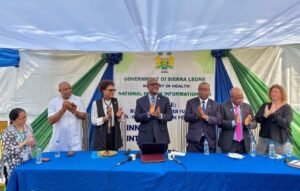
The Ministry of Health (MoH) has officially launched Sierra Leone’s first-ever National Health Information Hub, marking a major milestone in the country’s efforts to modernize healthcare delivery through real-time, evidence-based decision-making. The launch ceremony took place on Monday, 19 January 2025, at Riverside Drive, Brookfields, Freetown and was attended by senior Government officials, United Nations representatives, development partners, civil society organizations, health sector leaders and members of the media.
Unveiling the state-of-the-art digital facility, the Minister of Health, Dr. Austin Demby, described the Hub as a central pillar of the Ministry’s digital transformation agenda and a critical step toward building a stronger, smarter and more responsive health system. He said the initiative is designed to enhance service quality, strengthen coordination across the health sector and accelerate progress toward Universal Health Coverage (UHC).
Dr. Austin Demby explained that while Sierra Leone has made significant investments in health digitization over the years, the sector has continued to face challenges due to fragmented data systems. According to him, critical health information has often been scattered across multiple platforms, arriving late or lacking consistency, thereby limiting the Government’s ability to make timely and informed decisions. Those challenges, he noted, have had serious implications for emergency response, health service management and efforts to reduce maternal and child mortality.
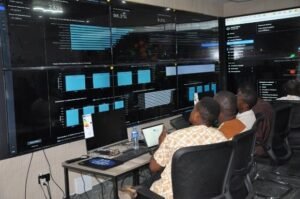
The Minister said the National Health Information Hub is the Ministry’s strategic response to those gaps. Fully Government-owned and Government-led, the Hub integrates data from multiple existing health information systems, including DHIS2 and other priority platforms. It currently features 12 real-time interactive dashboards and a 3D geospatial map with advanced analytics, providing decision-makers with clear and timely insights at national, district and facility levels.
“This is not a pilot or a concept,” Dr. Austin Demby emphasized. “We are commissioning a functional national health information hub with live dashboards covering priority health indicators and automated national reporting. It forms the foundation of a robust, scalable and sustainable national health information system.”
Looking ahead, the Minister outlined plans for the next phase of the digital transformation, which will include the nationwide rollout of electronic medical records (EMRs) across health facilities. Those systems, he said, will feed directly into the Hub, improve data quality and support real-time, patient-centred care. He also disclosed plans to establish regional and district-level health information hubs to decentralize data use and ensure that evidence-based decision-making is embedded across the country not only in Freetown.
Dr. Austin Demby stressed that the success of the Hub will depend on its active use by policymakers, programme managers, district teams and partners. He described the Hub as a critical national asset and called on all stakeholders to use it consistently so that data informs action and ultimately saves lives.
The United Nations Resident Coordinator in Sierra Leone, Ms. Seraphine Wakana, described the launch as a landmark achievement in advancing evidence-based governance and improved health outcomes. She said the Hub reflects strong national leadership, strategic vision and a firm commitment to using reliable data to guide policy and service delivery.
Ms. Seraphine Wakana noted that timely, high-quality and accessible data is essential for effective action, particularly as Sierra Leone works toward achieving the 2030 Sustainable Development Goals (SDGs). She explained that by integrating routine health data into a centralized platform, the Hub will enable decision-makers to identify who is being reached by health services, who is being left behind and where corrective action is needed.
She further highlighted that the initiative supports a person-centred, life-course approach to healthcare by integrating data from maternal and newborn health through childhood, adolescence, adulthood and older age. This holistic perspective, she said, is essential for delivering continuous, equitable and responsive care.
According to the UN Resident Coordinator, the Hub also strengthens Health Information Systems, one of the core building blocks of a resilient and high-performing health system. Improved data integration and use will support stronger governance, more effective health financing, better workforce planning and improved service delivery, thereby accelerating progress toward Universal Health Coverage.
Reaffirming UN support, Ms. Seraphine Wakana disclosed that the United Nations system is finalizing an additional flagship joint programme aimed at further strengthening routine data systems across sectors. She said the National Health Information Hub will play a central role in building a sustainable, nationally owned health information ecosystem.
Deputy Chief Medical Officer–Clinical, Dr. Mustapha Kabba, highlighted the Hub’s ability to transform raw data into actionable insights. He said the platform will provide real-time data that enables faster responses to emerging health issues, improved prioritization of interventions and more efficient allocation of resources.
According to him, the system offers comprehensive visibility into healthcare delivery across districts, communities and referral networks, thereby strengthening planning and monitoring.
Chief Medical Officer, Dr. Sartie Kenneh, reflected on the country’s long-standing challenges with health data reliability, particularly regarding maternal mortality statistics. He recalled that past Demographic and Health Surveys often generated controversy and mistrust due to infrequent data collection and perceived inconsistencies. That, he said, led to delays in decision-making and overreliance on external assessments.
“For many years, we doubted our own data,” Dr. Sartie Kenneh noted. “This Hub represents our decision to trust ourselves and to believe that we can generate and use our own data effectively.”
He emphasized that while the Hub is a major technological achievement, it does not replace frontline health workers or district health management teams. Instead, it strengthens accountability by making real-time data visible to decision-makers. He also called for mobile-accessible dashboards to allow senior officials to regularly monitor key health indicators.
The launch of the National Health Information Hub marks a significant step in strengthening Sierra Leone’s health information systems, improving accountability and enhancing planning and responsiveness across the healthcare sector. Stakeholders described the initiative as a transformative development that positions the country to deliver better, fairer and more responsive healthcare for all Sierra Leoneans.