
By Amin Kef (Ranger)
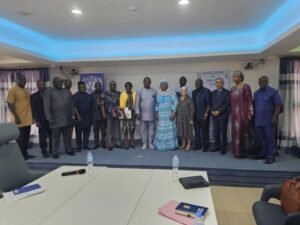
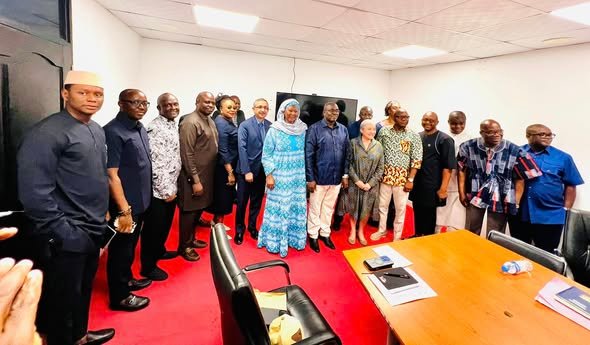
A high-level delegation of International Moral Guarantors on Wednesday, 15 April 2026, deepened ongoing efforts to sustain political dialogue and electoral reforms in Sierra Leone, holding strategic engagements with the Electoral Commission for Sierra Leone (ECSL), the National Civil Registration Authority (NCRA) and Members of Parliament from both the ruling and opposition benches.
The delegation, led by former Gambian Vice President, Fatoumata Jallow-Tambajang, included senior representatives from the United Nations, ECOWAS, the Commonwealth and other international bodies serving as guarantors of the 2023 Agreement for National Unity between the Government of Sierra Leone and the main opposition All People’s Congress (APC).
At the ECSL headquarters, the visiting team met with Chief Electoral Commissioner and Chairman, Edmond Sylvester Alpha, alongside fellow Commissioners, in a session focused on the progress of electoral governance reforms and preparations toward the 2028 general elections. Also present at the meeting was the Director General of the National Civil Registration Authority, Mohamed M. Massaquoi, whose institution remains central to voter registration and national identity management.
The meeting formed part of broader consultations by the Moral Guarantors aimed at assessing the implementation of the Tripartite Committee recommendations and the wider National Unity framework intended to strengthen trust in Sierra Leone’s democratic institutions.
In a parallel engagement at Parliament, the International Moral Guarantors met Members of Parliament from both the Government and Opposition benches, where discussions centered on the continued boycott of parliamentary proceedings by some opposition lawmakers and the implications for democratic governance.
The delegation commended Rt. Hon. Speaker Segepoh Solomon Thomas for what they described as his proactive mediation efforts in encouraging opposition MPs to return to Parliament and resume legislative business.
Speaking during the engagement, Madam Fatoumata Jallow-Tambajang described the visit as a continuation of previous consultations with Sierra Leone’s Parliament, noting that the delegation’s mission was to evaluate progress made on the implementation of the National Unity Agreement and to examine Parliament’s oversight role in advancing the peace process.
She emphasized that the team was equally interested in identifying any obstacles hindering the effective execution of the Agreement and ensuring that the spirit of compromise remains alive among all political stakeholders.
In his response, Speaker Segepoh Solomon Thomas welcomed the delegation and reaffirmed his support for the peace process, while clarifying that the National Unity Agreement had not yet been formally laid before Parliament, a development he said constrained the House from taking direct legislative action on it.
The Speaker stressed that Parliament, as an independent arm of Government, should not become entangled in disputes between the Executive and any political party. He revealed that he had already held two separate meetings with opposition MPs in a bid to facilitate their return, underscoring that Parliament remains the most appropriate platform for lawmakers to articulate concerns and hold the Executive to account.
He reminded Members that while they belong to political parties, their foremost responsibility is to represent the interests of their constituents.
Opposition Leader, Hon. Abdul Kargbo, praised the Speaker’s mediation initiatives, describing the engagements so far as productive. He explained that the opposition’s primary concern relates to the Constitutional Amendment Bill, alleging that some previously agreed positions between the two major political parties had been altered in the version currently before Parliament.
Hon. Abdul Kargbo, however, reiterated the opposition’s support for constitutional reform in principle, particularly welcoming the inclusion of a fixed election date in the proposed legislation. He called for strict adherence to the Tripartite Recommendations and renewed calls for the Agreement on National Unity and its recommendations to be formally tabled before Parliament to grant them full legal force.
He also urged the formal establishment of the Committee on Electoral Management Bodies, describing it as essential to rebuilding public confidence ahead of the 2028 elections.
On the Government side, Majority Leader and Leader of Government Business Hon. Mathew Nyuma said Parliament remains the supreme law-making institution and noted that all bills before the House, including the Constitutional Amendment Bill, remain open to amendments through parliamentary debate.
He maintained that elections should serve to consolidate democracy rather than deepen divisions, while cautioning that external political interference often complicates the smooth functioning of Parliament.
Hon. Mathew Nyuma further assured the delegation that Parliament has not acted in any way to undermine the Tripartite Agreement and joined calls for opposition MPs to end the boycott and return to legislative work.
In her closing remarks, Madam Fatoumata Jallow-Tambajang urged the opposition to embrace constructive engagement, stressing that meaningful representation often requires compromise. She warned that continued absence from Parliament would weaken the opposition’s ability to influence national decisions and effectively hold the Executive accountable.
The delegation also raised concerns over the pace of electoral preparations ahead of the 2028 polls, particularly regarding pending constitutional and security sector reforms.
Responding, Speaker Segepoh Solomon Thomas said progress was ongoing, pointing to both the Constitutional Bill and the Security Bill currently before Parliament. He noted, however, that the opposition’s absence had slowed inclusive deliberations on these key pieces of legislation.
He disclosed that President Julius Maada Bio had been kept informed of his engagements with the opposition and remained supportive of continued dialogue in the interest of peace, national cohesion and democratic stability.
The latest round of consultations underscores renewed international commitment to ensuring that Sierra Leone’s political actors remain engaged in dialogue, with the ultimate goal of safeguarding reforms, strengthening institutions and fostering consensus ahead of the next electoral cycle.