
By Amin Kef-Ranger
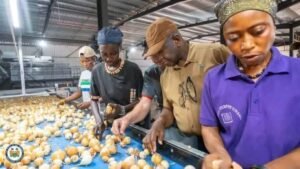
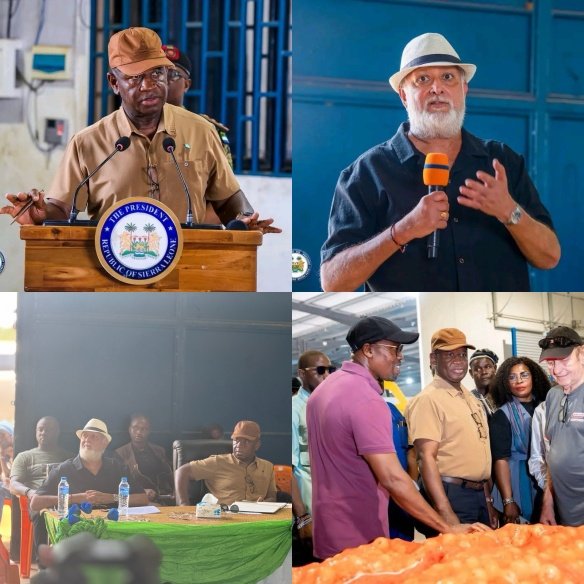
His Excellency President Julius Maada Bio on Thursday, 16 April 2026, undertook an inspection visit to the rapidly expanding Pee Cee Agriculture Limited, a subsidiary of Pee Cee Holdings Ltd onion farm and the company’s new state-of-the-art processing house in Mathene, Lokomasama Chiefdom, Lungi, Port Loko District, further underscoring Government’s commitment to boosting local food production under the Feed Salone initiative. The high-level visit formed part of broader efforts to assess large-scale private sector investments that are driving agricultural transformation, reducing dependence on imported onions and strengthening Sierra Leone’s food security agenda.
The visit enabled President Julius Maada Bio to personally assess the progress of the company’s onion cultivation project, its expanding storage capacity, employment impact and wider contribution to Sierra Leone’s agricultural self-sufficiency drive before concluding with an inspection of the company’s new state-of-the-art processing house. Residents, stakeholders and development observers described the visit as another strong demonstration of Government’s resolve to promote private sector-led agricultural growth, industrial value addition and sustainable economic expansion through strategic collaborations with local investors.
President Julius Maada Bio was accompanied by the Minister of Trade and Industry, Alpha Ibrahim Sesay, the Minister of Labour and Social Security, Mohamed Rahman Swaray, the Minister of Agriculture and Food Security, Dr. Henry Musa Kpaka, the Minister of Gender and Children’s Affairs, Dr. Isata Mahoi, as well as Presidential Spokesman Alpha Kanu. Also present were the Chairman of Pee Cee Holdings Ltd and Head of the Agricultural Project, Mahesh Nandwani, senior management officials, technical experts facilitating the onion cultivation programme, community stakeholders, traditional authorities and residents from nearby villages.
The programme commenced with prayers, after which an honourable son of the soil, Mohamed, formally welcomed President Julius Maada Bio and his entourage to the chiefdom. In introducing the dignitaries, Mohamed described Chairman Mahesh Nandwani as an exceptionally visionary and enterprising businessman whose decision to invest in large-scale onion production is already reshaping local livelihoods through job creation, food production and agro-industrial processing.
Speaking on behalf of the company, Chairman Mahesh Nandwani said the occasion symbolized productivity, innovation and confidence in Sierra Leone’s agricultural future. He expressed profound gratitude to President Julius Maada Bio for creating what he described as a conducive investment climate that inspired the company’s expansion into large-scale farming and agro-processing. Recounting his entrepreneurial journey from humble beginnings as a trader at age 16, Mahesh Nandwani described agriculture as one of the most strategic pathways for Sierra Leone’s economic transformation and long-term stability.
In his remarks, the Minister of Agriculture and Food Security, Dr. Henry Musa Kpaka, said the project has grown from a modest beginning into one of Sierra Leone’s most significant onion production hubs. He noted that the impact is already visible nationwide, with onions becoming more available and affordable on the local market. Dr. Henry Musa Kpaka emphasized that the Feed Salone initiative was deliberately designed with the private sector at the forefront, citing Pee Cee Agriculture’s shift from major importer to major local producer as a clear example of the transformation Government seeks to replicate.
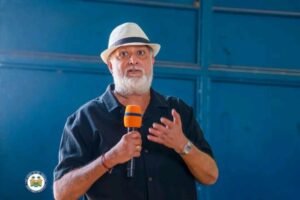
Addressing the gathering, President Julius Maada Bio consolidated his key message around food sufficiency, private sector leadership and community inclusion. He said he deliberately chose to inspect the farm because of its strategic importance to Sierra Leone’s food security and economic diversification agenda. Describing Pee Cee Agriculture Limited as an outstanding example of a successful public-private enterprise, he noted that investments in large-scale farming are drastically reducing the country’s dependence on imported onions while creating vital employment opportunities for surrounding communities.
President Julius Maada Bio emphasized that the Feed Salone programme is gaining momentum nationwide, with increased private sector participation playing a decisive role in driving productivity and strengthening food security. “We are scaling up rapidly and remain committed to partnering with more private sector actors to feed Salone,” he stated, adding that the initiative is already revolutionizing farming across Sierra Leone. He said his firsthand observation of the bustling Pee Cee Agriculture onion farm demonstrates how strategic partnerships with the private sector are transforming agriculture and stimulating rural livelihoods.
He further commended the community, especially the women, for embracing the enterprise and recalled that during his previous visit he had allocated 30 percent participation to them because of their active involvement. In a move that drew loud applause, President Julius Maada Bio announced an additional 30 percent allocation, reaffirming Government’s commitment to inclusive agricultural growth and women’s empowerment within productive sectors.
President Julius Maada Bio stressed that it is the private sector, not Government alone, that must actively drive agricultural and food production. He explained that the success of the initiative can serve as leverage for Sierra Leone to attract more international funding and support for similar investments. He also disclosed that his Government is promoting a “One Pot” vision in which products from various regions contribute to the national food basket, while citing his own involvement in fish, chicken and egg production as a practical example of the productive mindset he continues to encourage nationwide.
He further noted that in times of global uncertainty, including external shocks affecting fuel and commodity supply, national productivity remains the surest safeguard. According to President Julius Maada Bio, what may once have seemed impossible is now becoming possible, as Sierra Leone continues on a path of transformation marked by visible progress in agriculture, livestock and food systems resilience.
Earlier, Presidential Spokesman Alpha Kanu said the project is situated on his ancestral land and noted that the area has significantly opened up through strategic investment and development. He praised President Julius Maada Bio’s inclusive governance philosophy and thanked Chief Executive Officer Mahesh Nandwani for taking the bold step to invest in the locality, assuring him that additional land would be made available whenever expansion becomes necessary.
Providing operational evidence from the field, Deputy Farm Manager John Lahai Alieu disclosed that the project’s growth over the past four years has been transformational. He revealed that the storage facilities can now accommodate up to 2,000 tons of onions, significantly improving post-harvest preservation and market supply. From an initial pilot phase of five hectares, the farm has expanded to 70 hectares this year, with yields projected at 35 tons per hectare and future targets of 60 to 70 tons per hectare.
John Lahai Alieu further disclosed that after overcoming major soil and irrigation challenges through targeted investment, including an 80 million litre water reservoir, the company has significantly boosted productivity. He added that the project currently employs 250 workers, with the workforce rising to about 400 during peak periods, while the estimated value of machinery, structures and farm implements now stands at approximately US$2 million.
The visit climaxed with a field tour during which President Julius Maada Bio rode through sections of the onion farm on a tractor alongside the Minister of Agriculture and Food Security, Dr. Henry Musa Kpaka, closely observing the scale of cultivation, irrigation systems and storage infrastructure before proceeding to inspect the company’s new state-of-the-art processing house. The visit ended on a highly optimistic note, with Government officials, residents and company executives expressing confidence that Pee Cee Agriculture Limited will continue to stand as a national model for private sector-driven agriculture, industrial value addition, employment creation and long-term food self-sufficiency in Sierra Leone.