
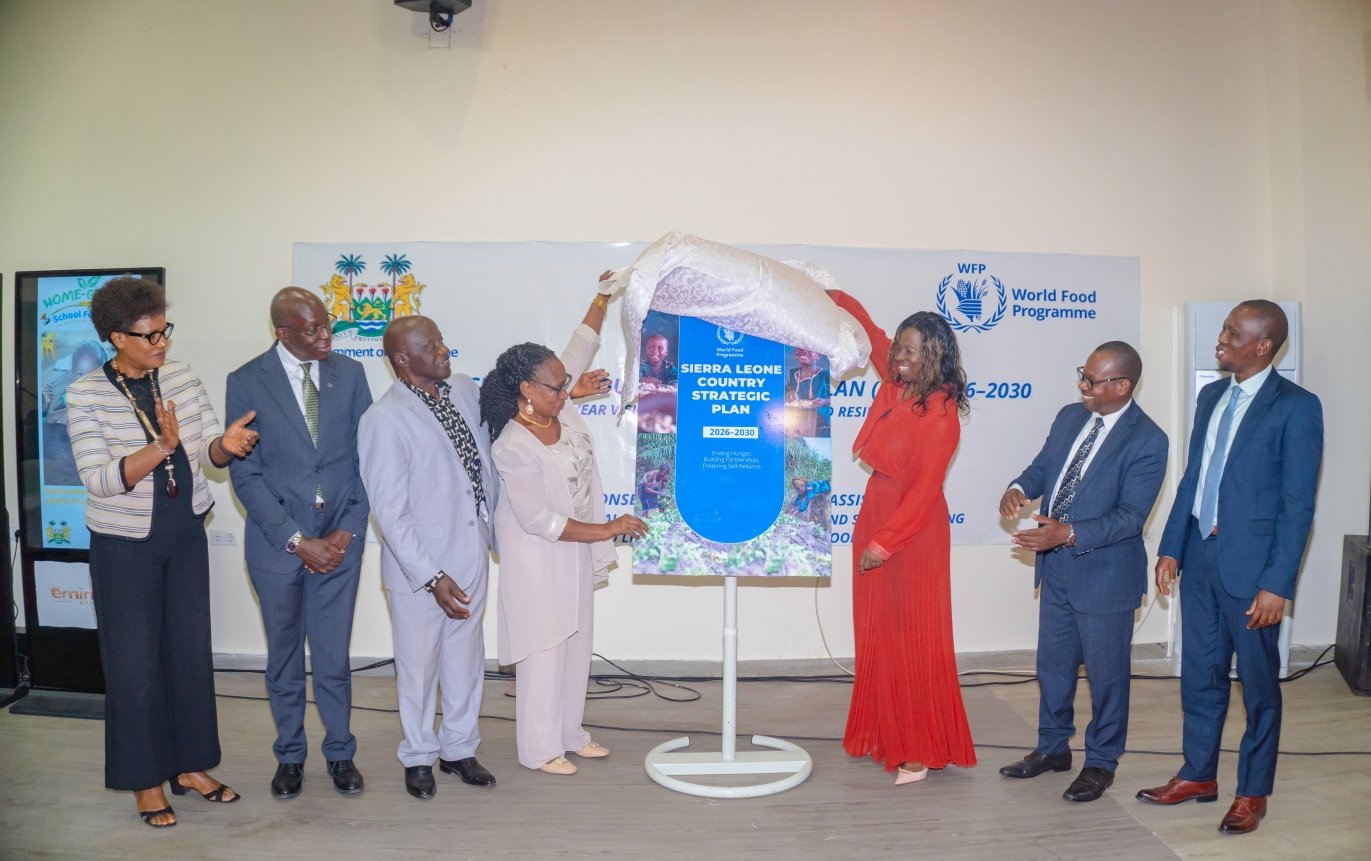
The Government of Sierra Leone, in partnership with the World Food Programme, has officially launched the WFP Country Strategic Plan 2026–2030, outlining a comprehensive roadmap aimed at strengthening food systems, improving nutrition and building resilience across the country.
The launch, held in Freetown, brought together senior Government officials, United Nations Heads of Agencies, development partners and representatives of Civil Society, underscoring food security as a central pillar of Sierra Leone’s national development agenda. The new plan aligns with the Medium-Term National Development Plan, the Feed Salone strategy and the United Nations Sustainable Development Cooperation Framework, reinforcing a coordinated approach to tackling food insecurity.
The Country Strategic Plan signals a shift from short-term food assistance to long-term systems strengthening, with a focus on three key outcomes: improved shock preparedness and response, increased access to safe, diverse and locally produced nutritious food, particularly for schoolchildren and vulnerable groups, and the development of resilient livelihoods supported by stronger local value chains.
Central to the plan is the expansion of home-grown school feeding, which integrates education, nutrition and local agricultural production. By sourcing food locally, the programme is expected to enhance learning outcomes while creating reliable markets for smallholder farmers, particularly women and young people. Speakers at the event emphasized that school feeding should be viewed not only as a social intervention but also as a strategic investment in human capital and economic growth.
Country Director of the World Food Programme, Andrew Odero, said the new strategic plan reflects lessons learned from previous programmes and responds to evolving realities. He noted that while food security indicators have improved in recent years, significant nutrition challenges persist, especially among children and rural households. He explained that the plan seeks to transform the trajectory of food security in Sierra Leone by linking nutrition, education, agriculture and livelihoods in a more integrated and sustainable manner.
Deputy Minister I of the Ministry of Basic and Senior Secondary Education, Emily Gogra, highlighted the importance of school feeding in supporting learning outcomes under the Free Quality School Education programme. She observed that although the programme has expanded access to education, hunger remains a major barrier to attendance, concentration and completion, stressing the need for sustained investment in school feeding initiatives.
The Ministry of Agriculture, represented by its Deputy Minister II, outlined progress made in promoting home-grown school feeding and local procurement, noting that an increasing share of food used in school meals is now sourced from Sierra Leonean farmers. Investments in aggregation systems, rice milling and value chain development are helping smallholder farmers, particularly women and youth, to access structured markets and improve their livelihoods. Officials described these developments as early but significant indicators that the country’s food systems are gradually becoming more predictable and sustainable.
United Nations Resident Coordinator, Seraphine Wakana, placed the Country Strategic Plan within a broader global and national context, noting that Sierra Leone continues to face climate shocks, economic pressures and global supply disruptions. She stressed that addressing these challenges requires stronger and more integrated systems rather than isolated interventions, adding that the plan reflects a wider shift within the United Nations system towards long-term resilience and coordinated action. She emphasized that national ownership remains central, with the United Nations playing a supportive and catalytic role.
Minister of Planning and Economic Development, Kenyeh Barlay, welcomed the plan as an important tool for aligning partners, mobilizing smarter financing and delivering measurable results. She noted that the success of the initiative will ultimately depend on effective implementation, particularly in ensuring that farmers can access markets, children receive nutritious meals consistently and communities become more resilient.
Looking ahead to 2030, the World Food Programme Country Strategic Plan 2026–2030 sets out a vision that goes beyond reducing hunger, aiming to build sustainable food systems that support education, livelihoods, resilience and inclusive economic growth for future generations.