

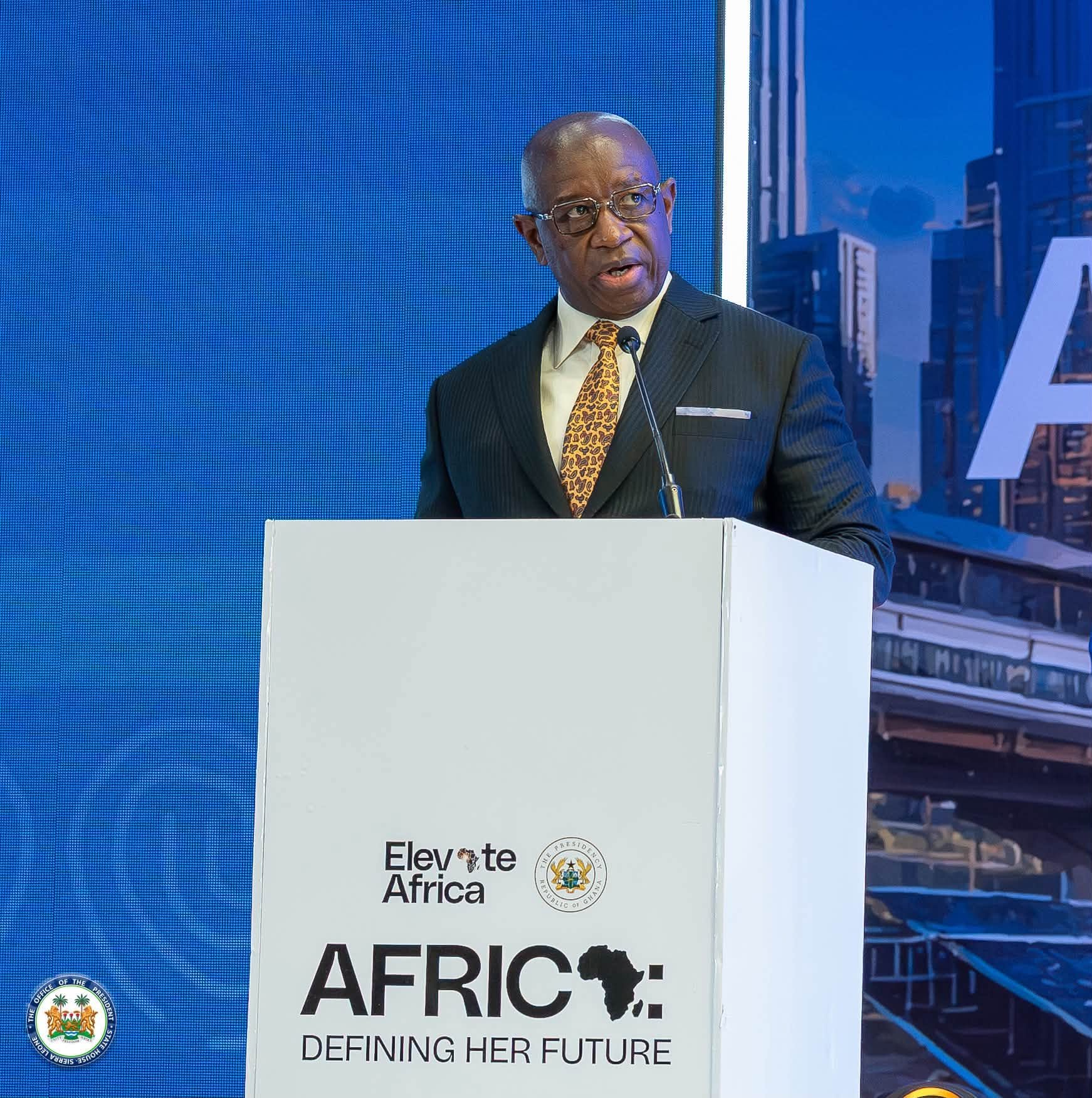
President Dr Julius Maada Bio has called for a fundamental transformation of Africa’s economic development strategy, urging African countries to strengthen their productive capacities, promote industrialization and negotiate international partnerships from a position of economic strength rather than continued dependence on foreign markets.
Delivering the keynote address at the Elevate Africa Convening 2 026 in Accra, Ghana, on Wednesday, 28 October 2026, President Bio challenged African leaders to translate political independence into meaningful economic sovereignty through investments in education, agriculture, manufacturing, innovation and regional trade.
Speaking on the theme, “Africa: Defining Her Future,” the President maintained that Africa must take greater responsibility for shaping its economic destiny by transforming its abundant natural resources into industries, employment opportunities and sustainable prosperity.
“Political independence gave us the authority to make our own decisions. True sovereignty requires the capacity to carry those decisions through,” President Bio declared.
He observed that Africa is experiencing a defining period characterized by shifting global economic relationships, increasing competition for natural resources, technological advancement and growing difficulties in accessing development financing.
According to him, those developments demand stronger African institutions, strategic leadership and the ability to negotiate international agreements that protect national interests while creating opportunities for citizens.
President Bio expressed concern that many African economies continue to depend heavily on exporting unprocessed minerals and agricultural commodities while importing manufactured products at considerably higher costs.
He argued that such economic arrangements limit industrial development, employment creation and the continent’s ability to retain greater value from its resources.
“Our resources must create industries, jobs and wealth for our people. That is how economic sovereignty becomes a reality,” he emphasized.
The President advocated increased investment in mineral processing, agricultural transformation, manufacturing and technological innovation, stressing that Africa must become an active producer and competitor in the global economy.
Drawing attention to Sierra Leone’s development priorities, President Bio highlighted the Free Quality School Education Programme, introduced in 2018, as a demonstration of his administration’s commitment to human capital development.
He maintained that access to education should not be determined by family income, emphasizing that investing in young people remains essential to building a productive and competitive economy.
He also referenced the Government’s Feed Salone initiative, describing agricultural development and food security as important components of economic independence.
According to the President, strengthening domestic food production would improve national resilience, create employment opportunities and reduce vulnerability to external economic disruptions.
He stressed that meaningful sovereignty requires Governments to translate development priorities into practical policies, adequate budgetary allocations and institutional actions capable of improving citizens’ living conditions.
Turning to continental economic integration, President Bio called for stronger implementation of the African Continental Free Trade Area, arguing that regional cooperation must deliver tangible benefits for businesses, entrepreneurs and ordinary citizens.
He said African countries should eliminate unnecessary trade barriers, improve market accessibility and create an environment that enables businesses to expand beyond national borders.
“I want to see a business in Freetown able to trade with customers in Accra without unnecessary obstacles,” he stated.
President Bio insisted that Africa’s economic integration should be assessed through increased commercial opportunities, stronger enterprises and improved employment prospects rather than the number of agreements signed or conferences organized.
Addressing leadership and accountability, he challenged participants to ensure that discussions at the convening resulted in practical commitments supported by adequate financing, implementation strategies and measurable outcomes.
“Before we leave Accra, let each of us identify one commitment we are prepared to finance, implement and account for,” he urged.
He encouraged political leaders, investors and development stakeholders to prioritize initiatives capable of expanding educational opportunities, strengthening African businesses and removing obstacles to regional commerce.
“Let Accra be remembered for what we began here, not simply for what we said here,” President Bio added.
Reflecting on Sierra Leone’s experience of civil conflict and post-war recovery, the President underscored the importance of peace, justice, constitutional governance and accountable institutions in sustaining national development.
He warned that economic progress could not be guaranteed without political stability, respect for democratic institutions and peaceful mechanisms for resolving disagreements.
“Peace gives development a chance to succeed. Strong institutions give that progress a chance to last,” he remarked.
President Bio further maintained that Africa’s development must be anchored in institutions capable of sustaining national priorities beyond the tenure of individual political leaders.
“A leader’s greatest legacy is a country that continues to make progress after that leader has left office,” he stated.
The President also called for greater inclusion of young Africans in leadership, entrepreneurship, innovation and national decision-making, arguing that the continent cannot realize its full potential while limiting opportunities for its youthful population.
“We cannot continue calling them the leaders of tomorrow while denying them opportunities to lead today,” he declared.
In a personal reflection, President Bio recalled the sacrifices of his late mother, Yei Amie, whose commitment to education, hard work and integrity helped create opportunities for her children despite limited resources.
He used her experience to illustrate the importance of making responsible decisions that benefit future generations.
During the opening ceremony, First Lady, Fatima Bio, also advocated stronger investment in women’s empowerment, emphasizing that Africa’s advancement depends significantly on expanding opportunities for women.
Concluding his address, President Bio challenged African leaders to demonstrate their commitment through practical achievements rather than declarations.
“They will not remember every speech we delivered or every declaration we signed. They will remember what changed because we had the opportunity to lead,” he affirmed.
His message reinforced the importance of economic sovereignty, industrial transformation, regional integration, accountable governance and inclusive development in determining Africa’s future.