

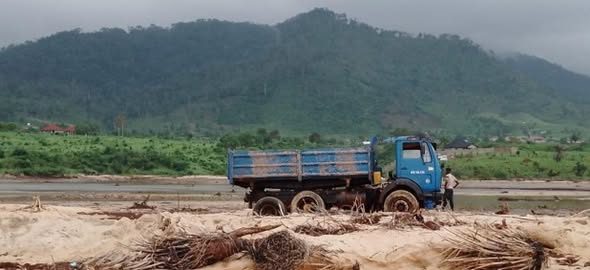
A World Bank-supported assessment has revealed growing environmental destruction, economic losses and serious regulatory weaknesses associated with sand mining in Sierra Leone, warning that continued extraction from vulnerable coastal areas could further undermine the country’s tourism industry, threaten biodiversity and expose coastal communities to increasing environmental hazards.
The findings, highlighted by the Sierra Leone Urban Research Centre (SLURC), are contained in a March 2026 report titled: “Assessment of the Scale and Impact of Sand Mining on Select Tourism and Coastal Communities in Sierra Leone.” The study calls for urgent Government intervention, including the adoption of a comprehensive national sand mining policy, stronger enforcement measures, improved transportation systems and sustainable alternatives to environmentally destructive extraction.
According to SLURC, although Sierra Leone’s overall demand for sand and gravel remains relatively modest by international standards, the environmental and economic consequences of existing extraction practices are disproportionately severe.
The report examines sand mining activities along the Western Area Peninsula and the Mahera–Lungi corridor, two strategically important coastal areas that accommodate tourism facilities, expanding settlements, commercial activities and environmentally sensitive ecosystems.
Those locations are particularly significant because they include communities surrounding the nation’s capital, Freetown, as well as the country’s principal international aviation gateway and an emerging tourism corridor.
The assessment identifies coastal erosion, biodiversity loss and the deterioration of tourism infrastructure among the most troubling consequences of poorly regulated sand extraction.
Findings presented during Sierra Leone’s Go Circular Week in April 2026 further illustrated the seriousness of the situation.
According to figures presented by Braima M. Koroma, Director of Research at SLURC, an estimated 1.25 million cubic metres of sand are extracted annually from the affected coastal areas.
Researchers also reported average shoreline retreat of approximately 53 metres since 2000, highlighting the growing vulnerability of coastal settlements and tourism infrastructure. However, shoreline changes are influenced by several factors, including climate change, natural coastal processes and human activities.
The assessment examined locations including John Obey, Lakka, Hamilton and Mahera Beach, where sand mining continues to support construction activities and provide income for local residents despite its environmental consequences.
Particularly concerning were findings presented during the April discussions indicating that approximately 60 percent of hotels along the Lakka–Hamilton corridor had reported structural damage associated with coastal erosion.
Such developments raise questions about the long-term sustainability of tourism investments in areas where beaches and coastal landscapes constitute major economic attractions.
The World Bank’s Global Sector Lead for Tourism, Louise Twining-Ward, also raised concerns during the engagement about the consequences of continued sand mining for tourism development along the Freetown Peninsula and Mahera corridor.
Beyond the immediate damage to tourism facilities, uncontrolled extraction can weaken natural coastal barriers, increase exposure to flooding and contribute to the destruction of habitats that support marine life and fishing communities.
The study also identifies serious inefficiencies within Sierra Leone’s sand supply chain.
One of its most striking findings is that transportation accounts for between 50 and 85 percent of the delivered price of sand, making logistics a major factor influencing construction costs and the choice of building materials.
This means that a substantial proportion of what consumers pay for sand is associated with moving the material from extraction sites to construction locations rather than the value of the resource itself.
According to the assessment, those high transportation costs reinforce inefficient sourcing practices and complicate efforts to introduce more sustainable construction materials.
The report consequently argues that Sierra Leone’s principal challenge is not necessarily a shortage of sand but weaknesses in governance, transportation, regulation and spatial planning.
Another major concern highlighted by SLURC is the country’s prolonged failure to establish an effective national policy framework governing sand extraction.
The organisation disclosed that Sierra Leone’s initial response to the problem included the drafting of a National Sand Mining Policy in 2016, which, according to the March 2026 assessment, had still not been formally adopted.
The delay has raised concerns about the country’s capacity to regulate extraction activities, protect environmentally sensitive locations and establish clear responsibilities among institutions involved in managing natural resources.
Without an effective policy framework, monitoring extraction sites, enforcing environmental standards and ensuring accountability remain difficult.
The World Bank-supported assessment therefore recommends updating, adopting and implementing a national sand mining policy supported by practical enforcement mechanisms.
It also calls for stronger spatial planning to identify suitable extraction locations while protecting beaches, tourism facilities, coastal settlements and ecologically sensitive areas from further degradation.
Improving the availability of sustainably sourced construction materials is another important recommendation.
The report encourages the exploration of alternative building materials and more efficient transportation arrangements that could reduce pressure on coastal sand deposits without unnecessarily increasing construction costs.
Such reforms would require cooperation among Government Ministries, environmental regulators, local authorities, construction companies, transport operators and communities involved in the sand trade.
However, the study acknowledges that sand mining also represents an important source of employment and household income.
In several coastal communities, residents depend on sand extraction, transportation and trading to support their families, particularly where alternative livelihood opportunities remain limited.
Consequently, restricting harmful extraction practices without providing viable economic alternatives could create additional hardship for already vulnerable households.
To address that challenge, the assessment recommends a just transition that combines environmental protection with alternative employment opportunities, appropriate fiscal measures and support for affected communities.
That approach seeks to ensure that efforts to protect Sierra Leone’s coastline do not disproportionately burden those whose livelihoods depend on the existing sand economy.
The findings come at a time when Sierra Leone is pursuing greater investment in tourism, infrastructure and economic diversification.
In September 2026, the World Bank reported that activities under the Sierra Leone Economic Diversification Project had contributed to more than 35,000 direct and indirect jobs while helping to leverage over US$92 million in private investment.
Protecting the country’s beaches and coastal attractions is therefore increasingly important to sustaining tourism-related employment and attracting further investment.
Community-led environmental protection efforts have also gained attention.
In October 2026, eight communities along the Western Area Peninsula endorsed a coastal conservation declaration aimed at strengthening environmental protection, community monitoring and cooperation with relevant authorities.
The initiative identified illegal sand mining, pollution, poor waste management and climate-related threats among the challenges confronting coastal communities.
For SLURC, the findings reinforce the urgency of translating research and policy recommendations into practical measures capable of reversing environmental degradation.
In drawing attention to the assessment, the organisation emphasized that the time for action is now, urging greater attention to sand mining, coastal erosion, sustainable development and environmental protection.
The report’s broader message is that sand and gravel remain essential resources for Sierra Leone’s development, supporting the construction of homes, roads, public infrastructure and tourism facilities.
As urbanization accelerates and demand for construction materials increases, policymakers face the challenge of ensuring adequate supplies without sacrificing the country’s fragile coastal ecosystems.
The assessment stresses that addressing those competing demands requires coordinated Government action, responsible private-sector participation and meaningful engagement with communities directly affected by sand extraction.
It also highlights the importance of evidence-based planning, improved monitoring of supply chains and stronger institutional cooperation.
Ultimately, the World Bank-supported study presents Sierra Leone with a pressing policy challenge: how to balance the construction industry’s growing demand for sand with the urgent need to protect beaches, preserve biodiversity, safeguard tourism investments and secure sustainable livelihoods for coastal communities.
With a national sand mining policy drafted a decade ago but still awaiting adoption as of the March 2026 assessment, the findings add weight to calls for decisive reforms before further environmental damage imposes even greater economic and social costs on the country.