By Kemo Cham
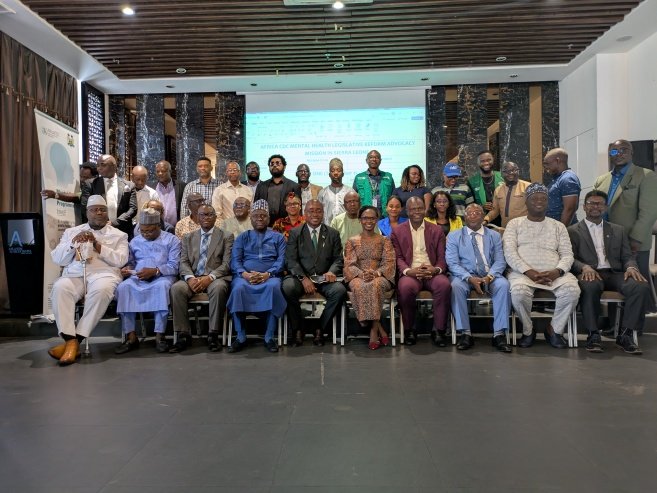
The Africa Centres for Disease Control and Prevention (Africa CDC) has intensified advocacy efforts in Sierra Leone with a high-level stakeholders’ meeting on Monday, September 15, 2025 in Freetown, calling for urgent action to pass the long-delayed Mental Health Bill. The initiative is designed to replace the country’s colonial-era Lunacy Act of 1902 with a modern legal framework aligned with international human rights standards and best practices in mental health care.
Sierra Leone’s draft Mental Health Bill has been under development since 2011, spearheaded by the Ministry of Health (MoH) with support from the Mental Health Coalition of Sierra Leone and other advocacy groups. For more than 15 years, campaigners and policymakers have debated the legislation, but progress has been slow. The bill now sits before Parliament, awaiting deliberation.
Experts and stakeholders argue that passing the bill is critical to transforming mental health services in Sierra Leone, a country where stigma, cultural beliefs and outdated laws continue to limit access to care. The Lunacy Act, inherited from the British colonial administration, uses derogatory language and provisions that allow the confinement of patients in asylums without proper safeguards.
“This law is over a century old and no longer fit for purpose,” said Joshua Abioseh Duncan, Country Director of the Mental Health Coalition of Sierra Leone. “We cannot continue to treat our citizens under a law that denies their dignity and human rights. This engagement is an opportunity to finally move forward.”
The stakeholders’ meeting was convened as part of a three-day mission by the African Union’s High-Level Committee on Mental Health. The delegation was led by Dr. Mohammed Abdulaziz, Head of the Division of Disease Control and Prevention at Africa CDC, who underscored the importance of legal reform as a foundation for building resilient health systems across the continent.
Dr. Mohammed Abdulaziz told participants that modernizing mental health laws is central to achieving the African Union’s Agenda 2063, the continental development blueprint.
“It is the hope of the Africa CDC that all outdated laws in the space of mental health are updated,” he said. “African Union Agenda 2063 cannot be attained without modern laws. Mental health must receive the same attention as other public health issues if we are to reduce the burden of disease and disability on the continent.”
The engagement in Freetown took place at the Atlantic Lumley Hotel in Aberdeen and brought together officials from the Ministry of Health, Members of Parliament, advocacy groups, international experts and representatives from neighboring countries such as The Gambia, who were invited to observe and learn from the reform process.
One of the highlights of the meeting was the sharing of experiences from other African countries that have enacted modern mental health legislation. Nigeria, Kenya and Zimbabwe were represented by lawmakers and mental health experts who have played key roles in their national reform processes.
Professor Taiwo Lateef Sheikh, a Nigerian psychiatrist and member of the Africa CDC Advisory Board on Non-Communicable Diseases, warned of the dangers of retaining outdated legislation.
“Many of these colonial laws were already outdated when they were transplanted into Africa,” he explained. “They use degrading terms like ‘lunacy’ and make it legal for patients to be locked away and forgotten. This has fueled decades of neglect and underfunding for mental health services.”
Prof. Taiwo Lateef Sheikh noted that while mental health accounts for around 5% of the disease burden in Africa, it is responsible for 19% of disabilities, making it one of the most pressing but overlooked health challenges. Yet, in most countries, 95% of people needing mental health services do not receive them.
“There is no vaccine for mental health, so nobody is immune,” he cautioned.
Lawmakers from Kenya and Zimbabwe shared stories of overcoming political resistance, stigma and legislative bottlenecks to secure the passage of their mental health bills. These case studies, according to Sierra Leonean campaigners, provide valuable lessons for navigating similar obstacles at home.
Recognizing the pivotal role of Parliament, the Africa CDC ensured that Sierra Leonean lawmakers were at the heart of the discussions. The meeting was attended by Hon. Abdul Kargbo, Minority Leader, and Hon. Kekura Vandi, representing the majority leadership and Parliamentary Committee on Energy. Both pledged their commitment to ensuring the bill’s swift passage and securing greater budget allocations for mental health services.
Hon Abdul Kargbo stressed that failure to reform Sierra Leone’s mental health laws could have dangerous consequences.
“Without reform, Sierra Leone risks repeating the mistakes of the past, including mental health-related issues that contributed to our civil war,” he said.
Hon. Kekura Vandi added that mental health is an issue that affects every family in Sierra Leone.
“Passing this bill should be straightforward, because every Sierra Leonean is either directly or indirectly affected by mental health challenges,” he said.
The Ministry of Health has been leading the process through its Directorate of Mental Health and Non-Communicable Diseases, headed by Dr. Abdul Jalloh, an African Union Global Health Leadership Fellow. Dr. Abdul Jalloh explained that the new bill will not only modernize Sierra Leone’s legal framework but also bring it into alignment with World Health Organization (WHO) recommendations.
“The draft legislation, when passed, will protect the rights of patients, standardize care in facilities and end degrading treatment,” Dr. Abdul Jalloh said.
He pointed to recent progress at the Sierra Leone Psychiatric Teaching Hospital, the country’s only specialized mental health facility, which has undergone major reforms under his leadership. Once described as a “torture chamber,” the hospital is now transitioning into a facility focused on modern, humane care.
The event was also attended by Deputy Chief Medical Officer for Public Health, Dr. Alie Wurie and Deputy Minister of Health, Dr. Charles Senesie. Dr. Senesie reaffirmed the Government’s commitment to passing the bill and placing mental health at the top of the health agenda.
“We have faced war, Ebola, Covid-19 and now Mpox – all of which left deep mental scars,” he said. “This Government is firmly committed to ensuring that the Mental Health Bill becomes law.”
Beyond legal reform, stakeholders emphasized the importance of combating stigma and changing cultural attitudes. Mental health remains a highly stigmatized issue in Sierra Leone, with patients often hidden from public view or treated with traditional practices rather than medical care.
Campaigners believe that a modern law, backed by political will and adequate resources, will help break this cycle. They argue that updating the legal framework is not just a matter of health policy but also of human rights and social justice.
For many in attendance, the Africa CDC’s involvement marked a turning point. By aligning Sierra Leone’s efforts with the African Union’s broader mental health strategy, campaigners hope the country can finally overcome years of delay.
The next steps include continued engagement with Parliament, public awareness campaigns and sustained technical support from Africa CDC and other international partners.
As Prof. Sheikh reminded participants, the stakes could not be higher:
“Mental health is everyone’s business. If we fail to act, the consequences will be felt in every family, every community and across the nation.”
With momentum building, Sierra Leone has an opportunity to move beyond its colonial past and embrace a modern, rights-based approach to mental health; one that places dignity, access and care at the center of public health policy.