
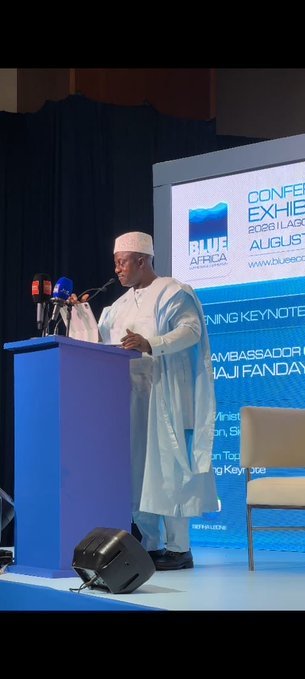
Sierra Leone’s Minister of Transport and Aviation, Ambassador Alhaji Fanday Turay, Esq., has called on African countries to transform their oceans, ports, fisheries and maritime resources into engines of sustainable economic growth, employment and shared prosperity.
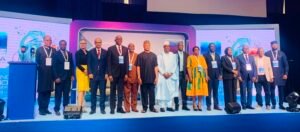
Ambassador Alhaji Fanday Turay made the appeal while addressing the Blue Africa Conference and Exhibition held in Lagos, Nigeria, from 13 to 14 August 2026. The conference brought together Government Ministers, representatives of the African Union and regional institutions, development partners, investors, industry leaders and members of the media.
He reaffirmed Sierra Leone’s commitment to developing a sustainable Blue Economy capable of generating jobs, strengthening regional trade and creating opportunities for African businesses.
“We must move from potential to production, policy to implementation and raw resources to African value,” Ambassador Alhaji Fanday Turay said. “The ocean that separates our shores must become the highway that connects our prosperity.”
The Minister commended the Government and people of Nigeria and the conference organizers for providing a platform to discuss the future of Africa’s oceans, seas, rivers and lakes.
Describing Africa as a “Blue Continent,” Ambassador Alhaji Fanday Turay said its oceans, coastlines and inland waterways are major economic assets supporting international trade, food security, livelihoods, biodiversity, energy production and access to global markets.
He noted that the global ocean economy is estimated at approximately US$1.5 trillion annually and could reach about US$3 trillion by 2030. Africa, he stressed, must position itself to secure a greater and more sustainable share of that expanding economic opportunity.
According to Ambassador Alhaji Fanday Turay, Sierra Leone is well placed to benefit from the Blue Economy because of its long Atlantic coastline, productive fisheries and Freetown’s natural harbour.
He said those assets could enable the country to become an important maritime and logistics gateway in West Africa. However, he maintained that Sierra Leone’s ambition must extend beyond merely operating a port.
“We must build a maritime economy around the port,” Ambassador Alhaji Fanday Turay stated.
He disclosed that Sierra Leone is pursuing reforms aimed at modernizing and digitizing its maritime and transport sectors. The Government’s priorities include improving port infrastructure and operational efficiency, strengthening maritime safety and security, expanding digital logistics, enhancing regional connectivity, developing professional skills and protecting the environment.
Ambassador Alhaji Fanday Turay observed that maritime transport remains Africa’s principal gateway to international markets, but the continent’s participation in global shipping and maritime trade remains disproportionately low.
He said Africa has, for decades, exported commodities through its ports while much of the value generated from shipping, logistics, processing, insurance, technology and other maritime services has been created outside the continent.
“Africa must create and retain more of that value. Our ports must become centres of production, logistics and value addition,” he emphasized.
The Minister also called for greater cooperation among African ports, arguing that no port on the continent could achieve its full potential in isolation. He said the future must be built around connected African ports, integrated markets and stronger regional economies.
Ambassador Alhaji Fanday Turay identified the African Continental Free Trade Area as a historic opportunity to strengthen those connections. Efficient ports and maritime transport systems, he said, could help translate the trade agreement into increased production, commerce and employment across Africa.
He stressed that infrastructure development must be accompanied by sustained investment in human capital. African young people, he said, must receive the training and opportunities required to participate meaningfully in the global ocean economy.
The Minister called for the training of more African seafarers, marine engineers, port managers, logistics specialists, fisheries experts, maritime professionals and entrepreneurs. He also urged Governments to expand opportunities for women and strengthen partnerships among educational institutions, public authorities and the private sector.
“Our success must ultimately be measured by the African jobs, African businesses and African opportunities our Blue Economy creates,” Ambassador Alhaji Fanday Turay said.
Turning to fisheries, the Minister said the sector provides food, income and livelihoods for millions of Africans. He warned, however, that illegal, unreported and unregulated fishing continues to threaten national economies, coastal communities and marine resources.
He advocated stronger regional cooperation in surveillance, monitoring and enforcement, alongside greater investment in aquaculture, cold-storage facilities, processing and distribution. Such investments, he explained, would ensure that more of the value generated by Africa’s fisheries remains on the continent.
Ambassador Alhaji Fanday Turay further stressed that economic development must not come at the expense of the marine environment. He cited pollution, coastal erosion, climate change and unsustainable exploitation as serious threats to the natural resources upon which Africa’s future prosperity depends.
“Economic growth that destroys the ocean is not a Blue Economy. Our economic ambition must therefore go hand in hand with environmental responsibility,” he stated.
The Minister declared that the period of merely discussing Africa’s Blue Economy potential must give way to practical implementation. He said Governments could not finance the required transformation alone and called for partnerships with development finance institutions, commercial banks, investors, private businesses and international development organisations.
He also underscored the need for effective governance, regulatory certainty and credible, bankable projects in ports, maritime infrastructure, fisheries, digital systems, coastal resilience and sustainable ocean industries.
“Africa does not lack blue potential. What we need are investment-ready projects capable of converting that potential into prosperity,” Ambassador Alhaji Fanday Turay said.
He announced that Sierra Leone is seeking investment and collaboration in port modernization, maritime logistics, digitalization, maritime safety and security, fisheries infrastructure, skills development and environmentally sustainable ocean-based industries.
Ambassador Alhaji Fanday Turay concluded by calling on African countries to move from fragmented markets to integrated maritime corridors and from exporting raw resources to creating value within the continent.
He reaffirmed Sierra Leone’s readiness to work with Nigeria, the African Union, other African countries, development partners and the private sector to build efficient ports, safe waters, productive fisheries and thriving maritime businesses.
“Together, let us transform Africa’s blue potential into African jobs, African enterprise and African prosperity,” Ambassador Alhaji Fanday Turay declared.