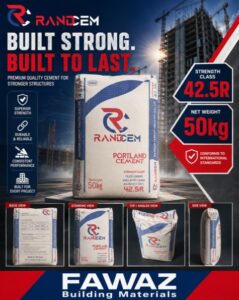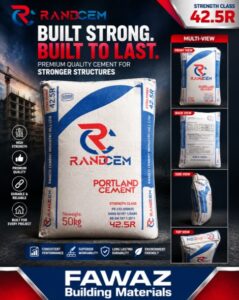

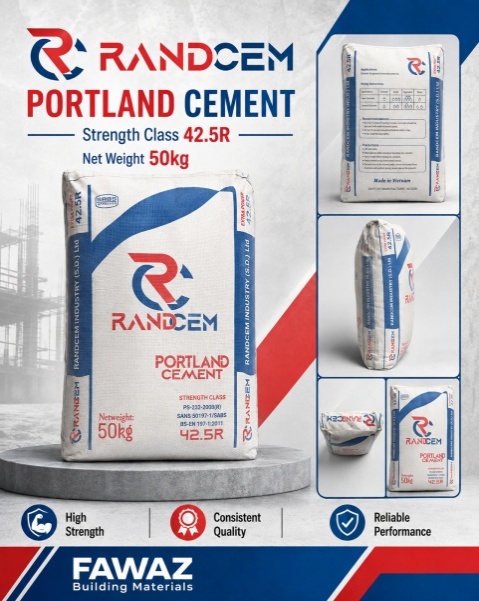
Sierra Leone’s growing investment in housing, commercial facilities and public infrastructure has increased the need for dependable building materials. Responding to this demand, FAWAZ Building Materials is promoting RANDCEM 42.5R Cement as a reliable product for contractors, engineers, developers, masons and homeowners.
Construction activity continues to expand across the country, with new houses, schools, hospitals, offices, shopping centres and other major projects taking shape. This development has renewed public attention on structural safety and the importance of choosing cement that delivers consistent results.
Manufactured in Vietnam, RANDCEM Cement is supplied in 50-kilogram bags and classified under Strength Class 42.5R. The product is designed for general concrete and masonry work, making it suitable for foundations, columns, beams, floors, concrete blocks and other important building components.
FAWAZ Building Materials says RANDCEM Cement provides the consistency required for residential, commercial and public infrastructure projects. Its strength classification makes it a practical choice for customers seeking both durability and value for their investments.
One of the product’s recognized features is its early-setting performance. Under suitable working conditions, RANDCEM Cement reportedly begins setting within approximately 30 minutes. This can assist builders in organizing their work efficiently, particularly on projects where time and productivity are important.
The company has stressed, however, that early setting requires proper planning at the construction site. Sand, aggregate, water and other materials should be prepared before mixing begins, while the concrete must be placed and compacted without unnecessary delay.
Construction professionals have repeatedly cautioned that quality cement must be combined with sound engineering and responsible workmanship. A safe structure depends on several factors, including approved designs, strong foundations, clean sand, appropriate aggregates, correct water measurements, proper reinforcement and professional supervision.
For ordinary concrete work, a general mixture of one part cement, two parts sand and four parts aggregate may be used, with water carefully controlled. Lean concrete may require one part cement, three parts sand and six parts aggregate. However, builders are advised to follow project-specific instructions provided by qualified engineers.
The volume of water added to any concrete mixture must also be carefully managed. Excessive water may weaken the concrete, increase shrinkage and contribute to cracking. Poor measurements of sand or aggregate can similarly reduce the quality and long-term performance of a structure.
Curing remains an essential part of construction and should not be neglected. Newly cast concrete surfaces must be kept sufficiently moist during the early stages of development, particularly within the first few days. Proper curing helps concrete achieve the required strength and protects it from premature damage.
RANDCEM Cement’s growing presence in Sierra Leone reflects changing attitudes among consumers. Many contractors and property owners are now looking beyond the immediate price of cement and considering consistency, structural performance, safety and long-term value.
Proper storage is equally important in maintaining the product’s condition. Cement bags should be kept in a dry, covered and well-ventilated location. They should be raised above the floor and protected from rain, groundwater, leaking roofs and damp walls.
Opened bags should preferably be used within seven days. Where this is not possible, the remaining cement must be tightly sealed and protected from exposure to moisture and air, which can affect its quality and performance.
Workers handling RANDCEM Cement are encouraged to observe basic health and safety measures. Gloves and face masks should be worn to reduce exposure to cement dust, while safe lifting procedures should be followed when carrying the 50-kilogram bags. The product must also be kept beyond the reach of children.
Public concern over building collapses has further highlighted the need for stronger regulation and enforcement within Sierra Leone’s construction industry. Structural failures may result from several problems, including defective designs, inferior materials, weak foundations, poor mixing practices and inadequate professional supervision.
Stakeholders have consequently urged the Sierra Leone Standards Bureau and other responsible institutions to strengthen market inspections and laboratory testing. Regular monitoring of importers, distributors and retailers would help ensure that cement products meet the required standards before reaching consumers.
Stronger enforcement would also protect customers from substandard materials, encourage fair competition among suppliers and promote greater accountability throughout the construction sector.
FAWAZ Building Materials says its distribution of RANDCEM 42.5R Cement reflects the company’s broader commitment to supplying products that contribute to Sierra Leone’s development. The company continues to focus on quality, customer confidence and dependable service.
With its 42.5R strength classification, early-setting properties and suitability for different building applications, RANDCEM Cement is establishing itself as a competitive option in the country’s construction market.
Sierra Leone’s development ambitions will ultimately depend on structures that are professionally designed, properly supervised and built with tested materials. By supplying RANDCEM 42.5R Cement, FAWAZ Building Materials is supporting builders and property owners in delivering projects designed to remain strong, safe and durable for generations.