

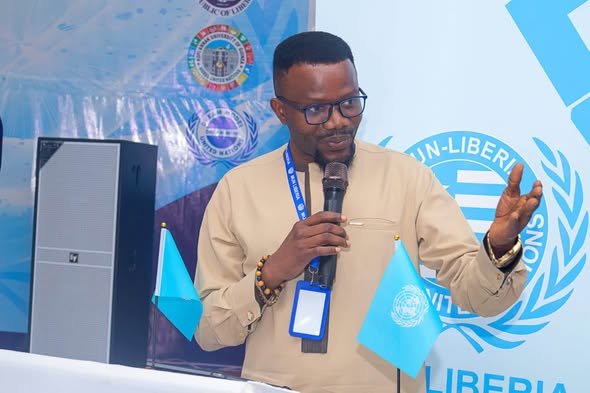
Prominent Sierra Leonean academic, entrepreneur and chartered accountant, Professor Ezekiel Kalvin Duramany-Lakkoh, has concluded a significant visit to Monrovia, Liberia, where he promoted stronger academic partnerships, collaborative research, postgraduate education and youth participation in Africa’s development.
Professor Duramany-Lakkoh, Deputy Vice Chancellor of the Institute of Public Administration and Management (IPAM), participated in four major engagements during the visit: the West Africa Academic Leadership Meeting, a partnership meeting with the Liberian Institute of Public Administration (LIPA), a partnership and Memorandum of Understanding review meeting with African Methodist Episcopal University (AMEU) and the sixth session of Model United Nations Liberia 2026.
Reflecting on the visit, Professor Duramany-Lakkoh said the engagements provided an important platform for discussing academic leadership, institutional cooperation, research opportunities and the role of young Africans in shaping the continent’s future.
The West Africa Academic Leadership Meeting brought together academic and institutional leaders to exchange ideas on strengthening higher education across the sub-region. Discussions centred on how universities and other academic institutions could collaborate to address emerging challenges and expand opportunities for students, researchers and professionals.
Professor Duramany-Lakkoh said participants placed particular emphasis on joint consultancy and research initiatives through which institutions could combine their expertise, resources and professional networks to conduct studies aligned with West Africa’s development priorities.
The meeting also explored the establishment of joint doctoral programmes. According to Professor Duramany-Lakkoh, collaborative PhD programmes could deepen institutional relationships, strengthen regional research capacity and enable scholars to pursue advanced studies within a more integrated West African higher education system.
He maintained that African academic institutions must move away from working in isolation and develop sustainable partnerships that promote knowledge exchange, academic mobility and cross-border research.
Professor Duramany-Lakkoh’s meeting with the Liberian Institute of Public Administration focused on strengthening institutional cooperation and identifying practical areas in which the two institutions could work together.
Discussions covered joint consultancy, research and professional capacity development, particularly in governance, leadership and public administration.
He noted that higher education institutions and public-sector organisations possess complementary strengths that could be combined to address governance and development challenges confronting African countries.
Professor Duramany-Lakkoh also participated in a partnership and MoU review meeting with African Methodist Episcopal University. The meeting assessed existing areas of cooperation and considered new opportunities to expand academic and research collaboration.
The discussions examined potential joint research projects, consultancy services and postgraduate programmes, including the possibility of developing joint PhD programmes.
Professor Duramany-Lakkoh stressed that institutional partnerships must go beyond ceremonial agreements and produce measurable benefits for students, academics, professionals and communities.
He said the meetings with LIPA and AMEU demonstrated the willingness of regional institutions to pursue sustainable relationships capable of generating meaningful academic and professional outcomes.
One of the major highlights of the visit was Professor Duramany-Lakkoh’s appearance as guest speaker at the opening of Model United Nations Liberia 2026 in Monrovia.
Addressing participants, he challenged young Africans to look beyond national boundaries and embrace opportunities to learn, compete, collaborate and build professional networks across the continent.
He encouraged young professionals to take greater responsibility for Africa’s development by becoming innovators, entrepreneurs, decision-makers and builders of strong institutions.
Professor Duramany-Lakkoh acknowledged the importance of understanding Africa’s colonial history but urged young people to focus more attention on practical actions that could improve the continent’s present and future.
He argued that Africa must build productive economies, improve regional integration and strengthen institutions capable of providing education, entrepreneurship and dignified employment opportunities.
“To avoid migration issues, we must build economies that create opportunities. If we strengthen institutions, invest in education and entrepreneurship, improve regional integration and create dignified employment, migration becomes a choice, not a survival strategy,” he stated.
Professor Duramany-Lakkoh said meaningful investments in young people could help countries retain their talent and enable African youth to contribute effectively to national and regional development.
More than 1,000 participants attended the two-day MUN-Liberia 2026 conference, which was organized to expose young people to diplomacy, international relations, negotiation, leadership and collaborative problem-solving.
The gathering included 250 delegates from different countries who participated in six specialized committees: the United Nations Security Council, UN Women, UNICEF, the United Nations Development Programme, the United Nations Framework Convention on Climate Change and the United Nations Population Fund.
Professor Duramany-Lakkoh described the scale and diversity of participation as evidence of the growing interest among young Africans in leadership and international affairs.
He said platforms such as MUN-Liberia enable young people to acquire practical skills, exchange ideas and interact with peers from different national and cultural backgrounds.
His message to the delegates was that young Africans should not regard themselves merely as beneficiaries of development programmes. Instead, they should consider themselves active partners with the capacity to influence decisions and build the continent’s future.
He warned that Africa could lose the enormous potential of its youthful population if governments and institutions failed to invest deliberately in quality education, entrepreneurship, regional integration and decent employment.
Professor Duramany-Lakkoh said the meetings and discussions in Monrovia reinforced the importance of stronger connections among African institutions, researchers, governments and young professionals.
He called on academic institutions to collaborate more closely, researchers to undertake cross-border projects and universities to create more opportunities for joint postgraduate education.
According to him, Africa possesses enormous human and intellectual resources, but their full potential can only be realised through systems that allow people to learn from one another, work together and access opportunities beyond their national boundaries.
Professor Duramany-Lakkoh described his visit as more than a series of formal meetings, saying it contributed to a broader discussion about using institutional cooperation to build knowledge, strengthen capacity and create opportunities for future generations.
He noted that the debates, negotiations and consensus-building exercises undertaken by MUN-Liberia delegates demonstrated that Africa’s young people must not only be prepared for the future but must also be given opportunities to help shape it.
“The future of Africa will be shaped by the quality of its institutions, the strength of its partnerships, the opportunities available to its young people and our collective willingness to work together across national boundaries,” Professor Duramany-Lakkoh stated.
He concluded that building a more connected, educated, innovative and prosperous Africa should not be treated as a future aspiration, but as a responsibility that African leaders and institutions must embrace today.