

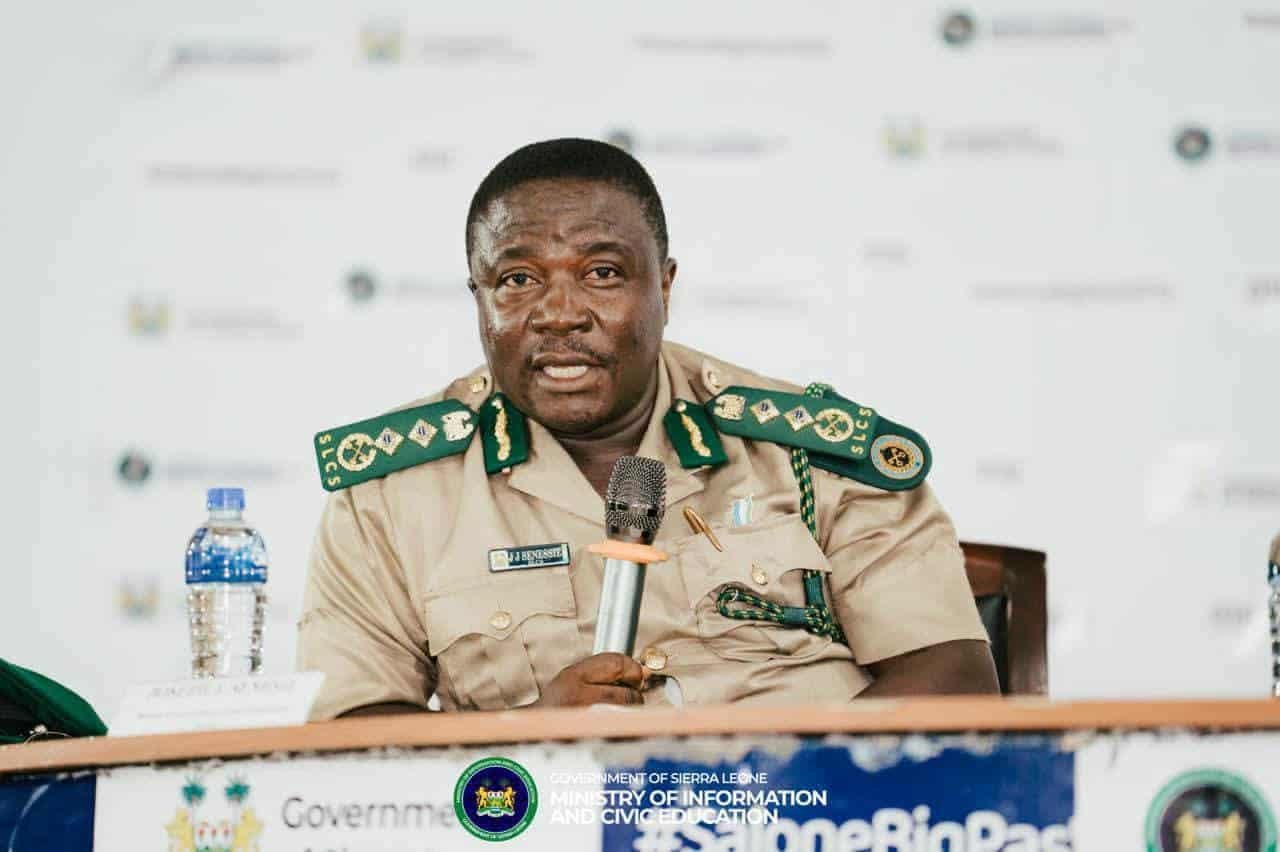
The Sierra Leone Correctional Service has outlined major reforms aimed at strengthening inmate welfare, education, rehabilitation and reintegration while improving access to justice and modernizing records management.
Director General, Joseph J. Senessie, announced the initiatives during the Weekly Government Press Conference held on September 1, 2026, at the Miatta Civic Centre, Youyi Building, in Freetown.
Joseph J. Senessie recalled the institution’s transformation from a prison service to a correctional service in 2014, describing the change as an important shift from punishment towards reforming offenders and preparing them for a productive return to society.
“Our transformation was guided by three key principles: reformation, rehabilitation and reintegration,” he stated.
The Director General disclosed that the Service currently holds 2,060 inmates across the country. He said it continues to collaborate with the Judiciary on case reviews designed to improve access to justice and address overcrowding in correctional facilities.
Education, according to Joseph J. Senessie, is becoming an increasingly important component of the rehabilitation process. The Service is exploring partnerships with universities and other educational institutions to create formal learning opportunities for eligible persons in custody.
He specifically mentioned the University of Sierra Leone and the University of Makeni, noting that discussions are focused on enabling qualified inmates to pursue recognized academic programmes while serving their sentences.
Joseph J. Senessie maintained that people who spend several years in custody should not be denied opportunities to learn, develop their abilities and acquire qualifications that could improve their prospects after release.
The Service is therefore working to establish structured educational programmes that could lead to recognized certificates and academic qualifications.
Vocational and practical skills training also forms a major part of the reform agenda. The Director General said inmates should leave correctional facilities equipped with skills that could help them secure employment, establish businesses and become self-reliant.
Such programmes, he added, would enable former inmates to support their families and contribute positively to their communities, reducing the likelihood of reoffending.
“Our overall objective is to ensure that inmates are treated with dignity, rehabilitated and eventually reintegrated into society as peaceful, useful and productive citizens,” Joseph J. Senessie said.
Human rights and inmate welfare remain central to the reforms. The Director General reaffirmed the Service’s commitment to protecting the fundamental rights of persons in custody while maintaining safe and secure conditions for inmates and correctional officers.
He highlighted ongoing engagement with the Human Rights Commission of Sierra Leone, Prison Watch Sierra Leone, parliamentary oversight bodies and other advocacy organisations. Those partnerships, he said, are helping to strengthen transparency, accountability and independent monitoring of correctional facilities.
Joseph J. Senessie also underscored the importance of gender equality within the institution. He disclosed that the Service has 130 senior male officers and 49 senior female officers, stressing the need to increase women’s participation in senior management and decision-making positions.
Digitalization is another priority under the reform programme. The Service is preparing to introduce modern electronic information-management systems to improve the organisation, security and accessibility of correctional records.
Joseph J. Senessie said artificial intelligence and other digital tools could potentially improve records management and assist authorities in accessing important information more efficiently. A local consultant is expected to support the development and improvement of the proposed systems.
Through partnerships with the Judiciary, educational institutions, development organisations and human rights groups, the Sierra Leone Correctional Service hopes to establish a more humane, accountable and rehabilitation-focused correctional system capable of preparing offenders for successful reintegration into society.