

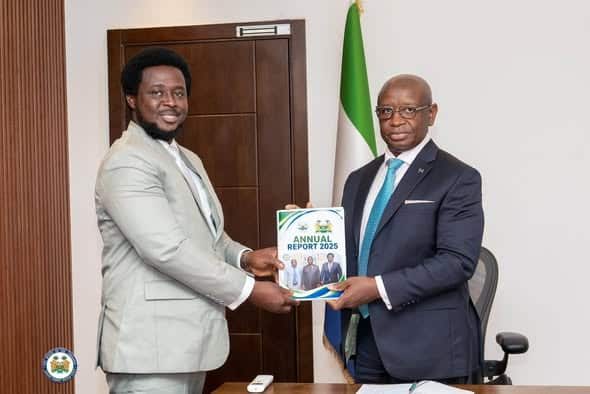
The Commissioner of the Anti-Corruption Commission (ACC), Francis Ben Kaifala, together with Deputy Commissioner Augustine Foday Ngobie and senior officials of the Commission, on Wednesday, 16 September 2026, presented the ACC’s 2025 Annual Report to President Julius Maada Bio at State House in Freetown.
The presentation was made in fulfilment of the Commission’s statutory obligation under Section 19(1) of the Anti-Corruption Commission Act No. 12 of 2008, as amended in 2019.
Presenting the report, Deputy Commissioner, Augustine Foday Ngobie described the occasion as the fulfilment of an important statutory responsibility, noting that the report provides a comprehensive account of the Commission’s activities, achievements, progress and challenges during the 2025 reporting period.
He highlighted the work undertaken across the Commission’s core areas, including prosecution, prevention, audits, investigations and intelligence, public education and outreach, human resource and administration. He also referenced the work of the Project Coordination Office, which is responsible for the grievance redress component of the Productive Social Safety Net and Youth Employment (PSSNYE) Scheme, as well as the National Anti-Corruption Strategy Secretariat and the Commission’s regional offices in Bo, Makeni, Port Loko, Kenema and Kono.
Commissioner Francis Ben Kaifala highlighted several major achievements recorded during the year, including the rollout of the National Anti-Corruption Strategy (NACS) 2024–2028 and strengthened enforcement of asset declaration requirements.
According to the report, 1,541 public officers were sanctioned for defaulting on their 2024 asset declarations, contributing to an asset declaration compliance rate of 99.54 percent.
The Commission also reported significant results in its enforcement activities. Of the 13 persons tried for corruption before the High Court during the reporting period, 12 were convicted, representing a 92 percent conviction rate.
The enforcement actions also resulted in the recovery of NLe23, 556,597, while NLe1, 394,491 was paid in restitution and NLe1, 460,000 in fines by persons convicted of corruption.
The ACC further reported progress in Sierra Leone’s international governance indicators. The country’s ranking on the Transparency International Corruption Perceptions Index improved from 114th in 2024 to 109th in 2025. The Commission also highlighted Sierra Leone’s eighth consecutive year of meeting the relevant excellence threshold on the Millennium Challenge Corporation scorecard.
Deputy Commissioner Augustine Foday Ngobie noted that the Commission had also strengthened its institutional framework during the year through the development and operationalization of the Whistleblower and Witness Protection Regulations 2025, in collaboration with the Office of the Attorney-General and Minister of Justice and Parliament.
He said the regulations were designed to strengthen protection for individuals who report corruption or provide evidence in corruption-related matters in the public interest, including mechanisms aimed at preventing retaliation.
The Commission also expanded its public engagement through intensified public education and sensitization programmes, increased social media and digital outreach, and stronger collaboration with the media and civil society organisations through formal partnerships and Memoranda of Understanding.
In his response, President Julius Maada Bio welcomed the ACC leadership and staff and commended the Commission for its contribution to Sierra Leone’s development and the fight against corruption.
President Bio praised the Commission’s leadership for the progress outlined in the 2025 Annual Report. He urged the Commission to remain unwavering in the discharge of its mandate.
The President described corruption as “an enemy of the state and a natural risk to the development of a nation,” stressing that the fight against corruption requires sustained commitment because the problem remains persistent.
He encouraged the ACC to remain relentless in its work while paying particular attention to protecting vulnerable citizens from the effects of corruption.
President Bio also emphasized the importance of safeguarding public resources, noting that while revenue collection falls within the responsibility of institutions such as the National Revenue Authority, ensuring that public resources are properly protected and used for their intended purposes remains an important part of the fight against corruption.
He described the ACC’s mandate as a “hard task” and urged its leadership and staff to remain vigilant in responding to emerging technological risks.
The President specifically called on the Commission to pay attention to the growing use of advanced technology and artificial intelligence, warning that such technologies could also be exploited by individuals seeking to undermine institutions and facilitate corrupt practices.
President Bio concluded by encouraging the ACC to remain resolute and not relent in the fight against corruption, while formally receiving the Commission’s 2025 Annual Report.
The presentation marks another stage in the Commission’s statutory reporting process and provides an overview of its enforcement, prevention, public education, institutional and policy activities during the year under review.