

By Amin Kef Sesay
United States Secretary of State Marco Rubio has declared that Washington will continue to place its national interest above the international order under President Donald J. Trump, while acknowledging that the current international system is struggling to address major conflicts and security challenges around the world.
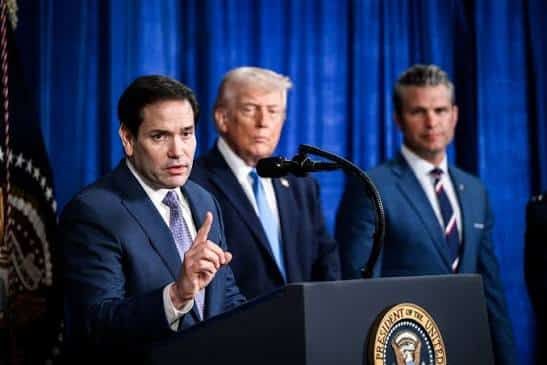
Speaking to journalists at the Palace Hotel in New York City on September 23, 2026, on the margins of the United Nations General Assembly, Secretary Marco Rubio addressed a wide range of international issues, including Iran, Sudan, Russia and Ukraine, Cuba, Venezuela, China, Taiwan, Gaza and the wider Middle East.
Secretary Marco Rubio said the Trump Administration sees value in international institutions, including the United Nations, but believes the global system has expanded beyond its intended mandate while failing to resolve many of the world’s major conflicts.
According to Secretary Marco Rubio, the primary responsibility of every government is to protect the national interest of its own country. He maintained that the United States would therefore not subordinate its national priorities to the international order.
“We will never put the international order above the interest of the United States,” Secretary Marco Rubio said, while arguing that international institutions still have an important role to play.
He pointed to conflicts and tensions involving Sudan, the Democratic Republic of Congo and Rwanda, Iran, and other parts of the world as examples of challenges he said the international system has struggled to resolve.
Iran featured prominently in the press engagement.
Secretary Marco Rubio said the Trump Administration’s central position remains that Iran must not acquire a nuclear weapon. He said Washington continues to communicate that position through direct and indirect diplomatic engagements involving mediators.
He added that President Donald J. Trump remained open to reaching an agreement with Iran, but warned that Washington would continue applying economic pressure if Tehran persisted with policies the United States considers threatening.
Secretary Marco Rubio also said the United States would continue protecting commercial shipping in the Strait of Hormuz, accusing Iran of attacks on vessels in the area. He said US forces had been involved in defending shipping and removing mines as part of efforts to maintain maritime access.
Turning to Sudan, Secretary Marco Rubio described the humanitarian situation as catastrophic and expressed frustration over repeated failures to implement agreements intended to reduce the conflict.
He said the United States has personnel working continuously on Sudan and has engaged alongside the United Kingdom and other international partners in efforts to facilitate progress.
Secretary Marco Rubio argued that external actors supporting opposing sides were contributing significantly to the continuation of the war. He did not identify those countries or actors, saying he did not want to create additional diplomatic friction.
According to him, even when progress appears possible, one side or the other often withdraws from commitments because it believes it can gain a military advantage.
He said Washington would like to see a permanent peace settlement but stressed that an immediate priority is securing humanitarian access and creating safer areas where aid organisations can reach civilians affected by the conflict.
Secretary Marco Rubio also addressed the Russia-Ukraine war, saying Washington remains interested in exploring a limited ceasefire covering energy infrastructure and grain-related issues.
He said both Russia and Ukraine had expressed some interest in arrangements involving energy, although reaching such an agreement would be complicated because both sides consider energy infrastructure strategically important to their war efforts.
Secretary Marco Rubio argued that the broader Russia-Ukraine war would ultimately require a negotiated settlement rather than a purely military conclusion. He said the United States was prepared to play a constructive role in efforts that could establish the foundation for a wider agreement.
On Cuba, Secretary Marco Rubio strongly criticised the Cuban Government and said Washington wanted to see political and economic changes on the island.
He said the United States preferred progress through political and negotiated means rather than military force, while declining to speculate about possible future actions.
Secretary Marco Rubio also discussed the prospects for greater private-sector involvement in Cuba, explaining that existing US law, particularly the Helms-Burton Act, places substantial restrictions on American commercial activity there.
Venezuela was another major subject during the engagement.
Secretary Marco Rubio said the Trump Administration was supporting efforts aimed at economic stabilisation and a political transition that would eventually lead to elections in Venezuela.
He stressed the importance of rebuilding institutions, strengthening political parties, expanding space for independent media and creating an electoral process in which Venezuelans have confidence.
According to Secretary Marco Rubio, economic recovery and political reform must advance together if Venezuela is to establish sustainable democratic institutions and create conditions for millions of Venezuelans living abroad to return.
Relations between the United States and China also featured prominently.
Secretary Marco Rubio described engagement between Washington and Beijing as necessary because of the economic and military importance of both countries.
He acknowledged serious disagreements between the two powers, particularly over trade, supply chains, critical minerals and security, but maintained that communication at the highest political level remains important.
“The relationship between the United States and China will define the 21st century,” Secretary Marco Rubio said, arguing that refusing high-level engagement between the two countries would be irresponsible.
He also addressed Taiwan and US arms sales, explaining that decisions on military equipment must be balanced against America’s own defence requirements and commitments in other parts of the world.
Secretary Marco Rubio said Washington is simultaneously managing military responsibilities in the Indo-Pacific, Europe and other strategic regions, meaning decisions on foreign military sales must consider existing US stockpiles and the ability of American industries to replenish equipment.
On Gaza, Secretary Marco Rubio said reconstruction and long-term political stability remain important priorities. He said donor countries were expected to make financial commitments toward reconstruction initiatives and stressed that rebuilding Gaza would be a long-term undertaking.
He also addressed tensions in the West Bank, saying the Trump Administration does not want additional flashpoints that could generate another crisis in the region.
On Yemen and wider Middle East security, Secretary Marco Rubio reiterated US security commitments to Saudi Arabia and accused Iranian-backed groups of threatening civilian and energy infrastructure across the region.
The Secretary of State also discussed Washington’s emerging “Shield of the Americas” initiative, which he described as a framework for cooperation among countries in the Western Hemisphere on transnational organised crime, security, economic cooperation and supply chains.
According to Secretary Marco Rubio, participating countries have different domestic procedures for designating criminal organisations as terrorist groups, but Washington is encouraging governments to strengthen collective action against transnational organisations that threaten national sovereignty.
Throughout the extensive press engagement, Secretary Marco Rubio repeatedly returned to one central theme: the Trump Administration views national interest as the foundation of US foreign policy.
While acknowledging the usefulness of diplomacy, alliances and international institutions, he maintained that Washington would judge international engagement principally by whether it advances American security and strategic interests.
His remarks reflected the Trump Administration’s broader approach to international affairs as world leaders gathered in New York amid continuing conflicts in Sudan, Ukraine and the Middle East and growing tensions involving Iran and other global security challenges.