

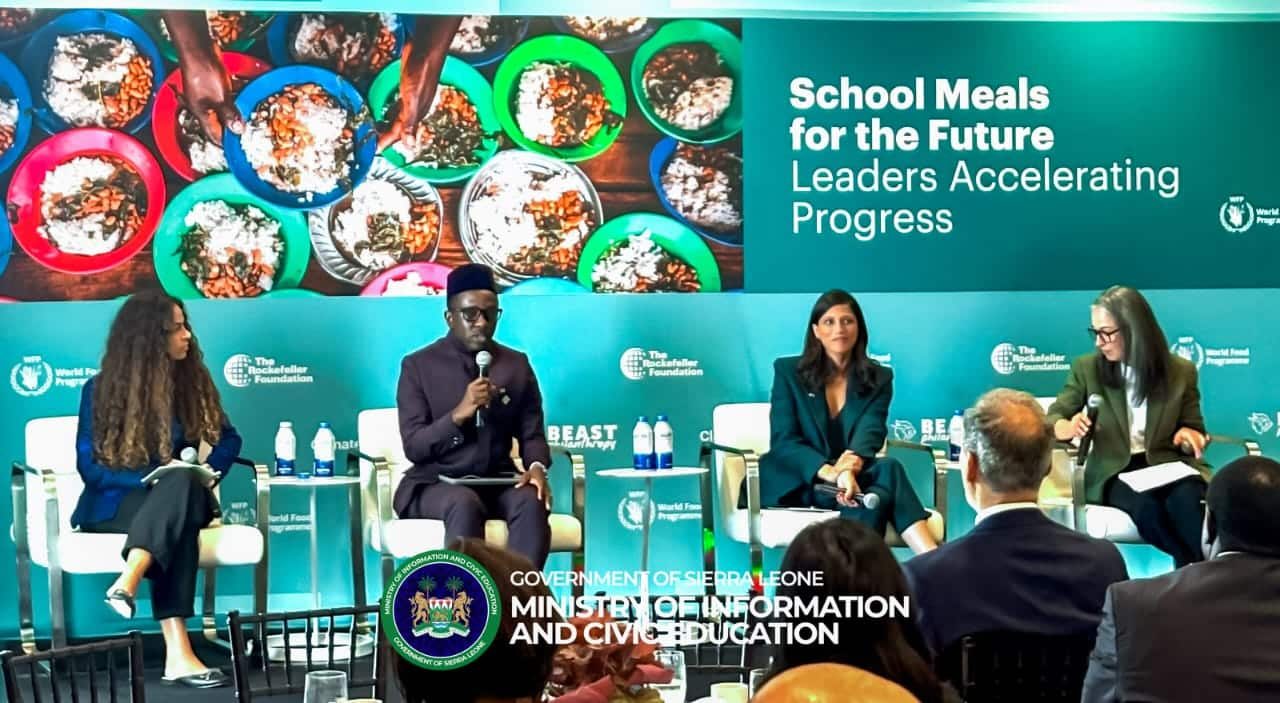
Sierra Leone’s Minister of Information and Civic Education, Chernor Bah, has called for school feeding programmes to be treated as part of a broader national investment in education, agriculture, youth employment, nutrition and human-capital development, stressing that locally produced school meals could help strengthen the country’s drive towards self-reliance.
Chernor Bah made the call during a high-level event held on the margins of the 81st Session of the United Nations General Assembly in New York on September 21, 2026.
The event, titled: “School Meals for the Future: Leaders Accelerating Progress,” was co-hosted by the World Food Programme and The Rockefeller Foundation and brought together senior Government officials, international development leaders, philanthropists and influential content creators to discuss how locally produced school meals can improve learning while strengthening national food systems.
Among the speakers were His Majesty King Letsie III of Lesotho; Kenya’s First Lady, Rachel Ruto; former British Prime Minister Gordon Brown; Nobel Peace Laureate Professor Muhammad Yunus; Philippine Secretary of Foreign Affairs Ma. Theresa Lazaro; World Food Programme Acting Executive Director Carl Skau; Rockefeller Foundation President Rajiv Shah and global content creator Jimmy Donaldson, popularly known as MrBeast.
Chernor Bah joined France’s Minister Delegate for International Partnerships, Éléonore Caroit and youth climate educator Sage Lenier on a panel examining how influence, civic action and youth leadership could accelerate progress in addressing hunger and improving access to education.
Drawing on his personal experience, Chernor Bah said the issue of hunger and access to education is deeply personal to him, recalling the difficulties he faced as a child.
“I went to school hungry,” he said. “Like many children in Sierra Leone, I knew what it meant for a parent to face an impossible choice: food for the family or transport to school.”
Chernor Bah explained that his early advocacy focused heavily on expanding access to education, but his personal experience taught him that children do not experience education and hunger as separate challenges.
“For a child, the questions are simple: Can I get to school? Can I eat? Can I concentrate? Can I dream beyond today?” he stated.
The Minister connected that experience to President Dr Julius Maada Bio’s wider national development agenda, noting that Sierra Leone had made a major investment in education through the Free Quality School Education programme, expanding access to schooling and placing human-capital development at the centre of national policy.
“But once we made that bet on education, we also had to bet on feeding children in school,” Chernor Bah said. “And once we commit to feeding children in school, we must confront the bigger national question: can we feed our own country?”
He said that connection brings together the Government’s Free Quality School Education programme and President Dr Julius Maada Bio’s Feed Salone initiative. While the education programme invests in the knowledge and potential of Sierra Leone’s children, Feed Salone seeks to strengthen the country’s productive capacity to feed its population, create employment and contribute to economic growth.
According to Chernor Bah, school feeding should therefore not be regarded merely as a stand-alone social intervention but as a programme positioned at the intersection of education, agriculture, nutrition, youth employment, local enterprise and national self-reliance.
The Minister noted that Sierra Leone has a predominantly young population, with a median age of about 19, while more than 55 percent of the country’s land is arable and close to 60 percent of the population is involved in some form of agriculture.
“These are not disconnected facts,” he said. “We have millions of young people who need opportunities, farmers who need reliable markets and children who need nutritious meals. Properly designed, these are not three separate problems. They can become one integrated solution.”
Chernor Bah maintained that locally sourced school meals could create dependable markets for Sierra Leonean farmers while opening employment and business opportunities for young people throughout the agricultural value chain.
He identified opportunities for young Sierra Leoneans to participate as farmers, processors, aggregators, transporters, technology providers and entrepreneurs, thereby transforming school feeding into an economic opportunity beyond its immediate nutritional and educational benefits.
The Minister further placed the initiative within Sierra Leone’s national civic education agenda, explaining that Feed Salone constitutes the second pillar of the National Civic Education Strategy and is built around the message: “Grow what we eat. Eat what we grow.”
According to Chernor Bah, the message goes beyond agricultural production and represents a broader call for citizens to actively participate in Sierra Leone’s economic and national development.
“That is not only an agricultural slogan. It is a statement about citizenship,” he said.
“When a young Sierra Leonean grows food, builds an agribusiness, chooses locally produced rice or develops technology that connects farmers to schools, that is not only economic activity. It is civic action,” Chernor Bah added.
Concluding his intervention, the Minister said Sierra Leone’s approach to education, school feeding and agricultural production could be understood as one connected national ambition aimed at developing children while building the country’s capacity to become more productive and self-reliant.
“We bet on education. So we had to feed children in school. Now we must bet on feeding the country and we must do it locally,” he stated.
Chernor Bah added that a locally produced school meal has the potential to deliver benefits across different sectors by keeping a child in school, providing a farmer with a reliable market, creating employment for a young person and strengthening confidence in Sierra Leone’s ability to produce more of what its citizens consume.
“The school meal is where our investment in the child meets our belief in ourselves as a country,” Chernor Bah concluded.