

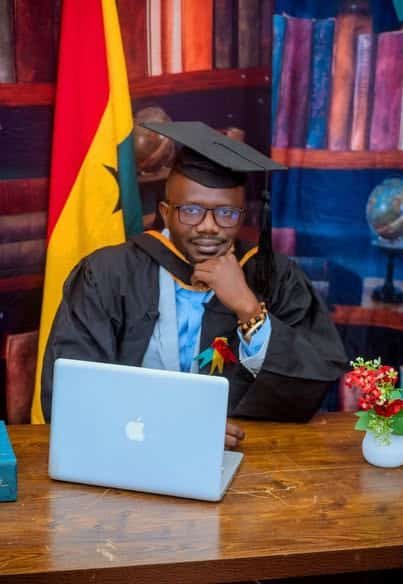
Professor Ezekiel Kalvin Duramany-Lakkoh has called on management accountants to play a stronger role in organizational strategy, saying their work must go beyond reporting figures to helping leaders understand risk, performance and the long-term consequences of their decisions.
Professor Ezekiel Kalvin Duramany-Lakkoh made the remarks while reflecting on his admission as a Chartered Global Management Accountant at a 2026 convocation in Ghana. He said he had qualified as a Chartered Accountant years earlier but had long wanted to pursue management accounting because of its close connection to financial strategy, corporate finance and enterprise risk management.
“Accounting has gone far beyond reporting figures,” Professor Ezekiel Kalvin Duramany-Lakkoh said. He explained that management accountants should provide executives and boards with informed financial and commercial perspectives on investment, performance, sustainability and governance.
According to Professor Ezekiel Kalvin Duramany-Lakkoh, their responsibility includes testing assumptions, explaining the financial implications of proposed decisions and helping organisations allocate resources responsibly. Financial information, he said, becomes most useful when it is translated into practical insight that supports sound decisions and accountability.
He identified budgeting, forecasting, cost management, financial modelling, internal control and risk assessment among the profession’s core responsibilities. He also stressed the importance of communicating complex financial matters clearly to directors and other decision-makers.
At Board level, Professor Ezekiel Kalvin Duramany-Lakkoh said, accountants should help Directors examine whether an organisation is financially resilient, whether its investments support its priorities and whether Management’s forecasts are backed by reliable evidence.
His comments reflect a wider emphasis on governance in his work at the Institute of Public Administration and Management (IPAM), a constituent college of the University of Sierra Leone. Professor Ezekiel Kalvin Duramany-Lakkoh is advancing a 2025–2028 agenda aimed at strengthening IPAM’s academic programmes, facilities, partnerships and institutional services.
The agenda seeks to position IPAM more strongly in business, governance and technology education. It also places greater emphasis on sustainability, digital transformation, entrepreneurship and links between academic programmes and employment.
Infrastructure forms part of those plans. A four-storey annex at IPAM’s Old Campus, initiated before the current review period, is expected to provide additional lecture theatres, seminar rooms and faculty offices when completed. IPAM was also preparing to commission facilities at its A.J. Momoh Street campus on Tower Hill.
Professor Ezekiel Kalvin Duramany-Lakkoh has encouraged alumni and other partners to support institutional development.
IPAM’s regional engagement also expanded on 22 September 2026 with the signing of a Memorandum of Understanding with the Liberia Institute of Public Administration. The agreement provides a framework for cooperation in public administration, governance, procurement, entrepreneurship, professional development and digital transformation.
Speaking separately at an executive training programme in Accra organized by the West Africa Bankers Association, Professor Ezekiel Kalvin Duramany-Lakkoh said effective governance depends on the combined efforts of Boards, Company Secretaries, Human Resource leaders and other professionals. He urged Non-Executive Directors to provide independent oversight and ask difficult questions about Management decisions and institutional risks.
The progress of IPAM’s transformation agenda will depend on how those plans are carried out, including the completion of facilities, improvements in student services and academic programmes and results from its partnerships.