

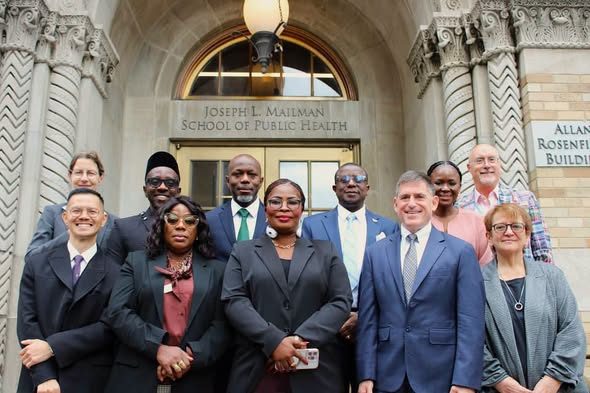
Sierra Leonean Cabinet Ministers attending the 81st Session of the United Nations General Assembly in New York have participated in a specially designed executive seminar at Columbia University aimed at strengthening leadership, critical thinking, problem-solving and effective Government service delivery.
Held on September 23, 2026, at Columbia University’s Mailman School of Public Health, the high-level programme brought together about a dozen Ministers for intensive sessions on systems thinking, implementation science and the use of evidence in policy and practice.
The training was designed to expose the Ministers to practical approaches that could help Government leaders navigate complex challenges, improve coordination across Ministries and strengthen the implementation of public policies and programmes.
Minister of Information and Civic Education, Chernor Bah, facilitated the initiative through the Ministry of Information and Civic Education as part of its ongoing Memorandum of Understanding and partnership with Columbia University.
Taking advantage of the presence of senior Government officials in New York for UNGA 81, the programme provided an opportunity for the Ministers to combine international diplomatic engagements with professional development and capacity building.
President Dr. Julius Maada Bio supported the participation of the Ministers in the programme, encouraging members of the delegation to use their time in New York not only for international engagements but also to acquire knowledge and skills that could strengthen Government delivery.
Chernor Bah said continuous learning remains important for public officials responsible for implementing Government programmes and responding to increasingly complex national challenges.
“UNGA is an extraordinarily busy period, but President Bio encouraged and supported us to make space for learning and capacity building,” Chernor Bah said.
“If we want to accelerate delivery, we must continuously strengthen our ability as leaders to solve complex problems, work across the Government and turn policy into results.”
Senior faculty members from Columbia University’s Heilbrunn Department of Population and Family Health conducted the sessions, providing participants with insights into approaches that could be applied to governance, policy implementation and institutional coordination.
The sessions covered systems thinking, implementation science and influencing discourse and were led by Helen DePinho, Patrick Kachur and Nicole Haberland. Professor Thoại D. Ngô, Chair of the Heilbrunn Department of Population and Family Health, led the overall programme.
A major focus of the seminar was encouraging participants to look beyond the responsibilities of individual Ministries and examine how Government priorities and challenges are interconnected.
The systems-thinking approach particularly highlighted the importance of understanding how decisions taken in one sector could affect outcomes in other areas, requiring stronger collaboration among Ministries and public institutions.
Minister of Energy, Cyril Arnold Grant, said the programme created an opportunity for participants to consider their responsibilities within the Government’s broader development agenda.
“It gave us the time to think through and discuss the whole-of-Government plan as it relates to our individual portfolios,” Cyril Arnold Grant said, noting that issues handled by individual Ministries could also have wider implications, including for public health.
Participants were also introduced to implementation science, which focuses on how policies, programmes and evidence-based interventions can be effectively translated into practice.
The seminar further examined critical thinking and structured problem-solving approaches that could assist Government officials in identifying challenges, evaluating available evidence and developing practical responses.
Organisers said strengthening such skills among senior public officials could contribute to improved decision-making, better coordination, more efficient use of public resources and stronger implementation of Government programmes.
Following the seminar, Professor Thoại D. Ngô thanked Chernor Bah for his role in facilitating the participation of the Sierra Leonean delegation and acknowledged the Ministers for dedicating time to the programme despite their demanding UNGA schedule.
Professor Thoại D. Ngô also reaffirmed Columbia University’s commitment to its continuing collaboration with Sierra Leone, particularly in areas related to health, development, research, leadership and institutional capacity building.
For the Ministry of Information and Civic Education, the Columbia University engagement forms part of efforts to ensure that Sierra Leone’s international partnerships produce practical benefits for the country.
The Ministry believes access to global expertise, research and professional networks can provide public officials with additional tools to address domestic challenges and improve the quality of Government services.
Chernor Bah stressed that international partnerships should ultimately translate into meaningful benefits for Sierra Leone and its citizens.
“Our partnerships must ultimately create value for Sierra Leone,” Chernor Bah said. “Through our MOU with Columbia, we are connecting our leaders to world-class knowledge and expertise that can help us deliver better for our people.”
The executive seminar formed part of a wider series of engagements involving Sierra Leonean officials during UNGA 81 in New York, where the delegation participated in bilateral meetings, policy discussions and international forums covering development, investment, peace, governance and other national priorities.
Beyond the diplomatic engagements, the Columbia University programme provided participating Ministers with an opportunity to examine practical tools that could be applied to their respective Ministries upon their return to Sierra Leone.
The training also underscored the growing importance of evidence-based decision-making and cross-Government collaboration as public institutions respond to economic, social, environmental and institutional challenges.
From Cabinet meetings in Sierra Leone to the classroom at Columbia University in New York, the initiative demonstrated an emphasis on continuous learning among senior Government officials, with the central objective of translating acquired knowledge into improved policy implementation and public service delivery.