

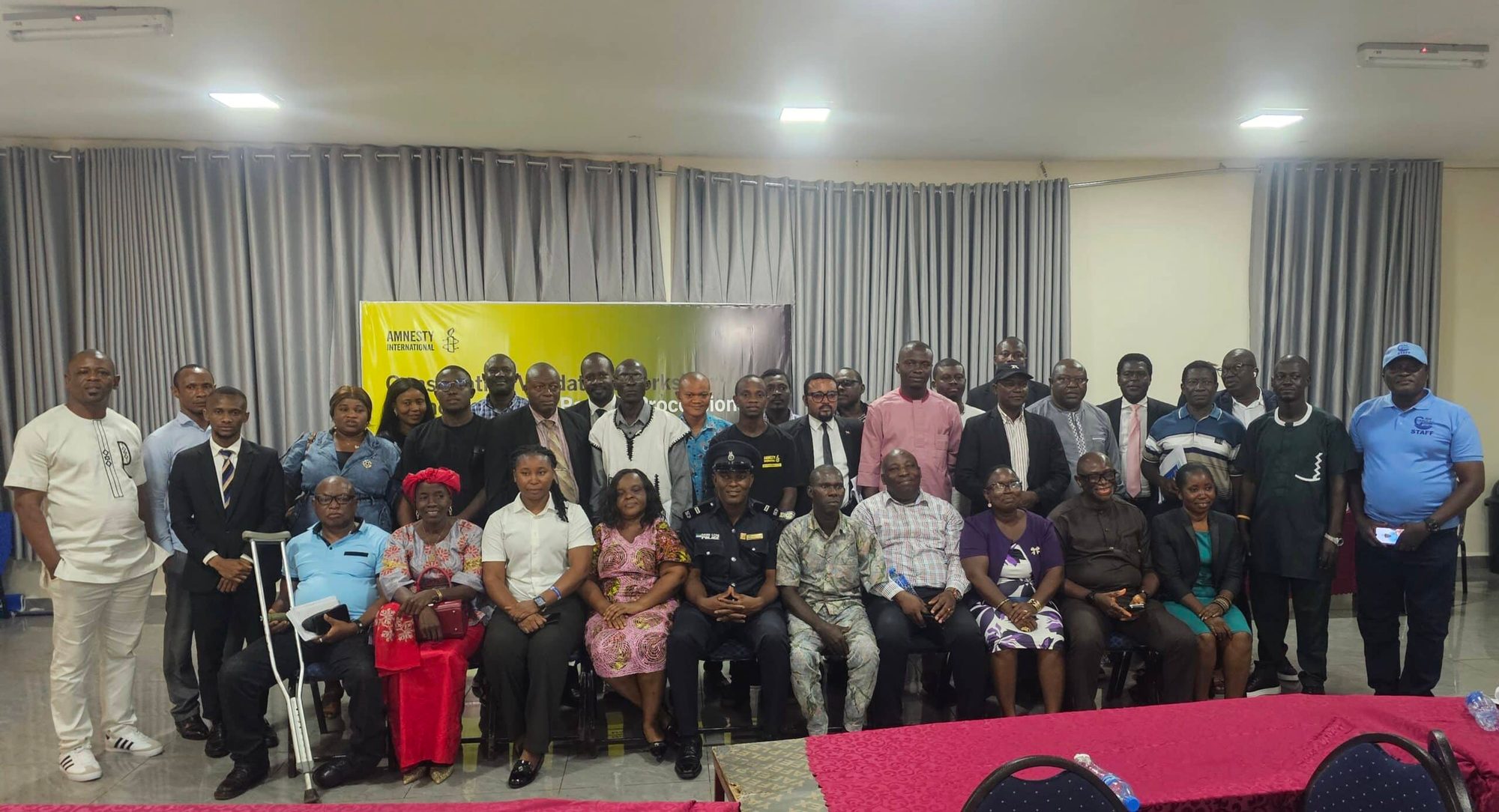
Amnesty International Sierra Leone has presented findings and proposed reforms from its nationwide consultation on Part III of the Public Order Act of 1965, which regulates public processions and demonstrations.
The findings were presented on Tuesday, September 29, 2026, at a validation workshop at the New Brookfields Hotel in Freetown. The engagement brought together policymakers, parliamentarians, civil society organisations, political parties, trade unions, universities, traditional leaders, youth organisations and other stakeholders.
The consultation was conducted in Freetown, Makeni, Kenema, Kambia and Bo by Amnesty International Sierra Leone’s legal consultants to gather views on the enforcement of Part III and possible reforms.
A key finding was the concern over the discretionary power of the police to approve or prohibit public processions. Civil society stakeholders consulted across Freetown and the provinces supported a shift from an approval based system to a notification based framework, while state institutions generally defended the existing system but acknowledged the need for greater clarity and accountability.
The findings also highlighted concerns from provincial stakeholders over access to the police leadership in Freetown and reported inconsistencies between decisions at the central level and the conduct of lower ranking officers in the field.
The report further identified the lack of clear definitions for terms including “procession”, “protest” and “demonstration” as an area requiring attention.
Among the proposed reforms is a transition to a notification based system, with a fixed notice period and a provision allowing a notified procession to proceed unless there is a lawful and reasoned objection.
The recommendations also call for objective and judicially reviewable criteria for restricting processions, expedited judicial review, decentralization of the notification process to regional and local authorities and independent oversight of police conduct.
The report further proposes removing imprisonment as a sanction for failure to notify and seeking Supreme Court interpretation of the term “notification” as used in Part III.
Opening the workshop, Acting Executive Director of the Centre for Accountability and Rule of Law, Jeremy Simbo, who chaired the event, said the state has a responsibility to prevent violence and disorder while ensuring that public spaces are used safely and responsibly.
Jeremy Simbo said maintaining public order should be balanced with the protection of human rights and political participation. He said the review provided an opportunity to examine whether the existing legal framework remains appropriate and consistent with the country’s legal obligations.
He stressed that the process should be guided by evidence, expert knowledge and broad public participation, adding that constructive differences among stakeholders could help strengthen the final report.
Jeremy Simbo said the validation exercise was important in determining whether the evidence gathered during the nationwide consultations and the proposed recommendations were clear, realistic and capable of contributing to sound policy and legislative discussions.
Amnesty International Sierra Leone Executive Director, Solomon M. Sogbandi, said peaceful assembly is an important part of democratic participation, allowing citizens to express their views, participate in public affairs and demand accountability.
He said the existing framework gives the police significant discretion in regulating processions and stressed that restrictions on peaceful assembly should be based on clear, objective, necessary and proportionate criteria.
Solomon Sogbandi said the consultations had also considered comparative practices and international standards, including notification based systems, risk assessments, dialogue between organizers and police, and independent oversight.
He said the proposed reforms should balance the state’s responsibility to maintain public order with the protection of citizens’ rights to peaceful assembly and participation.
The recommendations will undergo further stakeholder review and validation before Amnesty International Sierra Leone finalizes its report on the consultative process.