
By Amin Kef Sesay, reporting from Nanning, Guangxi, People’s Republic of China
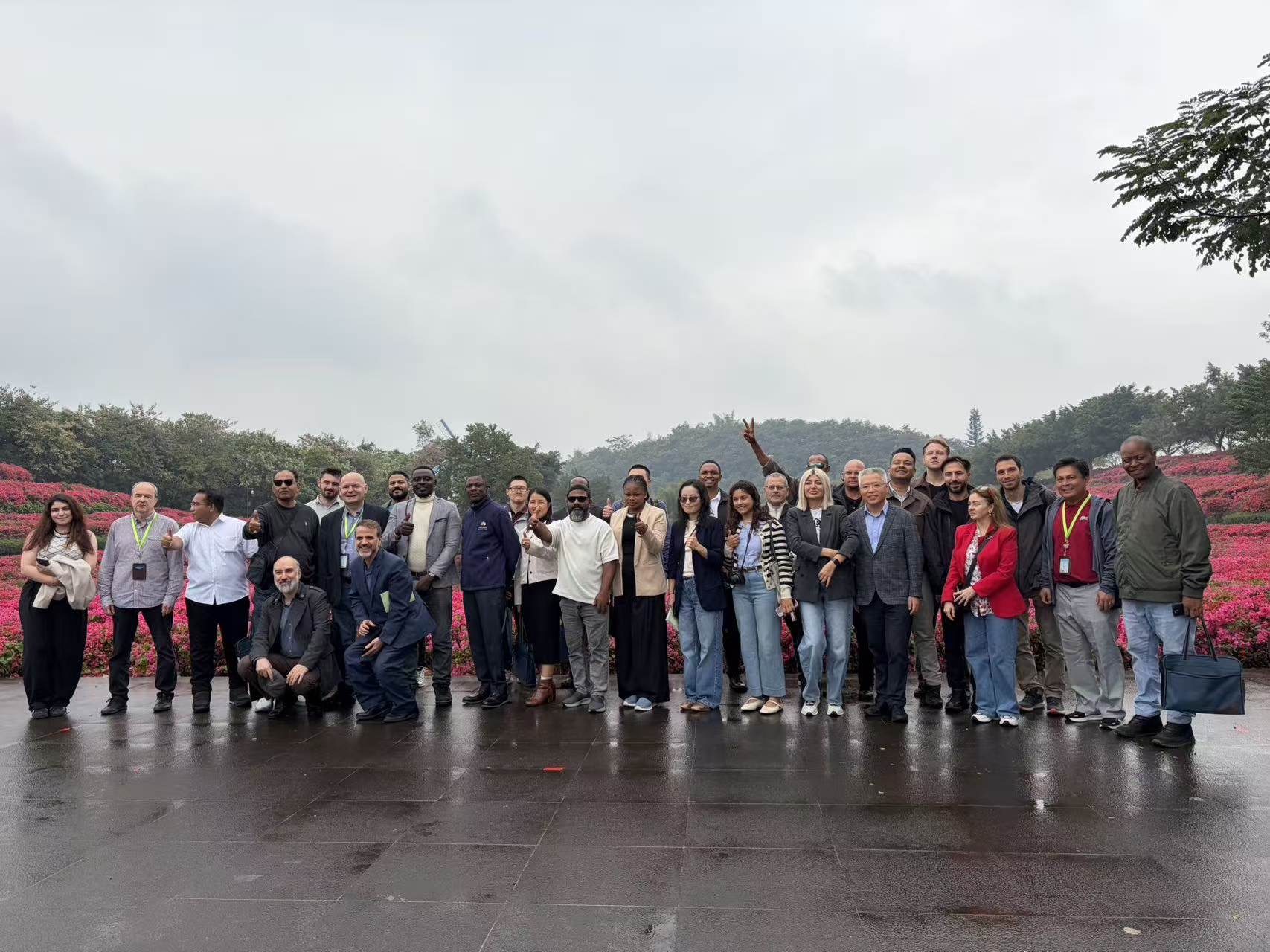
China has brought together 31 overseas experts and delegates from 24 countries for the Seminar on Theoretical and Practical Innovation of Political Parties, organised by the International Department of the Central Committee of the Communist Party of China (IDCPC). The programme, running across Yan’an, Xi’an and Nanning, is designed to examine the Communist Party of China’s (CPC) governance philosophy, people-centred development model, theoretical innovations and the continuity of its founding aspirations and mission.
Delegates include senior party officials, academics, researchers and media practitioners. Among them is Sierra Leonean investigative journalist, Publisher and Managing Editor of The Calabash Newspaper, Amin Kef Sesay. Other participants include Ali Salum Hapi (Head of the international delegation and senior official of Tanzania’s ruling Chama Cha Mapinduzi), Litvak Nikolay (Professor of Philosophy and Doctor of Sociology, MGIMO University, Russia), and representatives from countries across Africa, Asia, Europe and elsewhere.
The programme opened in Yan’an, Shaanxi Province, the historic revolutionary base. On 9 November at the China Executive Leadership Academy Yan’an, delegates attended a formal exchange session chaired by Wang Jigang, Vice President of the Academy. Addresses were delivered by Li Shufeng, Executive Vice President of the Academy, and Ali Salum Hapi on behalf of the international participants.
The centrepiece was a lecture by Wang Tao titled “Stay True to Original Aspiration and Founding Mission of the CPC — On General Secretary Xi Jinping’s People-Centered Development Philosophy.” The presentation covered China’s targeted poverty-alleviation approach, the Healthy China initiative, educational equity, and the principle that development must be for the people, rely on the people, and share its fruits with the people. Data presented showed the rural population living below the official poverty line falling from nearly 99 million in 2012 to zero by the end of 2020.
Later that day the group visited Liangjiahe Village in Wen’anyi Town, Yanchuan County, where General Secretary Xi Jinping lived and worked as a young man from 1969 to 1975. Former village Party Secretary Shi Chunyang and resident Liu Jinlian shared personal recollections. Delegates examined the village’s transformation and the practical application of people-centred rural development.
On 10 November participants visited the Yan’an Revolutionary Memorial Hall, the Yangjialing Revolutionary Site (venue of the CPC’s Seventh National Congress), and Baota Mountain. At the Memorial Hall, the display “The Ten Absences During the Yan’an Period” — headed by the absence of corrupt officials — drew particular attention. Standing on Baota Mountain, delegates compared historical photographs of barren loess hills with the modern city below.
The delegation moved to Xi’an for a high-level meeting with senior Shaanxi provincial leadership, including Deputy Secretary of the CPC Shaanxi Provincial Committee Xing Shanping and other officials from the provincial publicity, foreign affairs, commerce, culture and tourism, development and reform departments, as well as IDCPC representatives.
The session featured presentations on Shaanxi’s development achievements, a promotional documentary, and an interactive exchange with the international delegates.
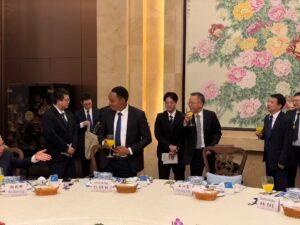
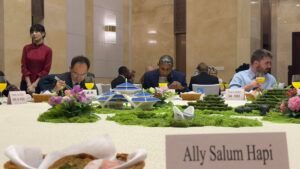
A banquet hosted in Xi’an followed the high-level meeting, providing an opportunity for further dialogue on governance experience, economic transformation and practical cooperation. Delegates also visited the Chanba Cross-border E-commerce Industrial Park, Shaanxi Vocational and Technical College, and cultural heritage sites, examining digital trade, vocational skills training and the preservation of intangible cultural heritage.
In Nanning, capital of the Guangxi Zhuang Autonomous Region, the programme included visits to the China–ASEAN Artificial Intelligence Application Cooperation Centre, Panlong Community and Qingxiu Mountain. The AI centre showcased practical applications in agriculture, healthcare, education, manufacturing, mining, logistics and cross-border trade, including smart-port cooperation between China and Vietnam.
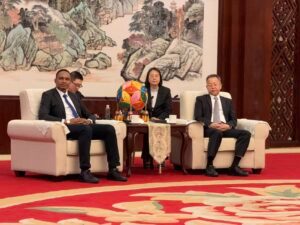
The highlight was a high-level meeting with H.E. Wang Xinfu, Deputy Secretary of the CPC Guangxi Zhuang Autonomous Regional Committee, at Liyuan Resort. Senior officials present included Hu Zhaoming (Director-General, Bureau of Public Information and Communication, IDCPC), Li Pan (Director-General, Information Office of the Guangxi People’s Government), Chen Shengliang (Deputy Director-General, Policy Research Office of the CPC Guangxi Committee), Zhou Tong (Deputy Director-General, Guangxi Foreign Affairs Office) and Hu Xiaodong (Division Director, IDCPC).
Discussions focused on people-centred development, poverty reduction experiences adaptable to other developing countries, media and public communication cooperation, digital governance, and concrete opportunities in agriculture, education, infrastructure, technology and trade. H.E. Wang Xinfu hosted a banquet dinner for the international delegates the same evening, further strengthening personal and institutional ties.
Ali Salum Hapi, Head of the international delegation and senior official of Tanzania’s Chama Cha Mapinduzi (CCM), observed: “China’s development has been a process, but the founding aspirations of the Communist Party of China have remained unchanged. By retracing this historical journey we can draw strength from its experiences. The people-first governance philosophy has stayed consistent even as the country has transformed.”
Litvak Nikolay, Professor of Philosophy and Doctor of Sociology at the Moscow State Institute of International Relations (MGIMO University) of the Ministry of Foreign Affairs of Russia, said: “I previously learned about China through newspapers and websites. During this visit I interacted face-to-face with local people and personally witnessed the development and transformation. This has given me a deeper understanding of the CPC’s governance philosophy. Upon returning home I will share these observations with colleagues. Eastern wisdom can provide inspiration to more political parties around the world.”
Amin Kef Sesay, Sierra Leonean investigative journalist, Publisher and Managing Editor of The Calabash Newspaper, remarked: “What stands out is how artificial intelligence is being applied as a practical solution across agriculture, healthcare, education, mining and public services, not merely as a concept. China’s people-centred approach and its cooperation model with ASEAN countries offer useful lessons for African countries, including Sierra Leone, especially in technology transfer, capacity building and vocational training. AI should support journalism through research and data analysis while journalists remain committed to accuracy, ethics and independent verification.”
In an interview with Chinese journalist during the Nanning engagements, Amin Kef Sesay described the overall programme as both educational and inspiring. He highlighted the value of seeing targeted poverty reduction, rural revitalisation and technological applications first-hand, and stressed the importance of adapting relevant experiences to Sierra Leone’s priorities in agriculture, mining, healthcare, education and media development. He emphasised that sustained mechanisms for knowledge-sharing, journalist exchanges and institutional partnerships would be particularly beneficial beyond the seminar itself.
The Seminar on Theoretical and Practical Innovation of Political Parties continues to provide a structured platform for the 31 delegates from 24 countries to examine how the CPC has maintained its founding aspirations while driving large-scale development and self-reform. Through classroom sessions, on-site visits to revolutionary sites and contemporary development facilities, and the high-level meetings and banquets in Xi’an on 11 November and Nanning on 13 November, participants are gaining direct exposure to the continuity of the Party’s mission and its practical governance outcomes.
The international participants include Ali Salum Hapi, Irada Gasimova, Mian Abrar Hussain, Thun Chhaypiseth, Khamphat Khounvithong, Ashraf Ali, Muhamad Azwan, Erdenebayar Munkhuu, Enkhjargal Munkhbayar, Md Mashequr Rahman, Rachhita Aryal, Kamal Rawal, Ali Alsaç, Alp Tanlasi, Armenuhi Avetisyan, Mikayel Yalanuzyan, Mohsen Raddadi, Seyed Kazem Seyed Bagheri, Yara Ibrahim, Kenoredy Osse Ehikioya, Faousiath Ayike Raimi, Patrick Yin Mahama, Mazibuko Kanyiso Jara, Wesley Daniel Seale, Amin Kef Sesay (Ranger), Sydney Sihubwa, Uladzilau Zasukhin, Litvak Nikolai, Tom Landry and Bojan Vulin.