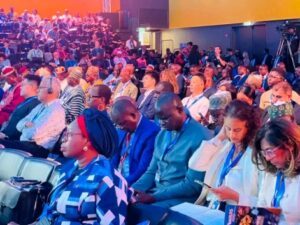

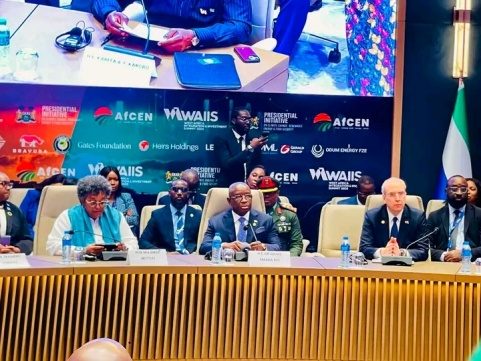
President Dr. Julius Maada Bio officially opened the inaugural West Africa Integration and Investment Summit (WAIIS) 2026 on Tuesday, November 17, at the Julius Maada Bio International Conference Centre in Lungi, Sierra Leone, bringing together Government officials, global investors, financial institutions, development partners and regional stakeholders to accelerate economic integration and sustainable development across West Africa.
The summit focuses on agriculture, energy, trade, digital transformation, food security, infrastructure, women’s leadership and human capital development, seeking to translate regional economic opportunities into viable investment projects.
Welcoming participants, the Chairman of the Presidential Initiative on Climate Change, Renewable Energy and Food Security and Chairman of WAIIS, Hon. Dr. Kandeh Yumkella, emphasized mobilizing African resources, strengthening regional cooperation and developing credible, bankable projects.
“We want to lead now as Africans,” Dr. Kandeh Yumkella declared, reaffirming that Sierra Leone and West Africa are open for business.
Addressing the High-Level Development Partners Forum, President Dr. Julius Maada Bio reaffirmed his administration’s commitment to regional integration, investment and economic resilience, urging development partners and investors to finance initiatives addressing climate vulnerability, food insecurity and economic challenges.
“Let us help to finance resilience,” President Dr. Julius Maada Bio urged, emphasizing the importance of translating commitments into measurable outcomes. “Let us continue to move from policy to partnership, from partnership to implementation.”
Sierra Leone’s Minister of Finance, Karefa Kargbo, highlighted the importance of development financing and stronger institutional partnerships in transforming investment opportunities into sustainable projects.
Delivering the keynote address, the Prime Minister of Barbados, H.E. Mia Amor Mottley, commended President Dr. Julius Maada Bio for convening the summit, emphasizing that stronger economic cooperation, shared resources and strategic investment partnerships could unlock Africa’s economic potential.
A high-level panel moderated by Dr. Kandeh Yumkella featured Denys Denya of Afreximbank; Oliver Alawula of United Bank for Africa; Helmut Hauschild of GIZ; Dr. Henry Musa Kpaka, Minister of Agriculture and Food Security; and Obai Khalifa of the Gates Foundation. Discussions centred on investment mobilisation, regional trade, climate resilience and food security.
During the agricultural investment session, Dr. Henry Musa Kpaka disclosed that West Africa would require approximately US$480 billion by 2030, describing the financing requirement as a significant investment opportunity.
Dr. Henry Musa Kpaka advocated commercial agriculture, highlighting opportunities in poultry production, crop cultivation, food processing and agribusiness. He also highlighted six agro-ecological zones along Sierra Leone’s border with Liberia and disclosed plans to launch a US$1 billion agricultural investment fund.
Another agricultural panel featured Aisha Hadejia, Obai Khalifa, Dr. MacDonald Saye Goanue, Dr. Yvonne Pinto, Providence Mavubi and Florian Winkler, examining financing gaps, agricultural value chains and investment readiness.
Meanwhile, the Minister of Communications, Technology and Innovation, Salima Monorma Bah, called for stronger regional cooperation and increased investment in digital infrastructure and Artificial Intelligence (AI).
Salima Monorma Bah observed that West Africa’s 15 national markets could not function effectively as an integrated economy without interconnected digital infrastructure. She advocated investments in broadband connectivity, data centres, digital payment systems, AI research and institutional capacity.
A technology panel comprising Lacina Koné, Obong Idiong, Mini Kouame, Fred Chenais, Fatou Haidara and Alex Tsado examined infrastructure financing, regulatory harmonization, cross-border connectivity and technological innovation as essential foundations for regional digital integration.
At another high-level session titled “Women in Leadership: Shaping West Africa’s Integration and Growth,” Sierra Leone’s First Lady and President of the Organisation of African First Ladies for Development (OAFLAD), H.E. Dr. Fatima Maada Bio, called for greater representation of women in leadership, business, investment, politics and decision-making.
Dr. Fatima Maada Bio maintained that meaningful regional integration could not be achieved while half of the population remained excluded from critical development processes. She emphasized that women are not merely participants but drivers of economic transformation, entrepreneurship, community development and policymaking.
“When women lead, West Africa rises,” Dr. Fatima Maada Bio declared.
The Minister of Planning and Economic Development, Kenyeh Barlay, also stressed the importance of dismantling structural barriers limiting women’s leadership and economic participation.
The session, moderated by Josephine Kamara, Director-General of the Sierra Leone Broadcasting Corporation, featured Kenyeh Barlay, Cecilia Attias, Aïssata Béavogui, Mima Yema Mimi Sobba-Stephens, Dr. Nadi Albino and Damilola Ogunbiyi.
Discussions focused on expanding women’s access to investment, leadership opportunities and inclusive economic policies through institutional reforms and strategic partnerships.
The summit reinforced the importance of translating regional commitments into practical investments, positioning agricultural transformation, digital innovation, women’s empowerment and economic resilience as interconnected priorities for sustainable development.
Through strengthened partnerships among Governments, investors and development institutions, WAIIS 2026 seeks to unlock West Africa’s economic potential, create employment opportunities, improve livelihoods and build a more integrated, inclusive, competitive and prosperous regional economy.