

Statistics Sierra Leone (Stats SL) has acknowledged logistical and operational challenges encountered during the ongoing training of enumerators and supervisors ahead of the 2026 Population and Housing Census, assuring the public that corrective measures are being implemented to ensure adequate preparation for the nationwide exercise.
In a Press Release dated 20 November 2026, Stats SL said preparations for the census are continuing in line with the national curriculum, with the Training of Enumerators and Supervisors (TOES) forming a critical component of the exercise.
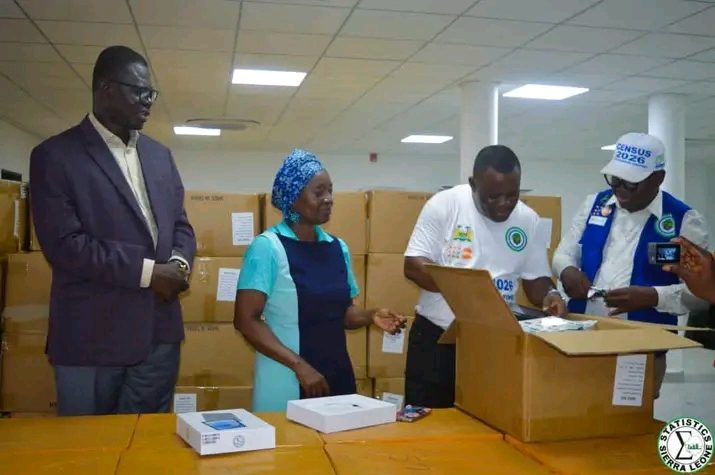
The institution said it had sufficient functional tablets to cover primary assignments in every Enumeration Area (EA) and Supervisory Area (SA) across the country, while efforts are ongoing to secure additional devices to cater for contingencies.
However, Stats SL admitted that higher-than-expected turnout, delays in tablet distribution and changes in training venues disrupted activities at some centres during the initial days of the training programme.
The institution explained that some training centres temporarily experienced shortages of tablets for individual use, prompting it to prioritize distribution to distant districts, including Falaba and Kailahun. It attributed the shortages to distribution schedules, unexpectedly high attendance and technical faults affecting some devices.
According to Stats SL, it has continued addressing technical problems as they arise and reallocating tablets made available through withdrawals and adjustments to reserve allocations. It also disclosed that the tablet allocation gap in Western Area Urban had been addressed, while redistribution efforts had narrowed the gap in Tonkolili District, where checks are continuing at individual training centres.
The institution further explained that the number of trainees invited for training included an allowance of up to five per cent above the actual field staffing requirements. Consequently, the number of tablets required during training was higher than the number expected to be needed during the actual census fieldwork.
On training attendance and class sizes, Stats SL said shortlisted candidates were initially given a specified period to confirm their availability. However, when confirmations fell below the anticipated number, supplementary invitations were issued to ensure that sufficient personnel would be available for the census.
It noted that some candidates who had initially been invited later confirmed their availability or reported for training alongside those who had received supplementary invitations. The unexpected increase in attendance placed additional pressure on tablet availability, catering, seating arrangements and training delivery at some centres.
The institution said training teams were using attendance records, continuous assessments and field practice to monitor participants’ progress and identify those requiring additional support. It emphasized that selection for deployment would be based on verification, attendance, assessment results, demonstrated competence and approved staffing requirements.
Stats SL also acknowledged catering and venue-related challenges during the training process. It said the higher turnout resulted in meal shortages at some centres, particularly during the first two days, prompting adjustments to catering arrangements based on verified attendance figures.
The institution further disclosed that payment arrangements and power supply problems necessitated changes to some training venues. While recognising the inconvenience caused by the short notice, it said training coordinators and its Communication and Public Relations team communicated confirmed venue arrangements through official institutional channels.
On the use of personal devices, Stats SL explained that it temporarily adopted the internationally recognised Bring Your Own Device (BYOD) approach at centres where official tablets were in short supply. This allowed trainees to access designated training materials and permitted functions of the census application using their personal mobile phones.
It added that training and assessment teams reviewed exercises completed on personal phones and established that the devices supported the designated training activities. The institution assured candidates that temporary differences in access to equipment would be taken into consideration when assessing their competence in census procedures and digital tools.
Addressing concerns about disrupted practical sessions, Stats SL said equipment constraints and venue changes had reduced practical training time at some centres. It explained that attendance records, training documentation, tablet distribution records and facilitator reports were reviewed to identify areas where additional intervention was necessary.
As part of the corrective measures, the institution said it was providing additional supervised practice, targeted revision sessions and further competency assessments for trainees requiring support. It also disclosed that training had been extended by one additional day at some centres to compensate for lost practical training time.
Stats SL maintained that trainees would be required to demonstrate the necessary practical skills before being considered for deployment, stressing the importance of ensuring that field personnel were adequately prepared to undertake their responsibilities during the national census.
The institution also provided clarification on the size and workload of Enumeration Areas, explaining that national mapping exercises used approximate planning ranges of 80 to 100 households per rural Enumeration Area and 100 to 120 households per urban Enumeration Area.
According to Stats SL, these planning ranges may vary depending on terrain, population and building density, as well as physical accessibility. It added that mapping considerations also included settlement patterns, geographical continuity and administrative boundaries.
Reaffirming its commitment to the successful conduct of the 2026 Population and Housing Census, Stats SL welcomed feedback from stakeholders, describing public engagement as an important part of collective efforts to deliver a credible, transparent and inclusive national exercise.
The institution’s latest update comes as preparations intensify for the December 2026 National Population and Housing Census, with the effectiveness of enumerator training, the availability of functional equipment and the readiness of field personnel remaining important factors in determining the quality and reliability of the exercise.
Stats SL has therefore assured the public that measures are being taken to address the challenges identified during training, while maintaining that only candidates who satisfy the required verification, attendance, assessment and competency standards will be selected for census field deployment.