
The Ministry of Gender and Children’s Affairs (MoGCA), in collaboration with development partners, have called for stronger institutional action, increased funding and effective prosecution of Gender-Based Violence (GBV), stressing the need to move beyond policy commitments to concrete measures that protect women and girls.
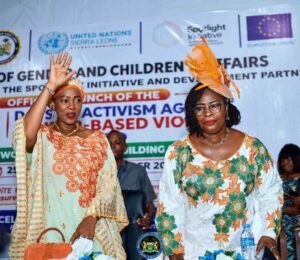
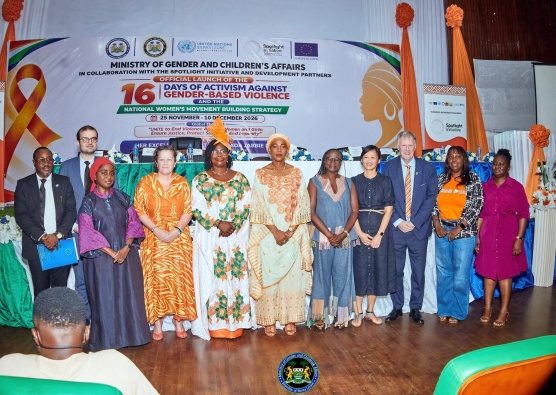
The call was made on Wednesday, 25 November, 2026 during the launch of the 2026 16 Days of Activism Against Gender-Based Violence and the National Women’s Movement Building Strategy at the Miatta Conference Centre in Freetown.
The launch brought together Government officials, development partners and Civil Society Organisations, including representatives of Japan International Cooperation Agency (JICA), the European Union, the Spotlight Initiative, the Rainbow Initiative and the Government of Ireland, to renew commitments towards ending violence against women and girls.
This year’s campaign, running from 25 November to 10 December 2026, is being observed under the global theme: “Unite to End Violence Against Women and Girls: Ensure Justice, Protect Survivors, End Impunity.”
Delivering the keynote address, the First Lady described Gender-Based Violence as a national, human rights and development concern rather than merely a women’s issue. She said the problem threatens families, weakens communities and undermines the country’s future.
She called for an end to the culture of silence, victim-blaming and impunity, emphasizing that responsibility for violence rests solely with perpetrators and never with survivors.
“Let us not allow 16 days of activism to become 16 days of speeches followed by 351 days of silence,” she said, urging Government institutions, traditional and religious leaders, development partners and citizens to translate their commitments into measurable action.
Reaffirming her commitment to the Hands Off Our Girls campaign, the First Lady described the enactment of the Prohibition of Child Marriage Act 2024 as a significant milestone in protecting women and girls. However, she stressed that the effectiveness of the law would depend on its proper implementation.
“Legislation alone is not enough. The true measure of progress is whether our laws protect the girls in the village, the women in the city, the survivors seeking justice and the child whose future is at risk,” she stated.
Speaking on behalf of the UN Resident Coordinator, UN Women Officer-in-Charge, Baindu Massaquoi, highlighted persistent challenges in securing justice for survivors, particularly cases undermined by inadequate transport, insufficient investigators and limited protection for witnesses.
She stressed that the justice system must move beyond legislation to ensure that perpetrators are held accountable and survivors receive the protection and services they need.
“A law that is not enforced is not justice. A service that is not funded is not protected. A case that is never prosecuted teaches a community that violence is permitted,” Baindu Massaquoi said.
She disclosed that the United Nations had supported 81 one-stop centres and strengthened 14 Family Support Units, while the Gender-Based Violence Information Management System had expanded its coverage from four districts to all 16 districts in Sierra Leone.
However, she called on the Government to take greater responsibility for sustaining those interventions through domestic funding, particularly as the EU-funded Spotlight Initiative approaches its end.
Speaking at the ceremony, the Minister of Gender and Children’s Affairs, Dr. Isata Mahoi, said the newly launched National Women’s Movement Building Strategy would provide a common platform for women across districts, chiefdoms and communities to organize, strengthen solidarity and influence national decision-making.
She explained that the strategy places survivors, young women, rural women, women living with disabilities and other traditionally excluded groups at the centre of decision-making.
According to her, lasting progress against Gender-Based Violence requires more than legislation and policies, as communities must take ownership of the process and women must be empowered to lead the change.
“Legislation alone does not end violence. Policies alone do not change attitudes. Institutions alone do not dismantle harmful norms. Change becomes sustainable when communities own it, when women lead it and when society collectively defends it,” Dr. Isata Mahoi said.
On the prosecution of Gender-Based Violence cases, Senior State Prosecuting Counsel, Vivian Esther Kargbo, committed the Attorney-General’s Office to strengthening oversight, engaging investigators earlier and regularly reviewing outstanding Sexual and Gender-Based Violence cases.
She assured survivors that her office would work towards improving the handling of their cases and addressing avoidable delays within its control.
“To the women and girls of Sierra Leone, I commit my office to respectful treatment, proper attention to your cases and action on avoidable delays within our control,” she said, adding that the real measure of commitment would be the treatment and outcomes survivors experience after reporting violence.
The World Bank Country Manager, Alissatou Diallo, emphasized the importance of providing survivors with accessible healthcare, psychosocial support and legal assistance. She also called for greater investment in education, skills training and livelihood opportunities to help women rebuild their lives and reduce economic dependence.
The representative of European Union, in his contribution, called for increased and sustained domestic financing for institutions responsible for preventing and responding to Gender-Based Violence, noting that effective policies and interventions require adequate resources and strong institutional support.
The launch ended with renewed calls for Government institutions, development partners and communities to sustain their commitment beyond the 16-day campaign, with speakers stressing that protecting women and girls and ensuring justice for survivors must remain a year-round national priority.