

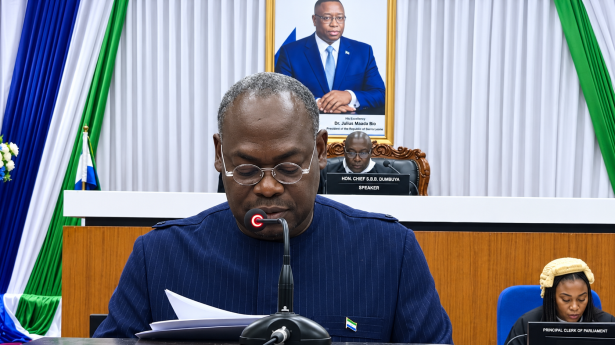
The Minister of Finance, Karefa A. F. Kargbo, has presented the Finance Bill, 2027, to Parliament for consideration and approval, outlining comprehensive tax and revenue reforms aimed at strengthening domestic revenue mobilisation, improving tax compliance, protecting local industries and supporting the Government’s national development agenda.
Presenting the Bill before Parliament on Thursday November 26, 2026, Karefa A. F. Kargbo explained that the proposed legislation seeks to give legal effect to the Government’s financial and economic policy proposals for the 2027 financial year. He emphasized that sustainable domestic revenue mobilisation remains fundamental to achieving fiscal stability, economic resilience and national self-reliance.
The Finance Bill, 2027, proposes amendments to several existing laws, including the Income Tax Act, 2000, the Customs Act, 2011 and the Tax and Duty Exemptions Act, 2023, to address existing revenue collection challenges and strengthen financial accountability.
Among the key proposals is the introduction of measures to strengthen income tax administration by linking bank accounts to Taxpayer Identification Numbers (TIN) or National Identification Numbers (NIN). The initiative is intended to improve financial transparency, enhance tax compliance and combat tax evasion.
The Bill also proposes adjusting non-taxable income thresholds in line with the statutory minimum wage to cushion low-income earners against the effects of inflation and rising living costs.
In the area of customs administration, the Minister proposed that duties and taxes on imported petroleum products be fully paid at the point of entry before the products are transferred to storage depots.
The proposed legislation further seeks to introduce minimum floor prices for public auctions conducted at the Queen Elizabeth II Quay to prevent revenue losses arising from the undervaluation of abandoned or seized goods.
To strengthen oversight of transfer pricing arrangements, the Bill proposes that the Commissioner-General obtain prior written approval from the Minister of Finance before entering into Advance Pricing Agreements.
Regarding tax and duty exemptions, Karefa A. F. Kargbo disclosed that beneficiaries would be required to submit import plans every six months to enhance monitoring, improve accountability and prevent the abuse of exemption privileges.
The Bill also proposes a 20 percent surcharge on imported goods that are already produced locally in sufficient quantities and meet acceptable quality standards. The measure is intended to protect domestic industries, encourage local production and strengthen the competitiveness of Sierra Leonean businesses.
Another significant proposal is the introduction of an annual local poll tax of Le10 for residents aged 18 years and above within local council jurisdictions. However, indigent persons, full-time students and persons living with severe disabilities would be exempted.
According to the Finance Minister, the proposed tax is designed to strengthen the internally generated revenue of local councils and enhance their capacity to provide essential community services, including sanitation, waste management and market maintenance.
The Finance Bill also seeks to promote transparency and accountability in public procurement by requiring bidders for major Government contracts to present verifiable Certificates of Good Standing through a QR-code verification system.
The proposed requirement is intended to ensure that businesses seeking Government contracts comply with their tax, National Social Security and Insurance Trust (NASSIT), public procurement and local content obligations.
Additionally, the Minister announced a proposed 20 percent performance incentive for designated revenue-generating Ministries, Departments and Agencies (MDAs) on additional revenue collected above their respective targets and paid into the Consolidated Revenue Fund.
The initiative is expected to encourage public institutions to improve revenue collection, minimize leakages and strengthen operational efficiency.
Concluding his presentation, Karefa A. F. Kargbo maintained that the Finance Bill, 2027, represents a significant step towards closing revenue loopholes, promoting fairness in taxation, protecting local industries and strengthening Sierra Leone’s fiscal position.
He urged Members of Parliament to consider and approve the proposed legislation, describing the reforms as essential to financing the Government’s development priorities, strengthening economic resilience and improving public service delivery.
Following the presentation, Members of Parliament, including members of the Parliamentary Leadership, made various contributions during the debate on the Bill.