By Amin Kef (Ranger)
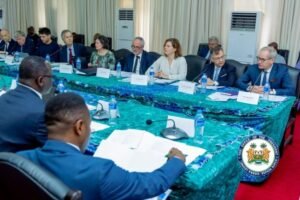
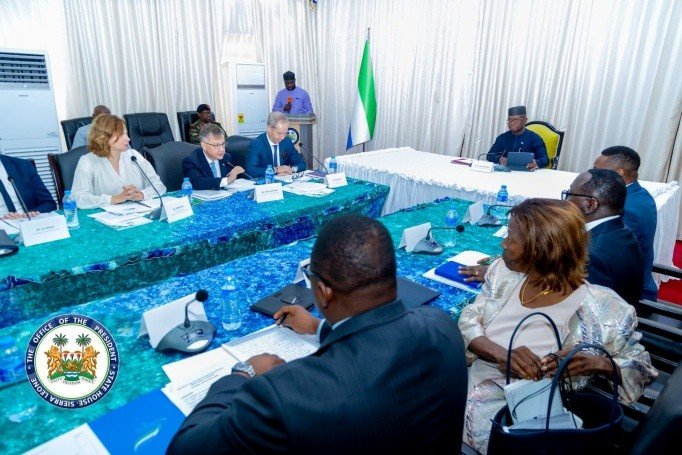
The Government of the Republic of Sierra Leone and the European Union (EU) have reaffirmed their enduring political, economic and development partnership following the successful conclusion of the 2025 Annual Political Partnership Dialogue, held on Tuesday December 16, 2025 at State House in Freetown.

The high-level engagement was chaired by His Excellency Dr. Julius Maada Bio, President of the Republic of Sierra Leone and brought together senior Ministers and top Government officials. The European Union delegation was led by Olof Skoog, Deputy Secretary-General for External Action, accompanied by six EU Ambassadors accredited to Sierra Leone and senior diplomats, reflecting the importance both sides attach to the dialogue.
Both parties welcomed the continued convening of the Political Partnership Dialogue, describing it as a cornerstone of the long-standing, mutually beneficial relationship between Sierra Leone and the European Union. The forum provides a structured platform for frank exchange, strategic alignment and cooperation on key national, regional and global issues.
Discussions during the dialogue were constructive and forward-looking, organized around three interrelated priority areas: democracy and the rule of law, regional and multilateral affairs and socio-economic partnership.
On democracy and governance, both parties reaffirmed their shared belief that democratic systems remain the most sustainable foundation for peace, stability and inclusive development. The Government of Sierra Leone highlighted ongoing political and governance reforms aimed at strengthening public trust in democratic institutions and electoral processes. In that regard, Sierra Leone welcomed continued EU support, including through European Union Electoral Observation Missions, which have played a key role in reinforcing electoral credibility and transparency.
Building on that commitment to the rule of law, both sides agreed to intensify cooperation in the fight against organized crime, illicit drug trafficking and transnational criminal networks. They stressed the need for coordinated action, stronger institutions and enhanced information-sharing to confront those growing threats, which undermine security, public health, governance and regional stability.
The European Union acknowledged Sierra Leone’s strengthened international profile in 2025, marked by its second year as a Non-Permanent Member of the United Nations Security Council and its Presidency of the Council in November 2025. The EU commended Sierra Leone’s constructive engagement in addressing regional and global crises and its consistent advocacy for African perspectives within multilateral platforms.
At a time when multilateralism faces mounting global pressures, both parties reaffirmed their commitment to a rules-based international order anchored in the United Nations system. They underscored their shared dedication to international law, the principles of the UN Charter, human rights and fundamental freedoms, with particular emphasis on gender equality as a cross-cutting priority.
The dialogue also focused on regional peace and security challenges, highlighting Sierra Leone’s leadership role as Chair of the ECOWAS Authority in 2025. In line with the outcomes of the African Union–European Union Summit held in Luanda in November 2025, the European Union reiterated its support for ECOWAS initiatives aimed at preserving peace, democratic governance and constitutional order across West Africa.
Both sides further emphasized the strategic importance of maritime security, recognizing its central role in safeguarding trade routes, protecting coastal communities and strengthening economic resilience in the sub-region amid increasing transnational threats.
On socio-economic cooperation, the dialogue reviewed progress on Sierra Leone’s Medium-Term National Development Plan (MTNDP) 2024–2030 and the implementation of the Government’s Big Five Game Changers. Discussions highlighted the importance of fiscal discipline, improved public financial management and sustained structural reforms to create a more conducive environment for private sector investment and inclusive economic growth.
Both parties agreed that strong governance, respect for the rule of law and decisive action against organized crime and trafficking are essential not only for social stability and citizen confidence, but also for attracting responsible investment and supporting long-term development outcomes.
At the conclusion of the dialogue, the Government of Sierra Leone and the European Union reaffirmed their shared commitment to maintaining regular high-level consultations on issues of mutual interest. The Political Partnership Dialogue will continue to complement ongoing bilateral engagement and coordination within the Development Partners Coordination Group (DEPAC), further strengthening cooperation in support of Sierra Leone’s national development priorities.