
By Amin Kef (Ranger)
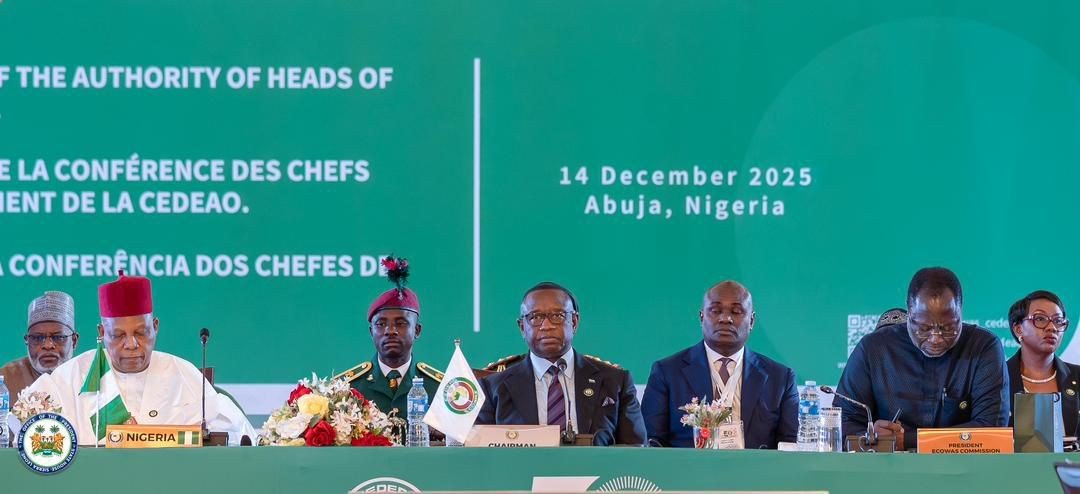
West African leaders meeting in Abuja on Sunday have adopted far-reaching decisions aimed at deepening regional integration, strengthening democracy, accelerating economic transformation and confronting growing security threats across the sub-region. The decisions were contained in the Final Communiqué of the Sixty-Eighth Ordinary Session of the Authority of Heads of State and Government of the Economic Community of West African States (ECOWAS), held under the chairmanship of President Julius Maada Bio of Sierra Leone.
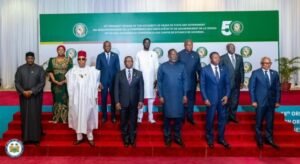
The high-level summit at Abuja, Federal Republic of Nigeria, on December 14, 2025 brought together Presidents, Vice Presidents, Ministers of Foreign Affairs and senior regional and international officials, reflecting the strategic importance of the meeting at a time when West Africa faces complex economic, political and security challenges. Among those in attendance were the Presidents of Cabo Verde, The Gambia, Ghana, Senegal, Sierra Leone and Togo, as well as Vice Presidents of Côte d’Ivoire and Nigeria and Foreign Ministers from Benin and Liberia. Leaders of ECOWAS, UEMOA, the African Union and the United Nations system in West Africa were also present.
The session was attended by the following Heads of State and Government or their duly mandated representatives: H.E. Jose Maria Pereira Neves, President of the Republic of Cabo Verde; H.E. Adama Barrow, President of the Republic of The Gambia; H.E. John Dramani Mahama, President of the Republic of Ghana; H.E. Bassirou Diomaye Faye, President of the Republic of Senegal; H.E. Julius Maada Bio, President of the Republic of Sierra Leone; H.E. Faure Essozimna Gnassingbé, President of the Council of the Togolese Republic; H.E. Tiémoko Meyliet Koné, Vice-President of the Republic of Côte d’Ivoire; H.E. Senator Kashim Shetima, Vice-President of the Federal Republic of Nigeria; H.E. Olushegun Adjadi Bakari, Minister of Foreign Affairs of the Republic of Bénin; and H.E. Sara Beysolow Nyanti, Minister of Foreign Affairs of the Republic of Liberia.
Also in attendance were H.E. Omar Alieu Touray, President of the ECOWAS Commission; H.E. Abdoulaye Diop, President of the UEMOA Commission; H.E. Mahmoud Ali Youssouf, Chairperson of the African Union Commission, represented by Dr. Bankole Adeoye, Commissioner for Political Affairs, Peace and Security; H.E. Mohamed Ibn Chambas, Chairperson of the ECOWAS Trade Liberalization Scheme Taskforce; H.E. Amb. Baba Kamara, Special Envoy on Terrorism; and H.E. Leonardo Santos Simão, Special Representative of the United Nations Secretary-General for West Africa and the Sahel (UNOWAS), represented by Dr. James Aji, Head of UNOWAS Representation to Nigeria.
In a special session on the future of the Community, the Authority took stock of ECOWAS’ 50-year journey and acknowledged both achievements and shortcomings. Leaders reaffirmed their commitment to deeper regional integration, youth and women empowerment, digital and economic transformation, stronger connectivity, peace and security, democratic governance and equitable partnerships. They also agreed on the need to review key Community texts to better align ECOWAS institutions with present-day realities and the aspirations of West African citizens.
On economic performance, the Authority welcomed the resilience shown by ECOWAS economies in 2025, noting improved growth, easing inflationary pressures and ongoing fiscal consolidation. Member States were urged to sustain reforms, intensify domestic resource mobilization and improve the efficiency and quality of public spending to consolidate gains and protect economic stability.
A major focus of deliberations was monetary integration and the planned launch of the ECOWAS single currency, the ECO. Leaders expressed concern over weak macroeconomic convergence among Member States and delays in implementing the agreed roadmap, with less than two years remaining before the target launch date. The Authority called on Member States to adopt appropriate policies to meet convergence criteria and directed the ECOWAS Commission to reactivate the Presidential Task Force on the Single Currency Programme to build consensus on sensitive and urgent issues.
On the free movement of persons, the Authority commended Nigeria for the successful deployment of the ECOWAS National Biometric Identity Card, describing it as a milestone for regional integration and security. However, noting that only seven Member States have so far deployed the card, leaders urged remaining countries to accelerate implementation to ensure seamless mobility and enhanced cooperation across the Community.
Trade and regional market integration also featured prominently. The Authority directed ECOWAS and UEMOA Commissions to harmonize rules of origin under the ECOWAS Trade Liberalization Scheme to promote free movement of goods. It further instructed dialogue with UEMOA to resolve issues surrounding the imposition of a community solidarity levy on goods from non-UEMOA ECOWAS states. On the African Continental Free Trade Area (AfCFTA), Member States were urged to fast-track national and regional implementation strategies to fully benefit from continental trade integration.
In the energy sector, leaders welcomed the historic synchronization of power systems across 15 West African countries under the West African Power Pool (WAPP) in November 2025. However, concerns were raised over persistent payment defaults by member companies, which threaten WAPP’s sustainability and the launch of the regional electricity market. Member States were urged to clear arrears and meet obligations in recognition of WAPP’s strategic role in economic development.
A landmark decision was reaffirmed on air transport, with the Authority directing uniform implementation of measures to reduce passenger and security charges by 25 percent and remove non-compliant taxes on air transport services. The directive, which takes effect from 1 January 2026, is aimed at lowering travel costs, improving connectivity and boosting intra-regional trade and tourism.
On democracy, peace and security, the Authority noted relative regional stability despite mounting geopolitical pressures. Leaders welcomed recent and ongoing electoral processes in several Member States and encouraged transparency and inclusivity, particularly in Guinea’s transition towards presidential elections scheduled for 28 December 2025. The Authority also commended progress in Sierra Leone on implementing the Agreement for National Unity, including electoral reforms and confidence-building measures between the Government and opposition.
Strong positions were taken on unconstitutional changes of Government. The Authority condemned the recent coup in Guinea-Bissau and the attempted coup in Benin, warning against any reversal of constitutional order. It authorized enhanced ECOWAS engagement, including potential sanctions, if inclusive transitions and credible elections are not restored. The Authority also warned former Gambian President Yahya Jammeh against actions from exile that threaten peace and cohesion, affirming that he remains accountable for alleged human rights violations.
Addressing the deteriorating security situation, particularly in the Sahel and Lake Chad Basin, the Authority expressed grave concern over terrorism, banditry, kidnappings and humanitarian crises affecting millions. ECOWAS reaffirmed its commitment to eradicating terrorism and announced financial support of $2.85 million each for affected frontline states, including Benin, Côte d’Ivoire, Ghana, Nigeria and Togo. Leaders also ordered urgent steps to operationalize the Regional Counterterrorism Brigade and strengthen intelligence and defence cooperation.
On humanitarian matters, the Authority directed the ECOWAS Commission to intensify multi-sectoral responses to worsening crises and urgently mobilize resources to evacuate ECOWAS citizens stranded in Libya and Algeria.
Institutionally, the Authority endorsed the allocation of key ECOWAS statutory positions for the 2026–2030 period among Member States, supported Ghana’s sole candidacy for Chairperson of the African Union in 2027 and approved the relocation of the West African Health Organisation headquarters to Côte d’Ivoire. It also admitted Burkina Faso, Mali and Niger as non-ECOWAS members of GIABA, subject to commitments on anti-money laundering and counter-terrorism financing standards.
The summit concluded with the Authority applauding President Julius Maada Bio for his leadership as ECOWAS Chair, praising his commitment to regional integration, peace and security. The date and venue of the next Ordinary Session will be announced in due course.