By Amin Kef (Ranger)
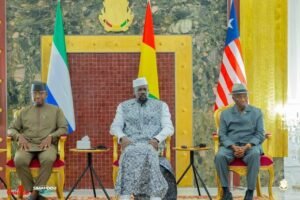
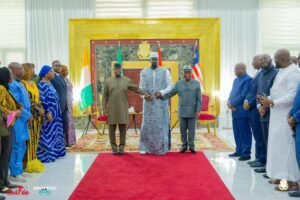
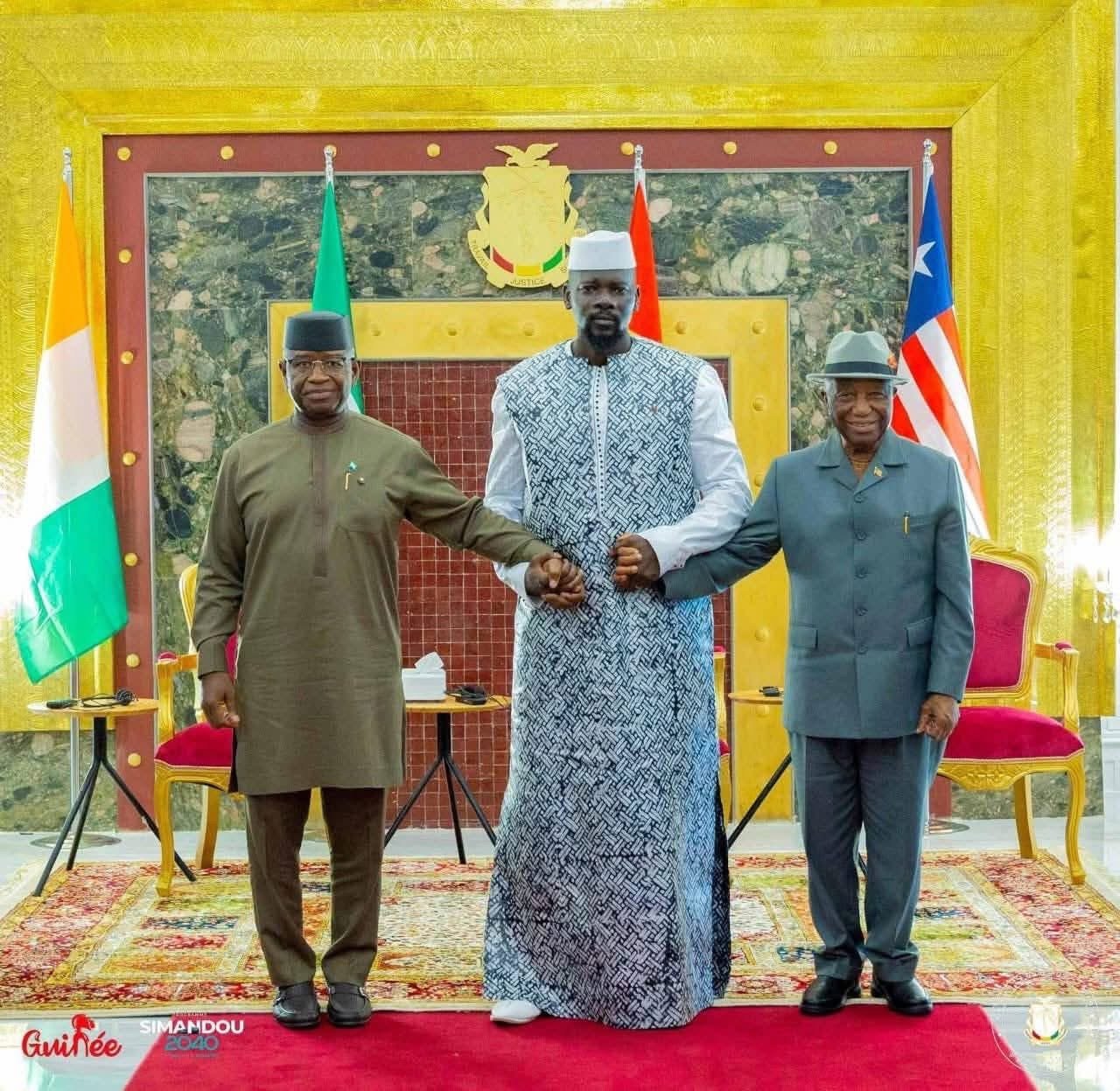
In a decisive display of leadership and regional solidarity, President Julius Maada Bio of Sierra Leone joined President Joseph Nyuma Boakai of Liberia and President Mamadi Doumbouya of Guinea in Conakry to broker a landmark agreement aimed at resolving escalating border tensions within the Mano River Union.

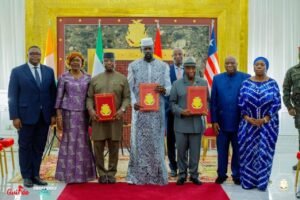
The high-stakes summit, held on Monday, 16 March 2026, comes at a critical juncture when fragile peace along the borders of Sierra Leone, Liberia, and Guinea was under threat due to a series of recent incidents that heightened fears of potential conflict. Against this tense backdrop, the three leaders rose above national differences to chart a path rooted in diplomacy, cooperation, and mutual respect.
At the center of the breakthrough was President Julius Maada Bio, who, in his dual capacity as President of Sierra Leone and Chairman of the Authority of Heads of State and Government of the Economic Community of West African States (ECOWAS), delivered a strong message of unity and peaceful coexistence.
“At the conclusion of the Tripartite Summit on border disputes held in Conakry, we, the Leaders, reaffirmed our shared commitment to maintaining stability along our borders, promoting security cooperation, and strengthening the bonds of neighborliness among our three nations,” President Bio declared.
His remarks captured the spirit of the summit—one defined not by confrontation, but by a shared determination to preserve peace in a region with a complex history of cross-border tensions.
President Bio also commended his counterparts, acknowledging the “openness and camaraderie” demonstrated by Presidents Boakai and Doumbouya during what many observers described as frank but constructive discussions.
The summit, hosted by President Mamadi Doumbouya at the Mohammed V Palace, brought together the three Heads of State for closed-door deliberations focused on de-escalating tensions and preventing further deterioration of relations among the Mano River Union countries. Côte d’Ivoire participated as a witness nation, reflecting broader regional concern over the situation.
Recent weeks had seen troubling developments along the borders. In the Yenga area—a longstanding flashpoint between Sierra Leone and Guinea—mutual accusations of territorial incursions resurfaced. Sierra Leone had alleged that Guinean forces detained its security personnel following border clashes, while Guinea maintained concerns over the integrity of its territorial boundaries.
Simultaneously, tensions along the Liberia–Guinea border intensified after reports emerged that Guinean troops crossed into Liberian territory in the Sorlumba area of Lofa County. The situation escalated further when local authorities reported confrontations between soldiers and civilians, resulting in injuries and displacement of residents.
These incidents triggered alarm across the subregion, prompting urgent calls for diplomatic intervention. ECOWAS, under President Bio’s leadership, had earlier urged restraint and announced plans to deploy a technical assessment mission to the Mano River Basin.
Against this volatile backdrop, the Conakry summit became a crucial platform for dialogue—and ultimately, a turning point.
At the conclusion of the meeting, the three leaders reached a comprehensive agreement anchored on peaceful dispute resolution. Central to their commitment was the decision to address all border-related issues through diplomatic channels, effectively rejecting any form of military escalation.
In a major step forward, the leaders announced the establishment of joint technical commissions tasked with examining border delimitation, management, and security coordination. These commissions are expected to provide practical, long-term solutions to disputes that have persisted for decades, many of which stem from colonial-era boundary demarcations.
Equally significant was the immediate de-escalation measure announced by Guinea’s military authorities. In Communiqué No. 003, issued by General Ibrahima Sory Bangoura, Chief of the General Staff of the Guinean Armed Forces, the military confirmed a “progressive easing of the defence apparatus” along the country’s borders with Sierra Leone and Liberia.
The move, which took effect on Tuesday, 17 March 2026, marks the first concrete implementation of the summit’s resolutions and is widely seen as a confidence-building measure aimed at restoring calm along the frontiers.
While announcing the troop drawdown, the Guinean military commended its defence and security forces for their “proactiveness and self-control” during the period of heightened tensions. At the same time, it reaffirmed its unwavering commitment to defending national sovereignty, highlighting the delicate balance between peace and preparedness.
For President Mamadi Doumbouya, the summit represented an opportunity to demonstrate both strength and statesmanship. Having earlier overseen troop deployments to Guinea’s borders, his decision to host and actively engage in diplomatic dialogue signaled a shift from military posture to regional cooperation.
President Joseph Nyuma Boakai, for his part, brought a strong message of peace and stability, particularly in relation to the situation along Liberia’s northern frontier. Backed by a high-level delegation, he emphasized the importance of protecting border communities and ensuring that disputes are resolved without further harm to civilians.
The significance of the Conakry summit extends beyond immediate de-escalation. It represents a reaffirmation of the founding principles of the Mano River Union—cooperation, integration, and shared prosperity.
Established in 1973, the Mano River Union was designed to promote economic collaboration among Sierra Leone, Liberia, and Guinea, later joined by Côte d’Ivoire. However, its history has been marked by periods of instability, particularly during the civil wars of the 1990s and early 2000s, when conflicts spilled across borders and devastated communities.
Today’s renewed commitment to dialogue signals a departure from that troubled past and a collective determination to safeguard the region’s future.
For Sierra Leone, President Bio’s leadership at the summit reinforces the country’s growing diplomatic influence within West Africa. His emphasis on dialogue, cooperation, and respect for sovereignty aligns closely with ECOWAS principles and underscores Sierra Leone’s role as a stabilizing force in the region.
Observers have described the summit as a “defining moment” for West African diplomacy—one that demonstrates the power of leadership in transforming potential conflict into opportunity for cooperation.
However, the true test lies ahead. The success of the agreements reached in Conakry will depend on sustained political will, effective implementation of technical recommendations, and continued engagement among the three nations.
Border communities, who have borne the brunt of recent tensions, now look forward to a return to normalcy—where trade can resume, schools can reopen, and livelihoods can be restored without fear.
As the leaders depart Conakry with renewed commitments, the message is clear: peace is not only possible, but achievable through dialogue, trust, and collective action.
In a region once scarred by conflict, the Conakry summit stands as a powerful reminder that unity among nations is the strongest safeguard against division—and that through cooperation, the Mano River Union can once again become a beacon of stability and progress in West Africa.