By Amin Kef (Ranger)
Public confidence in the independence of media and civil society institutions in Sierra Leone is facing renewed scrutiny, following the release of a citizens’ perception survey conducted by CHRDI. The findings paint a concerning picture of declining trust in institutions traditionally regarded as watchdogs of democracy.
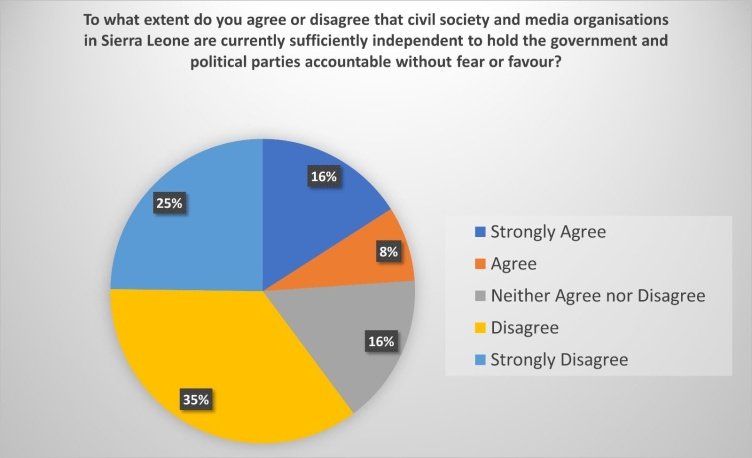
According to the poll, a significant majority of respondents expressed doubt about the ability of media and Civil Society Organizations to hold Government and political actors accountable without fear or favour. The data indicates that approximately six in ten citizens believe those institutions are not sufficiently independent, raising serious questions about the strength of democratic oversight in the country.
A breakdown of the survey results shows that 35% of respondents disagreed with the notion that media and civil society are independent, while an additional 25% strongly disagreed. In contrast, only 16% strongly agreed and 8% agreed that those institutions operate freely and without undue influence. Meanwhile, 16% of respondents remained neutral, suggesting a segment of the population that could be influenced by future developments in governance and accountability.
Analysts say the disparity between negative and positive perceptions, captured in what has been described as a “6-to-2 ratio”, underscores a growing credibility gap. Particularly notable is the intensity of sentiment among respondents, with those who “strongly disagree” outnumbering those who “strongly agree” by nearly ten percentage points. That imbalance signals not only skepticism, but also deep-seated concern about institutional performance.
Observers have warned that such perceptions, if left unaddressed, could weaken public trust in democratic processes. Media and Civil Society Organizations are widely regarded as essential pillars in promoting transparency, amplifying citizen voices and checking excesses of power. When those institutions are perceived as constrained, whether by political pressure, economic influence or fear, the broader system of accountability risks erosion.
Equally important is the group of undecided respondents, which constitutes 16% of those surveyed. Experts suggest this “silent middle” represents an opportunity for reform-minded actors. By demonstrating professionalism, courage and independence in reporting and advocacy, media houses and Civil Society Organizations could rebuild confidence and strengthen their legitimacy in the eyes of the public.
The findings come at a time when conversations around governance, transparency and civic engagement are gaining momentum across Sierra Leone. Stakeholders have increasingly emphasized the need for institutional reforms, legal protections and ethical standards that safeguard the independence of journalists and civil society actors.
Ultimately, the survey serves as both a warning and a call to action. A resilient democracy depends on fearless institutions capable of speaking truth to power. Rebuilding public trust will require deliberate efforts to ensure that accountability mechanisms function without intimidation or compromise, allowing citizens to once again believe that their voices and the institutions that represent them can operate freely and effectively.