By Amin Kef (Ranger)
President Dr. Julius Maada Bio has reaffirmed the Government’s commitment to the Feed Salone Initiative, describing it as Sierra Leone’s flagship response to long-standing food insecurity and a central pillar of the country’s economic transformation agenda.

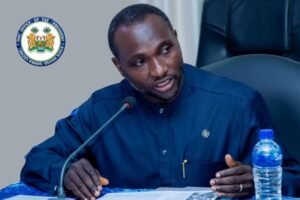
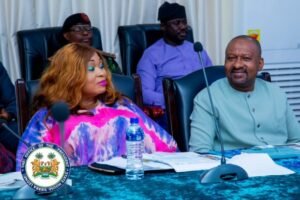
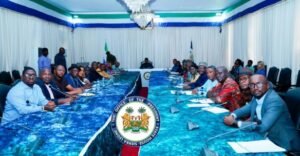
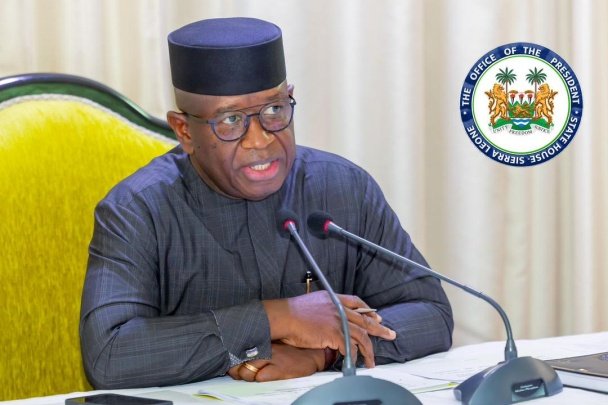
The President made the statement on Thursday, March 12, 2026, at State House in Freetown while receiving a progress report from members of the Presidential Council for Delivering Feed Salone, the body mandated to oversee the implementation of the agricultural initiative.
The council, which was inaugurated in October 2023, is composed of experienced and qualified Sierra Leoneans tasked with ensuring that the Feed Salone programme delivers measurable and sustainable outcomes for citizens across the country.
Addressing members of the council, President Bio underscored the importance of transforming agriculture from subsistence farming into a productive and commercially viable sector capable of generating employment and strengthening the national economy.
He noted that the initiative is already contributing to improvements in rural livelihoods and helping to address malnutrition, particularly in vulnerable communities. According to the President, innovation, collaboration and the exchange of ideas remain critical ingredients for the successful transformation of the country’s agricultural sector.
“Sierra Leone possesses the natural potential to produce enough food to feed its population,” President Bio stated, emphasizing that the Feed Salone initiative is designed to unlock that potential through strategic investment and coordinated national action.
The President further highlighted the importance of strengthening domestic food production at a time when global supply chains are increasingly affected by geopolitical tensions and conflicts around the world. He described Feed Salone as a national resilience strategy intended to reduce the country’s dependence on food imports.
President Bio disclosed that pressure on food imports has already begun to decline as a result of progress made in the past three years. He also pointed to increased cocoa exports as an important development that is contributing to Sierra Leone’s foreign exchange earnings.
Among the key milestones highlighted was the establishment of a seed laboratory at Mile 91, which is supporting farmers with improved access to quality seeds. The President also commended the ongoing work of the Sierra Leone Agricultural Research Institute in strengthening agricultural productivity across the country.
Calling for broader collaboration, President Bio encouraged increased private sector participation in the agricultural sector, particularly in poultry production, which he described as a vital component in the country’s efforts to reduce food imports.
He stressed that 2026 must be a year of accelerated action for the Feed Salone initiative, urging members of the council to intensify efforts to track progress, expand irrigated farmland, strengthen technical expertise and mobilize greater investment in the sector.
The President also revealed that irrigation works currently underway in Tormabum and Gbondapi are nearing completion. He expressed optimism that sustained investment in agriculture will ultimately eliminate the country’s reliance on imported staples such as rice, onions and fresh eggs.
According to him, the next phase of the initiative will also prioritize the development of agricultural infrastructure, including storage facilities, rural roads, markets and milling plants, to support increased production and distribution.
President Bio further emphasized the need to enhance value addition through local processing of agricultural commodities while leveraging data, technology and innovation to modernize farming practices.
“This Feed Salone initiative must be treated as a national priority. We are building a Sierra Leone where we can feed ourselves and improve lives,” the President said.
Providing an update on the programme’s implementation, Minister of Agriculture and Food Security Henry Musa Kpaka reported that the country has recorded significant improvements in food security indicators.
He revealed that the rate of severe food insecurity declined from 28 percent in 2023 to 13 percent in 2025, reflecting the positive impact of Government interventions in the agricultural sector.
The Minister also reported increased agricultural exports, particularly cocoa, alongside improvements in feeder roads, bridges, milling facilities and storage infrastructure designed to support farmers and agricultural value chains.
He added that Sierra Leone has not imported seeds over the past three years due to strengthened domestic seed production systems.
According to the Minister, Government support has so far facilitated the cultivation of 17,100 hectares of rice, 3,000 hectares of cocoa, 490 hectares of onions and 670 hectares of maize.
Looking ahead, the Government plans to establish two major rice production clusters, a Cocoa Board, an Agricultural Development Bank and an Agricultural Insurance Scheme. Expansion of livestock and veterinary services is also part of the strategy to strengthen food production.
The Minister further announced the arrival of 40 new tractors, which will be deployed to support mechanized farming under the Feed Salone programme.
The meeting concluded with renewed commitment from Government and stakeholders to accelerate the transformation of agriculture into a modern, resilient and productive sector capable of feeding the nation, reducing poverty and driving sustainable economic growth in Sierra Leone.