By Foday Moriba Conteh
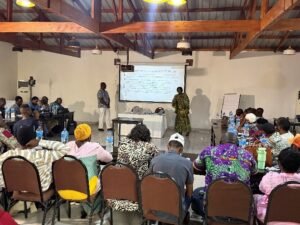
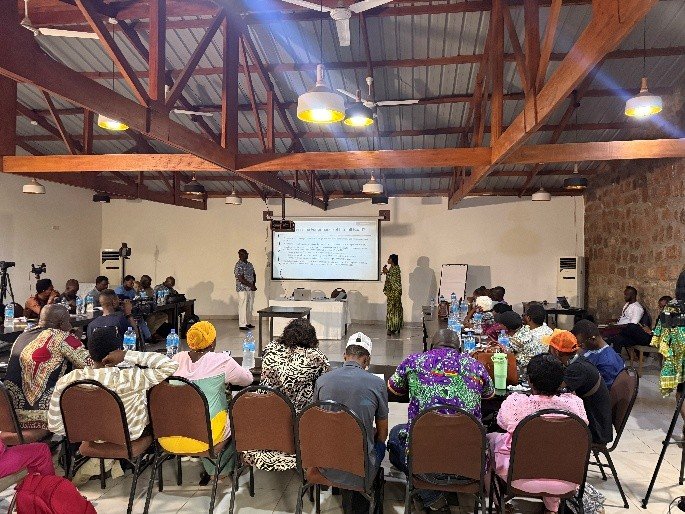
The Executive Director of the Institute for Governance Reform (IGR), Andrew Lavali, has presented a damning assessment of how political interests and opaque procurement deals are draining Sierra Leone of critical public revenue. He made the presentation on Friday, 30 January 2026 at Lacs Villa, Red Pump in Freetown, during the launch of IGR’s latest report titled: “Di Hade Pa Di Case: Politics and Revenue Failures in Sierra Leone.”

The report argues that while corruption, political instability and ethnic politics are often blamed for the country’s persistent poverty, a deeper problem lies in the way large state contracts are awarded and managed. According to IGR, vital revenue sources have been captured by a small network of business elites whose interests now exert a stranglehold on the national budget.
Andrew Lavali told the audience that understanding the politics of public procurement is essential to explaining why a resource-rich country remains unable to provide quality services for its citizens. “When governance is designed to benefit a few, state-owned enterprises collapse, mining agreements yield almost nothing and ordinary people pay the price,” he said.
The study analysed approximately 3,400 state contracts issued between 2016 and 2023, covering both the All People’s Congress (APC) and Sierra Leone People’s Party (SLPP) administrations. Researchers also conducted extensive interviews with current and former public officials from both Governments.
The central question posed by the report is why officials are willing to violate procurement rules in order to award contracts that mainly serve private business interests. IGR concludes that this is not accidental but part of a deliberate system through which economic institutions are controlled.
To ground its findings, the report examined two major agreements: the Wellington–Masiaka Toll Road concession and the national e-passport contract. Both deals were initiated under the APC and later inherited by the SLPP. Although the SLPP campaigned in 2018 on a promise to review the toll road contract, the Government abandoned the plan after taking office.
“This demonstrates that institutional behaviour rarely changes regardless of which party is in power,” the report notes.
IGR identifies four main strategies used by business interests to dominate public procurement:
- Financing leading politicians across both major parties to guarantee access to power after elections.
- Designing contracts around institutions rather than individuals so that exploitative deals survive changes in personnel.
- Taking advantage of newly appointed officials who often enter office with limited technical knowledge and financial vulnerability.
- Influencing sections of the media to limit scrutiny of controversial contracts.
The report further observes that none of the current presidential aspirants has presented a credible platform on economic governance reform, signalling weak political commitment to address the problem.
One of the most alarming findings concerns the Wellington–Masiaka Toll Road. IGR estimates that the road generates about USD21 million every year, amounting to roughly USD172 million over the past nine years. Yet only USD1 million has reportedly been paid to the National Revenue Authority.
The contractor has never made toll data public and oversight by Parliament and the Audit Service has been minimal. The Sierra Leone Roads Authority admitted that it has not conducted vehicle counts since the road was constructed.
Successive Ministers of Works, according to the report, have maintained secrecy around the project and increased toll fees without proper justification. IGR calculates that the investment will be fully recovered within 10.8 years, although the concession lasts 27 years under the BOOT model. This leaves an estimated 16 years of pure profit for the private operator.
“From a value-for-money perspective, this represents a massive transfer of public wealth to a private company,” Andrew Lavali stressed, urging Government to publish all toll revenue data and renegotiate the contract.
The report also raises serious concerns about the e-passport arrangement. Between 60,000 and 70,000 passports are sold annually, generating an estimated USD7–9 million each year. However, IGR found no evidence that any royalties have been paid into the Consolidated Revenue Fund.
With a price range of USD100 to USD180, Sierra Leone’s passport is among the most expensive in West Africa. Despite public complaints, the contract has been renewed at least three times without competitive bidding or assessment of value for money.
While critical, the report recognises that many ethical public servants and responsible business figures exist in both the APC and SLPP. IGR noted that the study was possible only because several officials provided candid information about efforts to promote reform.
Nevertheless, the organisation warns that a “machinery for normalising massive loss” has become institutionalised and continues to operate regardless of changes in Government.
To reverse the trend, IGR proposes far-reaching reforms:
- Rethink the fight against corruption by recognising the role of international firms whose operations contribute to illicit financial outflows.
- Criminalise the signing of contracts that officials know will cause systemic financial loss to the state.
- Shift focus from reactive prosecutions to fraud prevention and empower the ACC and NPPA to enforce full transparency of contracts.
- Dismantle extractive procurement systems and replace them with open, competitive economic management.
- Build a stronger alliance between civil society and the media to monitor revenue-raising sectors beyond existing networks like the Budget Advocacy Network.
Andrew Lavali concluded that unless the structural problems are addressed, Sierra Leone will continue to struggle to finance roads, hospitals and schools.
“Di hade pa di case, the heart of the matter ,is that public contracts have become instruments for private enrichment,” he said. “Until we confront this reality, the promise of development will remain distant.”
The launch attracted civil society leaders, journalists, economists and representatives of donor agencies, many of whom called for a parliamentary inquiry into the toll road and e-passport deals. Whether the political leadership will act on the recommendations remains the critical question facing the nation.
When this medium contacted CRSG, the company that signed the Wellington–Masiaka Toll Road concession agreement with the Government of Sierra Leone, to respond to the allegations, the management dismissed the revenue figures cited in the IGR report on toll roads as seriously inaccurate, stating that it was unclear how the statistics were generated.
The Management further assured that all toll revenue and vehicle traffic data are regularly submitted to the relevant Government regulatory authorities, including the Sierra Leone Roads Authority (SLRA) and Parliament. They added that the company would carefully assess the implications of the report.
CRSG Management also recalled that during the launch of the company’s Joint Education Programme, His Excellency President Julius Maada Bio highlighted the positive impact of the Wellington–Masiaka Highway on national development.