By Amin Kef (Ranger)
Sierra Leone’s Minister of Information and Civic Education, Chernor Bah, has highlighted the country’s significant strides in promoting gender equality, girls’ empowerment and democratic reforms during a high-level engagement at the 70th Session of the Commission on the Status of Women (CSW70) held in New York.

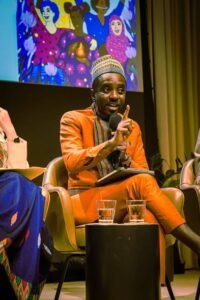
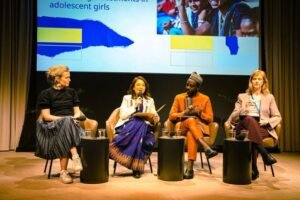
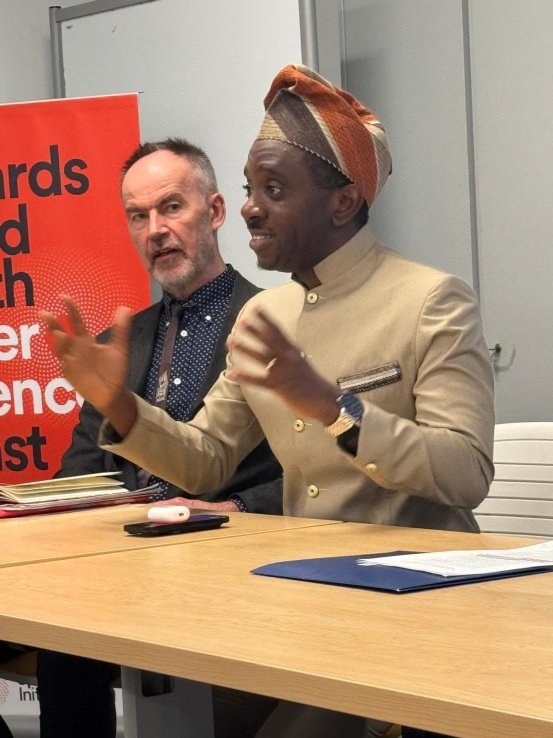
Speaking at an event hosted at the UN Women offices on Wednesday, 11 March 2026, the Minister joined global leaders, policymakers and civil society representatives for a high-level discussion on: “Progressive Policy Approaches to Engage Men and Boys in Countering Backlash on Rights, Gender Equality and Democracy.” During the forum, he presented Sierra Leone’s experience in implementing progressive reforms and the lessons the country has learned in advancing gender equality.
According to the Minister, Sierra Leone has experienced a period of far-reaching reforms under the leadership of President Julius Maada Bio over the past eight years. He noted that the Government’s reform agenda has resulted in some of the most transformative governance and social policy changes in the country’s modern history.
Among the key reforms he highlighted was the abolition of the death penalty, which he described as a major milestone in strengthening human rights protections in Sierra Leone. He also pointed to the decriminalization of criminal libel as a landmark decision that significantly strengthened press freedom and democratic accountability.
The Minister further emphasized the Government’s strong legislative framework aimed at protecting women and girls. These include the strengthening of the Sexual Offences Act to ensure stricter penalties for perpetrators of sexual violence, the criminalization of child marriage and sanctions against those who facilitate it, as well as the removal of the controversial policy that previously banned pregnant girls from attending school.
He explained that the decision to lift the ban restored dignity and educational opportunities to thousands of young women across the country, enabling them to continue their education and build better futures.
In addition, Sierra Leone has advanced the Gender Equality and Women’s Empowerment Act, which seeks to increase women’s participation in leadership and decision-making processes. The Government has also proposed legislation aimed at addressing Female Genital Mutilation and strengthening sexual and reproductive health rights for women and girls.
Information and Civic Education Minister stressed that those reforms were not implemented arbitrarily but were guided by evidence-based policymaking, strong conviction and a clear commitment to building a more just, democratic and inclusive society.
However, he acknowledged that progressive reforms often encounter resistance. According to him, Sierra Leone’s experience demonstrates that the push for gender equality frequently attracts organized backlash, often fueled by misinformation and narratives that portray gender equality as a threat to culture, tradition and family values.
“What we observed is that the backlash was not random,” he noted. “It was coordinated and amplified through misinformation and political narratives that framed equality as a threat rather than an opportunity.”
He said Sierra Leone’s experience reflects a broader global pattern in which progressive reforms are often contested by groups seeking to preserve existing power structures.
For that reason, the Minister emphasized that legislative reforms alone are not sufficient to sustain progress. He underscored the importance of strong public leadership, transparent communication, civic education and community engagement.
Particularly, he stressed the need to actively involve men and boys in conversations about gender equality, explaining that sustainable progress requires broad societal support.
“Gender equality is not a loss for men,” the Minister stated. “It is the foundation for stronger families, stronger societies and stronger democracies.”
During the panel discussion, Chernor Bah also drew attention to Sierra Leone’s deliberate policy focus on adolescent girls as a critical pillar of national development. He recalled that roughly a decade ago the country faced troubling statistics regarding the welfare of girls.
At the time, nearly half of all girls became pregnant before the age of 18, while a similar proportion were married before reaching adulthood. Only about one-third of girls completed school and access to tertiary education remained limited. In addition, the policy banning pregnant girls from attending school and the low rate of prosecution in rape cases further exacerbated gender inequality.
Recognizing the urgency of the situation, the Government embarked on a series of transformative policies designed to reverse those trends. They included removing discriminatory policies that prevented pregnant girls from attending school, strengthening sexual offences legislation with stricter penalties, establishing specialized courts to expedite sexual violence cases and criminalizing child marriage.
The Government also introduced a progressive Gender Equality and Women’s Empowerment law that established a minimum threshold of 30 percent representation for women in elective and appointive positions in Government.
As a result of those efforts, the Minister noted that the number of women serving in cabinet has tripled, while female representation in Parliament has doubled. Those developments, he said, are helping to ensure that young girls across the country can see women occupying leadership positions and shaping national decision-making.
Education reforms have also played a major role in advancing gender equality. The Government’s Free Quality School Education programme has significantly increased access to education, while targeted policies such as free tertiary education for girls studying Science, Technology, Engineering and Mathematics (STEM) have expanded opportunities for female participation in higher education.
According to him, Sierra Leone now records higher enrollment of girls in STEM programmes than at any other time in its history. He also pointed out that the country has achieved gender parity in school enrollment, demonstrating the impact of sustained policy commitment.
Beyond education, he intimated, the Government has introduced complementary measures aimed at addressing barriers that prevent girls from reaching their full potential. Those include one-stop centers for survivors of Gender-Based Violence and specialized courts designed to speed up justice for victims.
Minister Chernor Bah also highlighted encouraging national progress in health outcomes, noting that Sierra Leone has recorded one of the fastest reductions in maternal mortality globally.
Reflecting on those developments, the Minister stated that a girl born in Sierra Leone today faces significantly better prospects than a decade ago. According to him, girls are now more likely to remain in school, pursue higher education, delay early marriage and participate in shaping the country’s future.
He emphasized that those achievements were made possible through strong political will, collaboration with Civil Society Organizations and sustained civic engagement.
As Minister of Information and Civic Education, Chernor Bah said his Ministry plays an important role in ensuring that girls and young people are not merely beneficiaries of Government policies but active participants in shaping them. Through civic dialogues, town hall meetings and national engagement programmes, the voices of young people are increasingly influencing policy direction.
He concluded by reaffirming Sierra Leone’s commitment to advancing inclusive policies that protect fundamental rights, strengthen democratic governance and expand opportunities for all citizens.
“For Sierra Leone, investing in girls is not simply a policy option,” he said. “It is our development strategy and the clearest path to ending poverty and building an inclusive, green middle-income country by 2039.”