
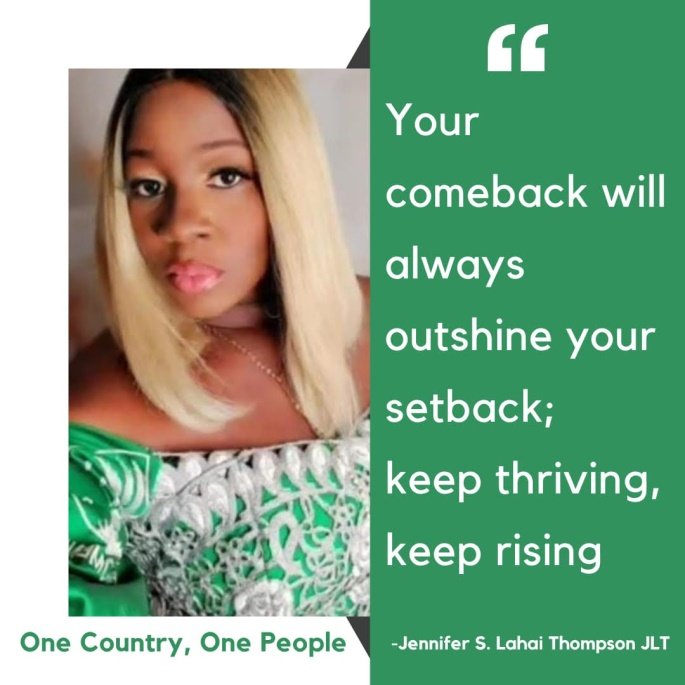
By Foday Moriba Conteh
In one of the most fiercely contested and male-dominated National Executive Elections of the Sierra Leone People’s Party (SLPP), Jennifer Lahai Thompson made history as the first woman to vie for the influential position of Deputy Secretary General.

Despite going up against some of the party’s most seasoned political heavyweights, Jennifer Thompson came within just four votes of victory, securing 264 votes against the 268 won by eventual winner Sheku Turay. For many observers, her near-win shattered long-standing barriers and set a new precedent for women aspiring to senior leadership roles, both within political parties and on the national stage.
Her bold contest came against the backdrop of the landmark 2022 Gender Equality and Women’s Empowerment Act (GEWE Act), which mandates a 30% quota for women in elective and appointive public offices. The law also guarantees equal access to training and financial resources for women. Yet, despite this legal framework, women remain significantly underrepresented in leadership, especially within internal party structures.
The recent SLPP National Executive Elections reflected that imbalance: men dominated the top positions; National Chairman, Deputy Chairman, Secretary General, Deputy Secretary General and Public Relations Officer while only a handful of women broke through into the executive.
Against that tide, Jeniffer Thompson’s candidacy is being hailed as courageous and transformative. Political analysts, women’s rights advocates and grassroots supporters have praised her for daring to challenge entrenched traditions and for proving that women can hold their own in the highest levels of political competition.
“Jennifer’s decision to run and her strong showing sends a powerful message that women are more than capable of competing for top political leadership,” noted one political commentator. “She may not have clinched the position but she has earned widespread respect and inspired countless women to step forward.”
For Jeniffer Thompson, the narrow loss is not a defeat but a foundation for future battles. Her campaign has amplified calls for stronger enforcement of the GEWE Act and sparked renewed debate about women’s representation in party politics.
Following the election, she shared an uplifting message with her supporters: “To every woman who didn’t get the position, remember, a ‘no’ doesn’t define your worth or your power. Sometimes, the door closes so we can rise through the window. We don’t shrink back, we grow forward. Keep your head high because our comeback will always be greater than the setback. We’re still rising.”
Many believe her groundbreaking bid will embolden other women to pursue leadership roles in both party and national elections. For Sierra Leone, Jeniffer Thompson’s campaign was more than a personal milestone; it was a political statement with lasting implications for gender equality and inclusive leadership.