
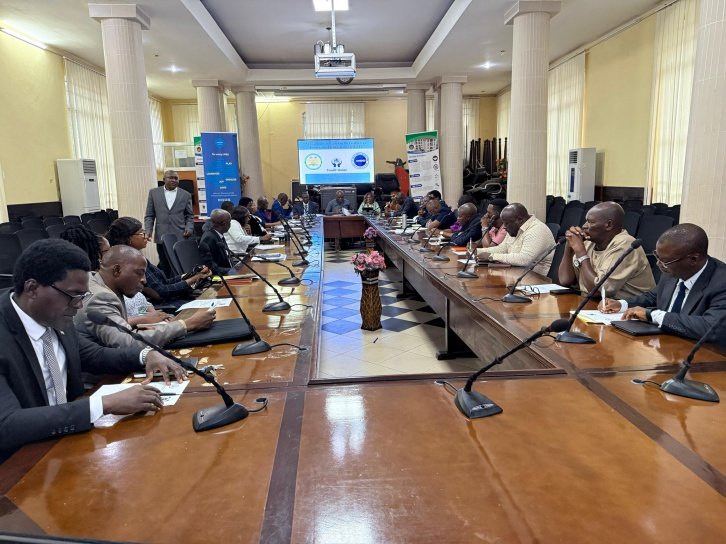
The Minister of Planning and Economic Development (MoPED), Madam Kenyeh Barlay, has called on stakeholders to expedite the operationalization of the Civil Service Cooperative Credit Union (CivSCCU), warning that bureaucratic delays will no longer be tolerated. She stressed that any further hold-ups would deprive civil servants of the opportunity to access much-needed loans for medical bills, school and college fees and other emergencies.
Madam Kenyeh Barlay made the appeal on Wednesday, 13th August 2025, at the Ministry of Finance Conference Hall on George Street, Freetown, during a high-level stakeholder meeting aimed at reviewing the one-year progress report on the CivSCCU initiative. The meeting also examined key recommendations, financial projections and strategies to establish a sustainable financial institution for civil servants nationwide.

Emphasizing the need for urgency, the Minister declared, “Now is the time for action, not words,” highlighting the scheme’s potential to uplift the lives of over 24,000 civil servants. She expressed satisfaction with the commitment shown by stakeholders and pledged to present the report to Cabinet without delay to seek ratification.
Madam Kenyeh Barlay further underscored that the CivSCCU will be guided by the principles of the cooperative movement, stressing trust and integrity as the foundations for its success. She also appealed for swift facilitation of the registration process by the Cooperative Department at the Ministry of Trade and Industry, as well as the opening of bank accounts and authorization for payroll deductions by the Ministry of Finance, the Accountant General’s Department and the Human Resource Management Office (HRMO).
Chairing the meeting, MoPED Development Secretary, Ambrose James, reaffirmed the Ministry’s readiness to advance the process and commended the dedication of David Abu and his team at the CivSCCU Secretariat.
Presenting the progress report, David Abu revealed that the initiative began in 2024 as a means to close the financial gap faced by civil servants. He noted that the scheme aligns with Sierra Leone’s Medium-Term National Development Plan (2024–2030) and will be open to all permanent and pensionable civil servants. According to him, savings are expected to commence by the end of September 2025, with plans for low-cost housing and agricultural investments starting next year. Seventy percent of savings will be used for loans and 30% for investments, he explained, adding that the scheme is not profit-driven but designed to ease financial pressures on civil servants.
Highlighting the scheme’s customer-focused features, David Abu expressed hope that it would serve as a model for similar initiatives.
The Deputy Accountant General pledged his office’s support, noting that salary deductions are already being done for teachers, insurance companies and other institutions. “What about us civil servants?” he asked, emphasizing the scheme’s relevance.
HRMO Director-General, Ansu Tucker, said the scheme was conceived to address the high-interest loans, often exceeding 20% that civil servants currently face from commercial banks. He stressed that the CivSCCU, which would charge about 9% interest, could provide members with a more dignified retirement. However, he reiterated that Cabinet approval remains crucial.
During an interactive session, stakeholders expressed strong support for the initiative but raised concerns about civil servant attrition rates, the need for deeper technical analysis and the importance of robust nationwide sensitization. They also discussed sustainability, annual interest rates and maintaining the cooperative movement’s core principles.
While acknowledging that extensive consultations have already taken place, participants agreed that success will depend on the collective will of all stakeholders to accelerate the process and ensure the scheme becomes a reality.